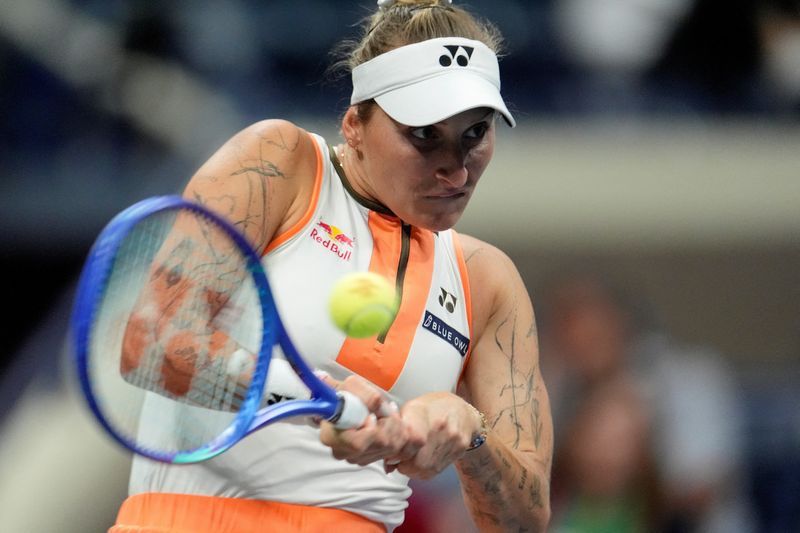
The tennis world is grappling with questions about fairness and player welfare following the International Tennis Integrity Agency's decision to impose a four-year suspension on former Wimbledon champion Marketa Vondrousova for failing to submit to an out-of-competition doping test. The Czech player's ban, announced on Monday, has reignited concerns about how anti-doping rules are enforced and whether professional athletes have adequate say in the regulatory framework that governs them across the sport.
Vondrousova's case centres on an incident in December when a doping control officer arrived at her home late in the evening, requesting an immediate test. The 26-year-old did not open the door to comply with the request, and she later explained her refusal by citing serious safety concerns. She disclosed that the unexpected arrival of an unidentified person at her residence during evening hours triggered anxiety rooted in her own traumatic experience and her awareness of a 2016 knife attack on fellow Czech player Petra Kvitova at her home.
In April, Vondrousova publicly described reaching a psychological breaking point, attributing her distress to months of mounting physical and mental strain. She characterised the officer's arrival at 8:15 p.m. demanding immediate compliance as an acute violation of her privacy and personal security. The incident appears to have crystallised her concerns about the unilateral nature of anti-doping enforcement and the emotional toll on athletes subject to unpredictable testing protocols.
The Professional Tennis Players Association has seized on Vondrousova's situation to push for structural reform of how anti-doping regulations are developed and implemented. In a statement, the PTPA acknowledged support for rigorous testing to maintain fair competition but contended that athletes deserve meaningful representation when rules affecting their daily lives and psychological wellbeing are established. The advocacy group specifically highlighted the disparity between Vondrousova's severe punishment for a procedural violation and the lighter sanctions imposed on other prominent players who tested positive for banned substances, noting that her case "should give this sport pause."
This criticism arrives amid broader scrutiny of the anti-doping system following high-profile cases involving top-ranked players. Jannik Sinner and Iga Swiatek both received relatively lenient outcomes after positive tests, a pattern that has fuelled perceptions of inconsistent enforcement and questioned whether elite status influences regulatory decisions. The PTPA's call for athlete involvement in rule-making is fundamentally about ensuring that standards are transparently applied across all players regardless of ranking or commercial value.
The legal and procedural framework governing tennis doping control came under the World Anti-Doping Agency code, which aims to establish consistency across all sports globally. Karen Moorhouse, the ITIA's chief executive, emphasised that sanctions are determined strictly by evidence and facts rather than a player's profile or achievements. She defended the necessity of unpredictable testing as essential for maintaining competition integrity, acknowledging that while the process is admittedly uncomfortable, it represents an unavoidable burden athletes must accept.
However, Moorhouse also addressed the safety concerns specific to women players undergoing out-of-competition testing at their residences. She noted that the ITIA employs gender-matched testing witnesses who carry identification, and that procedures exist to allow players to verify an officer's credentials before complying. These safeguards, she suggested, are designed to protect both athletes and testing personnel. Yet for many observers, the gap between theoretical protections and the lived experience of a player startled by an unexpected evening visitor remains significant.
Vondrousova's situation exemplifies an emerging tension within professional tennis between the sporting imperative for rigorous anti-doping enforcement and the practical reality that testing procedures can create genuine safety concerns, particularly for women athletes. The late timing of the December visit, the lack of prior warning, and the requirement for immediate compliance all intersect with broader issues about bodily autonomy, privacy, and the psychological impact of surveillance—concerns that arguably deserve accommodation in rule design without compromising testing integrity.
For Malaysian and Southeast Asian tennis fans and players, this case underscores how global sporting governance structures often operate with limited input from the athletes most directly affected by their policies. The PTPA's push for greater player involvement in anti-doping decision-making reflects a wider movement toward more democratic and inclusive governance in professional sports, a principle with relevance across regional competitions and national sports bodies in the Asia-Pacific region.
Vondrousova retains the right to challenge her four-year suspension at the Court of Arbitration for Sport, where she may present evidence about the circumstances surrounding her refusal and argue for reconsideration of the penalty's proportionality. The upcoming appeal could prove pivotal not only for her professional future but also for shaping how tennis authorities balance anti-doping imperatives with athlete welfare and due process protections. The case will likely inform discussions at forthcoming players' association meetings and potentially influence how governing bodies design testing protocols going forward, particularly those involving female athletes.
The broader implication is that the tennis establishment faces growing pressure to demonstrate that its anti-doping system, while robust in detecting potential cheating, is also responsive to legitimate concerns about privacy, safety, and procedural fairness. How the sport navigates this challenge will matter for athlete confidence in the system and for recruiting and retaining talent globally. The balance between protecting competitive integrity and respecting athletes' fundamental rights remains central to the legitimacy of sports governance in the twenty-first century.