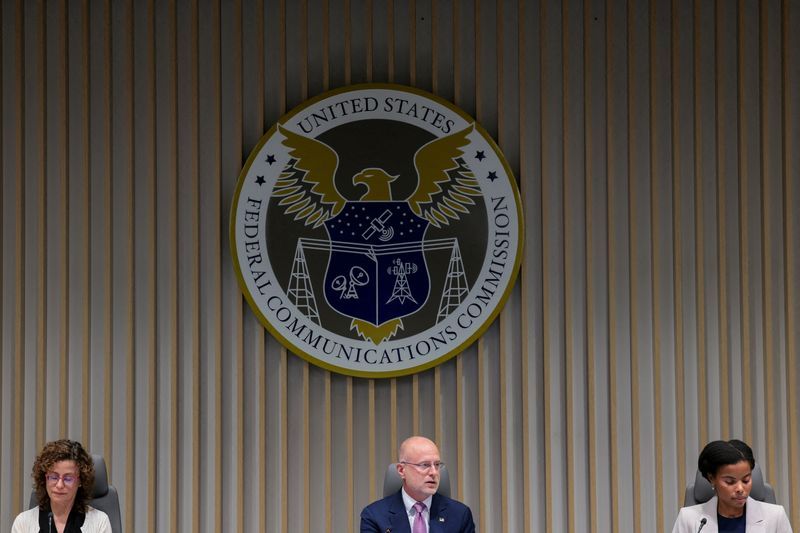
The United States Federal Communications Commission has taken sweeping action to prevent Chinese technology from infiltrating American networks by voting to ban the sale of any devices containing critical hardware components manufactured by firms on its security watchlist. The decision represents a significant escalation in Washington's technology competition with Beijing, effectively eliminating what regulators had long viewed as a dangerous workaround in existing import restrictions. The move specifically targets companies such as Huawei and ZTE, whose equipment has been prohibited from direct sale in the United States for years, yet whose component parts had continued to find their way into finished devices approved for market entry.
The regulatory shift addresses what FCC Chair Brendan Carr characterised as the "component part loophole" that had persisted since 2022. Under the previous framework, while finished devices manufactured by blacklisted companies could no longer receive authorisation for sale, those same companies could still supply essential logic-bearing semiconductor components to other manufacturers, who then assembled complete products for export to American consumers. This gap meant that devices containing Huawei-made processors or other critical hardware continued to gain approval, undermining the intent of the original sanctions regime. The new prohibition closes this avenue entirely by barring any device with Huawei-manufactured logic-bearing components, regardless of the final assembler's nationality or market position.
The timing reflects the Trump administration's broader strategic reassessment of technology supply chains and national security exposure. Beyond the FCC's latest action, Washington has implemented a cascade of restrictions on Chinese technology imports over recent months. In July alone, the agency moved to ban additional equipment from a wider range of Chinese manufacturers, while simultaneously proposing restrictions on military-grade drone imports from the same region. These measures form part of a coordinated campaign to systematically reduce American dependence on Chinese technology across critical infrastructure sectors.
Former White House national security officials have articulated the reasoning behind such aggressive action. Chris McGuire, who served on the National Security Council under the Biden administration, explained that compromised components—particularly semiconductors and communications devices—pose an existential risk to entire systems. A single malicious chip embedded in a device's core logic can potentially render the entire system vulnerable to manipulation, espionage, or disruption. This concern extends beyond simple functionality; it encompasses the possibility of backdoors that could be activated remotely or the capacity to intercept and alter data passing through compromised devices.
The implications for global technology markets are substantial. Many devices sold internationally contain components from multiple suppliers, and manufacturers have traditionally sourced parts based on cost, availability, and technical specifications rather than geopolitical considerations. The new American rules force a restructuring of these supply chains, requiring companies to conduct detailed component audits and likely spurring investment in alternative suppliers from allied nations. For Southeast Asian electronics manufacturers and distributors who have integrated Chinese components into their supply chains, compliance will require significant reengineering of sourcing strategies.
Beyond component-level restrictions, the FCC is simultaneously pursuing additional measures against Chinese telecom operators. The agency has proposed rules that would prevent American telecommunications carriers from establishing interconnection agreements with Chinese telecom firms deemed security risks. More ambitiously, regulators are considering whether to force Chinese telecom companies to cease operations at data centers and internet exchange points they maintain within the United States. Such a requirement would effectively expel major Chinese telecom operators from American internet infrastructure, a step that would have cascading effects on bilateral digital commerce and data flows.
These restrictions reflect a fundamental shift in how Washington conceptualises technology supply chain security. Rather than viewing such concerns as primarily a matter of espionage risk, American policymakers increasingly frame technology dependencies as threats to national autonomy. From this perspective, even the possibility that critical systems might contain components whose ultimate owners could theoretically interfere with them constitutes an unacceptable vulnerability. This logic has led to a comprehensive reimagining of acceptable sources for sensitive technologies.
For Malaysia and the broader Southeast Asian region, these developments carry significant consequences. Many countries in the region have positioned themselves as alternative manufacturing hubs to China, attracting investment from companies seeking to diversify supply chains away from mainland production. However, if these facilities still incorporate Chinese components, they may find their products barred from American markets. This creates pressure on manufacturers to establish entirely new supply chains using components from approved sources, a process that requires substantial capital investment and technical recalibration.
The measures also highlight tensions within global technology ecosystems that have become increasingly integrated. Companies that have optimised their operations around cost-effective Chinese components now face the prospect of rapid redesign and retooling. Larger multinational corporations with resources to maintain multiple product variants may adapt more readily, whilst smaller manufacturers and developing-nation suppliers could face acute pressure. The regulatory environment has shifted from one where geopolitical compliance was a peripheral concern to one where it constitutes a central operational consideration.
Huawei, the most directly affected company, has not yet responded publicly to the FCC's latest action. The firm has faced successive waves of American sanctions since 2019, each progressively more restrictive. These latest component-level restrictions represent perhaps the most comprehensive effort yet to prevent Huawei from participating in any segment of the American technology market. For the Chinese company, which has historically relied on sales to international markets to offset constrained domestic opportunities, the closure of American channels represents a significant strategic setback.
The broader question facing technology companies worldwide is whether similar restrictions will spread to other jurisdictions, potentially fragmenting the global technology market into geopolitically-defined blocs. European and Japanese regulators have indicated growing concern about supply chain security, though they have not yet adopted measures as sweeping as those implemented by the United States. If other major economies follow Washington's lead, the consequences for integrated global supply chains could be profound, requiring manufacturers to maintain geopolitically distinct product lines for different market regions.

