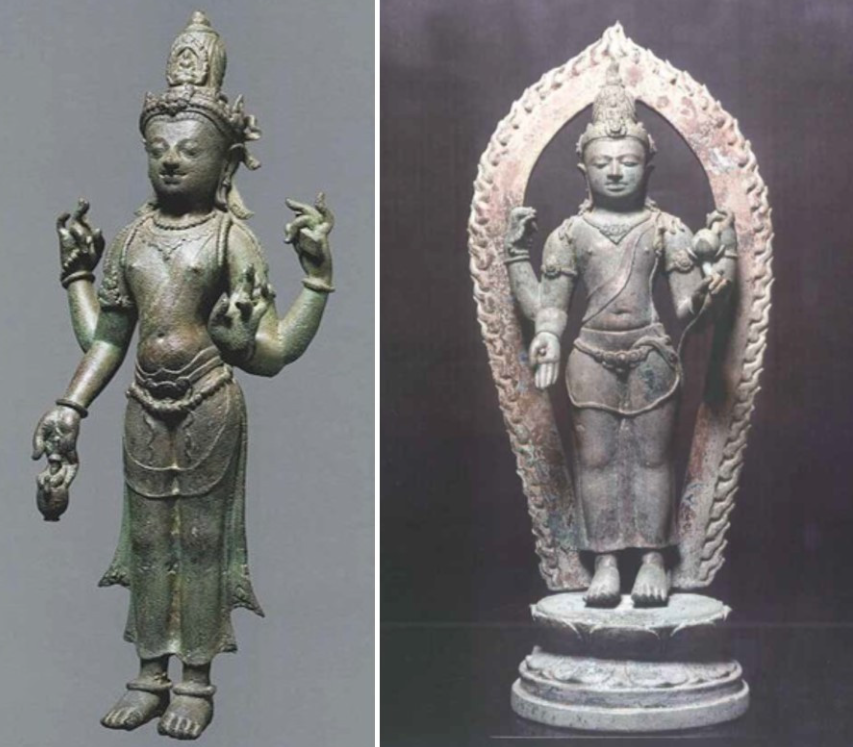
The United States has completed the repatriation of two eighth-century bronze Buddhist statues stolen from Indonesian archaeological sites, returning them to their homeland after they were recovered through a sprawling investigation into one of the world's most notorious antiquities trafficking networks. The formal handover occurred at the Indonesian Consulate in New York, representing a significant moment in Indonesia's ongoing efforts to reclaim its looted cultural heritage from international markets.
The two sculptures depict Avalokiteshvara, a four-armed bodhisattva venerated across Buddhist traditions for embodying compassion and mercy. These eighth-century standing bronze figures were originally taken from Indonesian archaeological sites decades ago before being channelled into the illicit art market through Douglas Latchford, a British dealer whose Bangkok-based operations became legendary—and ultimately infamous—for trafficking looted South-East Asian antiquities. The exact excavation sites from which these particular statues were removed remains uncertain, complicating efforts to fully document the scope of Indonesia's cultural losses during the decades when Latchford operated.
Latchford's trafficking operation functioned through a sophisticated scheme to obscure the illicit origins of artefacts. Between 2003 and 2007, he sold the Indonesian statues alongside numerous other South-East Asian objects to a private American collector, deliberately withholding information about their true provenance and fabricating documentation to create false histories that would make the stolen pieces appear legitimate when sold internationally. This methodical concealment allowed looted cultural property to circulate freely among wealthy private collectors and institutions, many of whom remain unaware they possessed stolen heritage.
The dealer's criminal enterprise might have continued indefinitely, but in 2019, federal prosecutors in the Southern District of New York indicted Latchford for orchestrating a decades-long scheme to traffic looted Cambodian and broader South-East Asian antiquities to buyers worldwide. Though the charges were eventually dismissed following his death in 2020, the investigation's momentum continued to yield results. In 2021, a private collector voluntarily surrendered thirty-four Cambodian and South-East Asian antiquities that had been acquired from Latchford, including these two Indonesian bronze sculptures, providing a crucial pathway for their eventual return to Southeast Asia.
US Attorney Jay Clayton, speaking at the repatriation ceremony, emphasised his office's commitment to disrupting antiquities trafficking and praised the anonymous collector for voluntarily relinquishing the looted objects. The repatriation demonstrates how American law enforcement agencies, working alongside Homeland Security Investigations, continue pursuing networks that profit from cultural theft even after primary targets have died. The voluntary cooperation of collectors—incentivised through legal frameworks that reward voluntary surrender—has become an increasingly important mechanism for recovering stolen heritage.
Latchford's criminal legacy extends far beyond the Indonesian statues now repatriated. During his four decades based in Thailand, where he became a Thai citizen in the 1960s, the British dealer established himself as a preeminent trader in Khmer antiquities, building a reputation as one of the world's most significant collectors and dealers of Cambodian art. His operation systematically looted temples and archaeological sites across Cambodia, extracting irreplaceable cultural property and selling it to museums and private collectors across North America, Europe, and Australia. Following his death, his daughter agreed to return his entire collection—valued at over fifty million US dollars—to Cambodia, signalling a partial reckoning with decades of acquisition.
The investigation into Latchford's network has triggered cascading repatriations globally. Museums and collectors across the United States, Europe, and Australia have surrendered numerous Khmer artefacts linked to the dealer as Cambodian authorities and international investigators persist in their efforts to recover the kingdom's systematically looted cultural inheritance. This broader repatriation movement demonstrates how targeting single traffickers can uncover interconnected networks and expose holdings in multiple countries, creating opportunities for coordinated international recovery efforts.
Indonesia's experience recovering its antiquities parallels Cambodia's, though Indonesia has received less international attention for its heritage losses. In 2024, US authorities returned three additional Indonesian artefacts valued at approximately six and a half billion rupiah, including a stone relief from the Majapahit period, a seated bronze Buddha, and a bronze statue of the Hindu deity Vishnu. These objects were recovered during investigations into Subhash Kapoor, an Indian-American dealer, and Nancy Wiener, a US antiquities merchant who trafficked looted South-East Asian objects through the Manhattan-based Art of the Past gallery. That investigation also recovered twenty-seven Cambodian pieces, illustrating how Indonesian and Cambodian heritage losses were often processed through the same criminal channels.
The Kapoor investigation has proven particularly productive for law enforcement. Between 2011 and 2023, agents from the Manhattan District Attorney's Office and the Department of Homeland Security recovered more than twenty-five hundred antiquities allegedly trafficked by Kapoor and his co-conspirators, with a combined estimated value surpassing one hundred and forty-three million dollars. The scale of these recoveries reflects both the magnitude of trafficking that occurred and the sophisticated investigative techniques now deployed against such networks, combining financial tracking, international cooperation, and witness cooperation to dismantle operations that had functioned for decades.
For Southeast Asian nations, these repatriations represent partial justice for cultural devastation that occurred during an era when looting faced minimal consequences. Archaeological sites were systematically plundered as dealers like Latchford exploited weak enforcement, political instability, and limited international awareness of heritage protection. The recovered artefacts are invaluable not only for their aesthetic and historical significance but also because they illuminate civilisations and provide irreplaceable information about the region's cultural development. Each repatriation strengthens precedent that cultural heritage belongs in source countries, potentially deterring future trafficking.
Yet the recoveries remain incomplete. Numerous looted Indonesian and South-East Asian artefacts remain in museum storage and private collections worldwide, often undocumented or misattributed. The continued cooperation between American law enforcement and Southeast Asian governments suggests the investigation into historical trafficking networks will persist, though each case requires substantial resources and international coordination. For Malaysia and other regional countries, these cases underscore both the vulnerability of cultural property to organised trafficking and the importance of strengthening domestic protection frameworks while maintaining international partnerships to pursue stolen heritage held abroad.

