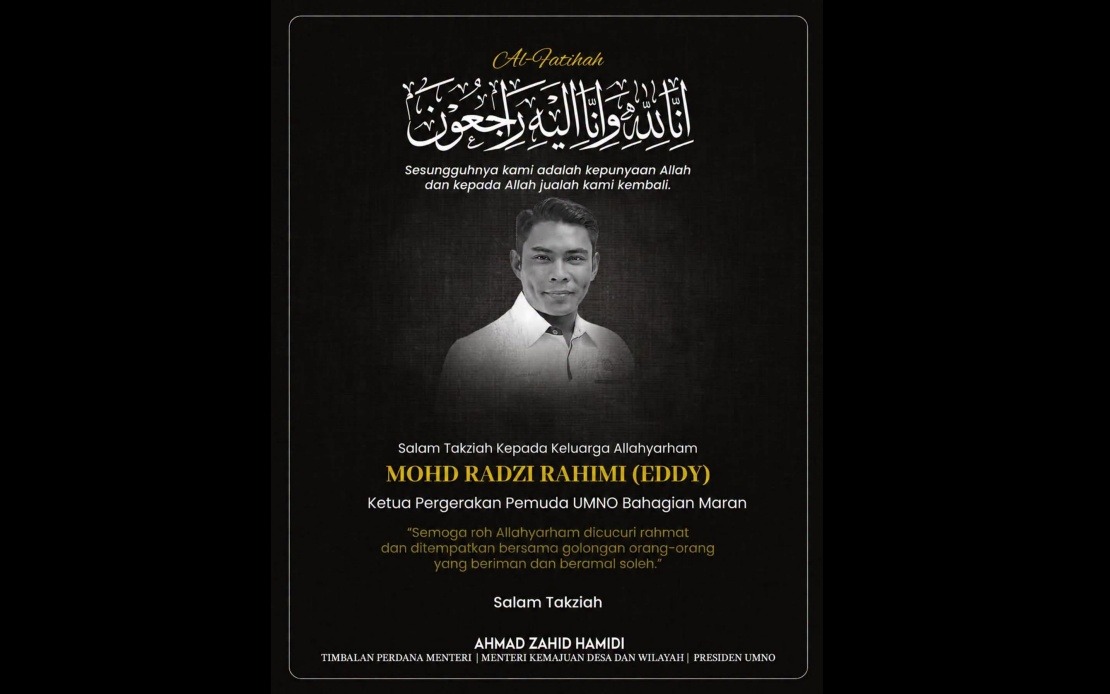
The death of Mohd Radzi Rahimi, the 40-year-old chief of Maran UMNO Youth, has prompted expressions of grief from the highest echelons of Malaysia's ruling party, with UMNO President Datuk Seri Dr Ahmad Zahid Hamidi characterising the loss as particularly significant for the party's grassroots structure. The fatal incident occurred in Bentong when a falling tree crushed the vehicle carrying Mohd Radzi, his wife, and his brother-in-law, along with two young children. The tragedy highlights the unpredictable dangers that can strike ordinary families without warning, leaving entire organisations grappling with unexpected absences in their leadership ranks.
In his formal statement released through social media, Ahmad Zahid articulated the profound impact of Mohd Radzi's passing on not only his immediate family but also the broader UMNO family network. The loss of a youth movement chief carries particular weight within UMNO's organisational hierarchy, as such leaders serve as critical connectors between the party's senior establishment and younger members, shaping the political orientation and energy of future party cadres. Ahmad Zahid's emphasis on the significance of this loss suggests recognition of how difficult it will be to replace someone embedded in the party's local structures across Maran and throughout Pahang's youth wing.
The circumstances of the accident underscore the random nature of tragedy. One of two young boys in the vehicle, a five-year-old child, was killed alongside the three adults. A second child, believed to be the deceased boy's twin sibling, survived the impact and was transported to Bentong Hospital for medical treatment. The survival of one twin while the other perished adds a dimension of particular cruelty to the incident, compounding the grief that will reverberate through Mohd Radzi's extended family and the wider community that knew him.
For UMNO, the loss of a youth movement leader represents more than the removal of an individual from an organisational chart. Youth divisions within major political parties across Southeast Asia function as incubators for future politicians, administrators, and party organisers. They develop the skills and networks that enable younger members to eventually assume more senior roles within government and party structures. The Maran UMNO Youth would have been looking to Mohd Radzi to nurture and guide the next generation of party activists and politicians in his constituency. His sudden death creates an operational vacuum that cannot be immediately filled.
Ahmad Zahid's invocation of Islamic principles in his condolence message, praying that Allah grant the grieving family strength during their difficult period, reflects the importance of religious sentiment within Malaysian political discourse and the personal faith that typically accompanies expressions of sympathy in the Malaysian context. Such statements serve both as genuine expressions of faith and as cultural touchstones that resonate with the predominantly Muslim Malaysian electorate that UMNO represents and seeks to mobilise.
The accident also carries implications for Pahang state politics more broadly. As a state consistently governed by UMNO or coalitions featuring UMNO prominence, the loss of active youth leadership in any constituency affects the party's capacity to mobilise support during election cycles and perform constituency-level administration. Youth movements conduct grassroots organising, conduct voter outreach, and maintain party presence in local communities between major electoral contests. The void left by Mohd Radzi's death will require immediate attention from state and federal UMNO leadership to ensure that momentum is not lost in Maran.
The tragic accident serves as a stark reminder of the personal costs and risks that accompany public service and political engagement in Malaysia. While most political leadership transitions occur through retirement, defeat, or electoral changes, unexpected deaths like this disrupt succession planning and force organisations to confront their own fragility. For UMNO, which has navigated numerous political challenges in recent years, the loss of an energetic youth leader represents yet another unforeseen challenge requiring institutional adaptation.
The broader Malaysian political ecosystem will likely take note of this incident and its aftermath, particularly regarding how UMNO manages the succession process in Maran UMNO Youth and whether the party is able to identify and rapidly elevate a replacement who can command the same respect and effectiveness that Mohd Radzi apparently achieved. The manner in which parties respond to leadership vacancies often signals organisational health and the strength of institutional processes for talent development and succession planning.
For Malaysian readers and observers of regional politics, this incident represents a human tragedy with cascading implications across organisational, local, and state-level political structures. It reminds us that political leadership, regardless of party affiliation or position within hierarchies, ultimately depends on individuals whose lives remain vulnerable to the same hazards that affect all citizens. Ahmad Zahid's public expression of sympathy acknowledges both the personal loss experienced by Mohd Radzi's family and the institutional loss experienced by UMNO at a time when the party continues navigating complex political terrain in Malaysia's evolving electoral landscape.

