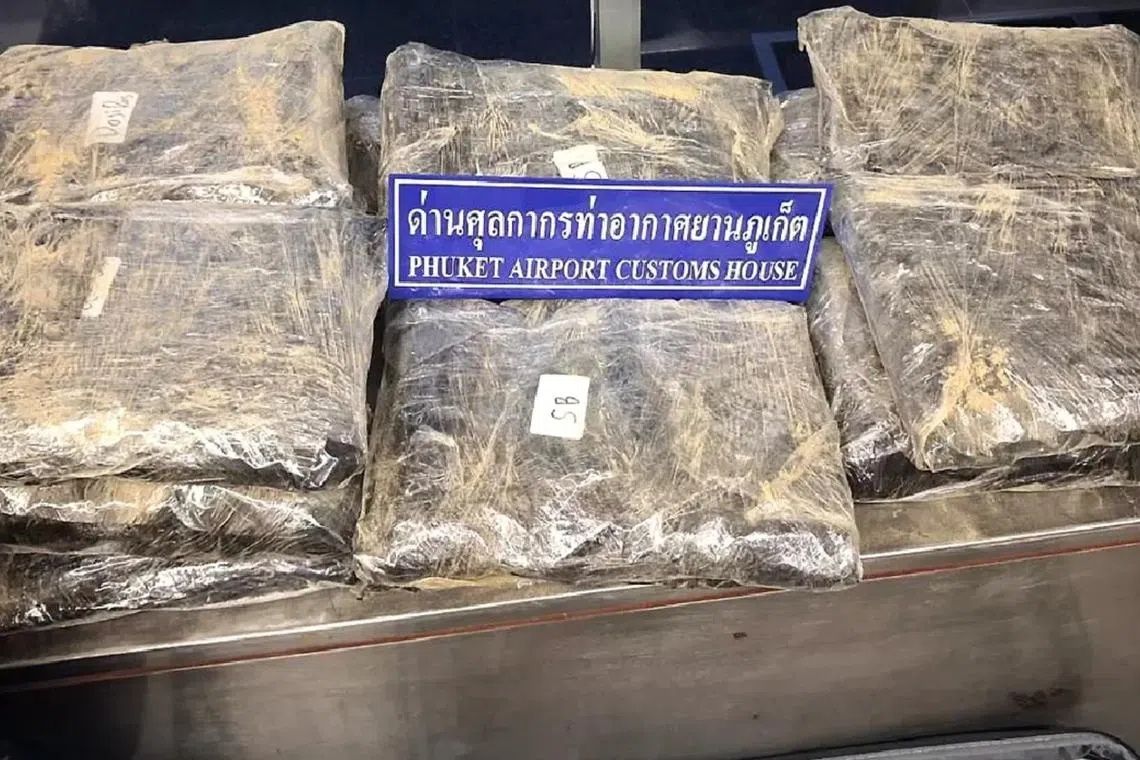
Thai and Philippine law enforcement have intensified their focus on preventing narcotics smuggling through major regional hubs, with a significant haul at Phuket International Airport underscoring the ongoing challenge of drug trafficking in Southeast Asia. On Thursday, July 9, two separate arrests within hours at the airport's international departures terminal exposed a coordinated effort to export large quantities of cannabis flowers, highlighting the vulnerabilities in outbound screening despite heightened vigilance.
The first suspect apprehended was Levannah Chelsea Guzman, an 18-year-old Filipino national, when customs officers from Phuket Airport Customs House and Sakhu Police Station inspected her black Pierre Cardin suitcase at approximately 11am. Inside the luggage, officers discovered 14 vacuum-sealed packages containing cannabis flowers, collectively weighing 14.5kg including packaging materials. During subsequent questioning, Guzman admitted ownership of both the suitcase and its contents, providing authorities with a straightforward confession that simplified the initial investigative phase.
Less than two hours after Guzman's detention, a second arrest occurred when officials scrutinised a green Swish Navy wheeled suitcase belonging to Penpitcha Phutsiang, a Thai national. The search proved even more significant in terms of quantity, revealing 16 vacuum-sealed packages of cannabis flowers totalling 17.6kg. Phutsiang similarly admitted full responsibility for the suitcase and its contents, though authorities have not disclosed whether the two women knew each other or were operating as part of a larger trafficking network.
The coincidental timing of both arrests—within hours of each other on the same day—raises questions about whether the incidents represent isolated cases or part of a coordinated smuggling operation exploiting the airport's volume of outbound traffic. Thai authorities have not publicly clarified the relationship, if any, between the two suspects, leaving open the possibility that they were working independently or that investigators are still piecing together broader connections. The scale of the seizure, combined with similar concealment methods in both cases, suggests either coincidence or deliberate compartmentalisation of a larger operation.
Guzman faces charges under Thailand's Customs Act BE 2560 (2017) for attempting to export goods without completing required customs procedures, a foundational charge reflecting the procedural violation itself. Beyond this administrative infraction, prosecutors brought charges under the Narcotics Code, establishing the more serious drug trafficking dimension of her offence. Additional charges cited the Protection and Promotion of Traditional Thai Medicine Wisdom Act BE 2542 (1999) and a 2025 Public Health Ministry notification specifically regulating cannabis as a controlled herb, indicating Thailand's evolving legal framework around cannabis classification and enforcement.
Phutsiang faces an identical set of charges, suggesting standardised prosecutorial approaches to cannabis smuggling cases at the airport. The multiplicity of statutes reflects Thailand's comprehensive regulatory approach, layering customs violations, drug trafficking laws, and traditional medicine regulations to maximise legal consequences and deterrent effect. For Malaysian observers, this prosecutorial strategy offers insight into how neighbouring jurisdictions are adapting their frameworks to address cannabis-related offences as legal landscapes shift across the region, particularly as some jurisdictions explore medical cannabis while maintaining strict export controls.
Thailand's stance on cannabis remains substantially stricter than certain neighbouring nations, particularly regarding export restrictions and personal possession thresholds. While some Southeast Asian countries have begun reconsidering cannabis policies for medicinal purposes, Thailand maintains robust export prohibitions to prevent trafficking, even as domestic discussions about therapeutic applications continue. The timing of charges referencing a 2025 regulation suggests recent regulatory tightening, possibly in response to increased smuggling attempts or international pressure to combat narcotics trafficking.
The arrests underscore the critical role of customs inspections at international departure terminals, where the majority of drug trafficking attempts occur as suspects attempt to move contraband across borders. Phuket, as one of Southeast Asia's busiest international airports and a major tourist hub, presents both opportunity and risk for smugglers seeking to exploit passenger volume and the inherent challenges of screening thousands of travellers daily. The detection of 32kg of cannabis represents a significant operational success for authorities but also suggests that larger quantities may successfully pass through despite enhanced screening protocols.
Thailand's authorities have indicated that stricter preventative measures and intensified luggage inspections of outbound passengers are ongoing priorities. This reflects a deliberate enforcement escalation aimed at disrupting trafficking networks before they can move product across borders. For the region, such efforts have cumulative impact, creating a more hostile environment for transnational drug operations and potentially displacing smuggling routes to less heavily monitored corridors—a dynamic that demands coordinated regional responses.
The broader context of cannabis regulation across Southeast Asia remains complex and contested. While some countries maintain absolute prohibition with severe penalties, others are cautiously exploring medical applications within tightly controlled frameworks. Thailand's multi-layered approach—prosecuting smuggling while simultaneously regulating medicinal cannabis—reflects this tension. For Malaysia, which maintains some of the region's strictest drug laws, the Thai model demonstrates how jurisdictions can adapt enforcement while preserving prohibition on personal use and export.
Investigators at Sakhu Police Station are reportedly conducting further inquiries into both cases, examining whether additional individuals were involved in logistics, coordination, or distribution planning. The identical concealment methodology—vacuum-sealed packages within wheeled suitcases—suggests possible training or guidance from more experienced traffickers, though authorities have not publicly indicated whether they suspect larger organisational involvement. Such investigations typically expand beyond the detained individuals to identify supply sources and intended recipients.
For Southeast Asian governments collectively, incidents like these highlight the persistent challenge of cannabis trafficking despite national and bilateral enforcement efforts. The drug remains sufficiently valuable and relatively accessible in certain jurisdictions to justify smuggling risks, even as penalties increase. Regional cooperation mechanisms, intelligence sharing between customs agencies, and harmonised enforcement standards remain critical to disrupting these operations more effectively across borders and airports.

