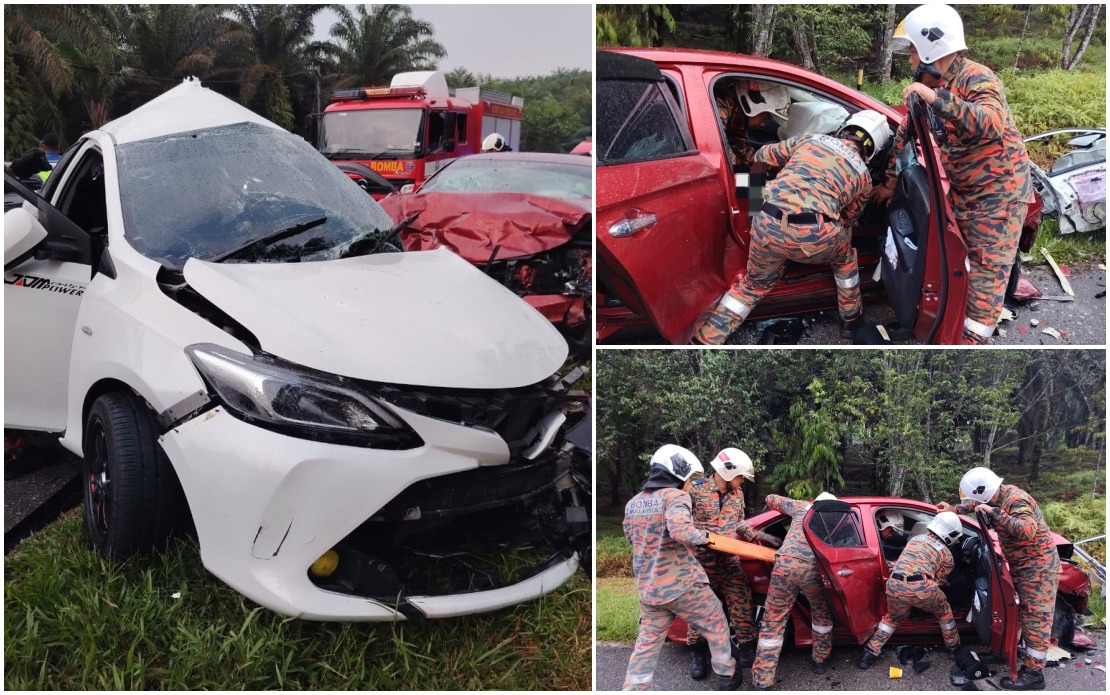
A fatal road accident in Kota Tinggi claimed three lives on Sunday afternoon when a Honda City and a Toyota Vios collided on Jalan Jemaluang near a petrol station in the Tanjung Leman area. The incident, which occurred around 5 pm, claimed the lives of two occupants in the Honda City—a 21-year-old man and a 20-year-old woman—as well as a 31-year-old man driving the Toyota Vios, according to preliminary findings by health ministry officials at the scene.
Emergency responders mobilised swiftly following reports of the accident. Senior Fire Officer II Azlan Hamzah, the operations commander at the Kota Tinggi fire station, confirmed that his team received notification of the collision at 5.05 pm. Given the location's distance of approximately 45 kilometres from their base, eight firefighters were immediately dispatched to undertake rescue operations. The distance posed a significant response challenge, yet emergency personnel arrived to find both vehicles severely damaged and the three victims trapped within the wreckage.
The rescue operation proved complex given the structural damage sustained by both vehicles. Firefighters deployed rescue cutters to extricate the trapped occupants from the mangled metal frames before transferring them onto stretchers for transport. Medical professionals from the Health Ministry declared all three victims deceased at the scene, suggesting the severity of impact forces generated in the collision. The operation concluded at 6.59 pm, with the victims subsequently handed over to police for documentation and further procedures.
Road safety remains a persistent concern across Johor's trunk routes, where high traffic volumes and variable driving conditions create elevated accident risks. The Kota Tinggi district experiences considerable vehicular movement, particularly along major corridors connecting urban and rural settlements. Collisions involving two vehicles frequently result in fatalities when high-speed impacts or head-on configurations occur, as the energy transfer between objects moving at velocity can prove catastrophic for occupants regardless of modern vehicle safety features.
Kota Tinggi District Police Chief Supt Othman confirmed that authorities had initiated a formal investigation into the circumstances surrounding the accident. Preliminary assessments would examine vehicle speeds, road conditions, driver awareness, visibility factors, and mechanical functionality to establish contributory causes. The police statement indicated that comprehensive findings would be released following completion of investigative procedures, which typically include scene photography, witness interviews, and vehicle forensic examination.
The tragic incident underscores the fragility of road safety despite advancements in vehicle engineering and emergency response infrastructure. While modern vehicles incorporate crumple zones, airbags, and structural reinforcements designed to absorb impact energy and protect occupants, high-velocity collisions can still overwhelm these protective systems. The composition of vehicles—a Honda City and Toyota Vios, both popular compact sedans favoured by Malaysian drivers for their fuel efficiency and affordability—speaks to the democratic nature of road fatalities across socioeconomic demographics.
Family members and friends of the victims would face the sudden grief of losing loved ones in what may have been a preventable accident, highlighting the human dimension beyond statistics. Each fatality represents shattered families, interrupted futures, and rippling community impact. The suddenness of road deaths distinguishes them from other causes of mortality by offering no opportunity for preparation, farewell conversations, or resolution.
Emergency response coordination between fire and rescue services and police demonstrates the established protocols for managing fatal accidents across Malaysia. However, effective intervention requires not merely reactive emergency response but proactive prevention through driver education, vehicle maintenance standards, road infrastructure improvements, and enforcement of traffic regulations. Speed limits, lane discipline, and vehicle condition checks represent controllable variables that could potentially prevent similar tragedies.
For Malaysian drivers, particularly those traversing Johor's busy roadways, the incident serves as a stark reminder of the consequences of momentary inattention or misjudgement. The accident occurred during late afternoon hours when traffic typically intensifies and fatigue may compromise driver alertness. Recommendations from road safety authorities consistently emphasise regular vehicle maintenance, adherence to speed limits, avoidance of distractions, and heightened caution during peak traffic periods.
The investigation's eventual conclusions may reveal specific causative factors—mechanical failure, driver error, environmental conditions, or combinations thereof—that authorities could address through targeted interventions. Public disclosure of findings contributes to broader road safety awareness and may influence future driver behaviour through demonstration of consequences.
As authorities continue their investigation, the Kota Tinggi community mourns three individuals whose lives ended in an instant on a Sunday afternoon. The incident reinforces uncomfortable truths about the risks inherent in road transportation and the critical importance of moment-by-moment attention and adherence to safety principles while operating vehicles on Malaysian highways.

