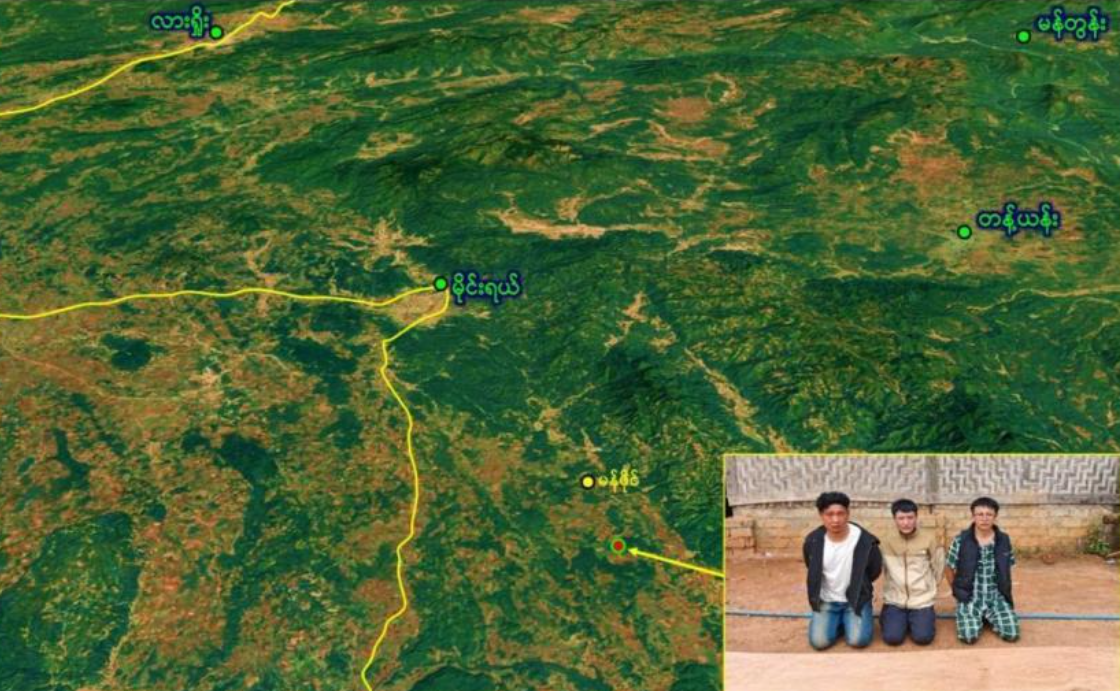
Myanmar's military forces have arrested three Chinese nationals suspected of running an online gambling scam operation in Mongyai Township, situated in the mountainous border region of northern Shan State. The apprehension on August 26 marks another significant blow against transnational cybercrime networks that have increasingly sought refuge in Myanmar's remote frontier zones, where porous borders and limited government oversight have created an attractive environment for illicit enterprises targeting victims across Southeast Asia and beyond.
The individuals in question had allegedly crossed into Myanmar illegally and established makeshift operational bases approximately 26 kilometres southeast of Mongyai town and about five kilometres south of Manphai Village, in an area known for its challenging terrain and sparse population. Their choice of location reflects a deliberate strategy employed by such networks to minimise detection by positioning themselves in sparsely populated regions where regular government patrols are less frequent and community surveillance is limited by geographical isolation.
Myanmar's government has designated the elimination of online fraud operations as a priority national objective, recognising the reputational damage and economic harm caused by scam networks that exploit residents and international victims alike. The campaign has gained particular momentum in recent years as authorities have grown increasingly concerned about the proliferation of such operations within Myanmar's borders, many of which target vulnerable populations across the region with promises of easy money through fraudulent gambling schemes and cryptocurrency investment platforms.
Local residents provided crucial intelligence that triggered the successful operation, reporting suspicious activity and the construction of temporary structures in the area. This community-led information sharing has become integral to Myanmar's enforcement strategy, as the distributed nature of scam operations makes them difficult to detect through traditional intelligence channels alone. Security personnel subsequently conducted extensive investigations and mounted comprehensive operations that culminated in the arrests and equipment seizure.
The scale of confiscated materials underscores the sophistication and resource intensity of modern online scam networks. Authorities recovered twenty-five mobile phones used to coordinate operations and contact victims, five all-in-one computers serving as processing centres for the scam infrastructure, two power stations providing electricity to the remote encampment, a Starlink satellite internet terminal enabling connectivity independent of local infrastructure, ten communication radios facilitating internal coordination, and various ancillary equipment. The Starlink device particularly demonstrates how scam networks have adapted to exploit modern satellite technology, circumventing conventional telecommunications surveillance methods.
Physical infrastructure seizures included one substantial fifty-by-twenty-foot structure featuring corrugated iron roofing and bamboo walls that served as the primary operational hub, alongside five temporary tarpaulin shelters of different dimensions that housed support functions and living quarters. This arrangement typifies how such networks minimise fixed investment whilst maintaining operational flexibility and the ability to relocate quickly if threatened by law enforcement.
The arrested individuals will now face prosecution under Myanmar's existing legal framework following comprehensive questioning and investigation procedures. The detained suspects are expected to provide investigators with valuable intelligence regarding the broader network structure, victim locations, financial flows, and relationships with other criminal organisations that may be operating in the region or across neighbouring countries.
Myanmar's commitment to dismantling such operations extends beyond individual arrests to systematic destruction of the physical infrastructure that enables their continuation. Authorities have announced plans to methodically dismantle and destroy all illegally constructed residential and operational structures in affected areas, depriving criminal networks of established bases that can be quickly reactivated. This preventive approach aims to raise operational costs and reduce the attractiveness of specific locations for future criminal enterprises.
For Malaysia and other Southeast Asian nations, Myanmar's crackdown carries significant implications. Online scam networks operating from Myanmar's border regions frequently target Malaysian citizens and businesses, with cross-border networks using Myanmar as a sanctuary to evade pursuit by Malaysian authorities. Enhanced cooperation between Myanmar and regional law enforcement agencies remains essential for disrupting these transnational criminal chains. The arrest demonstrates growing Burmese military commitment to countering such operations, though sustained progress requires resources and coordination that remain constrained by Myanmar's ongoing domestic political instability.
The persistence of online scam operations in Myanmar's frontier zones reflects broader challenges in border governance and law enforcement capacity across Southeast Asia. Despite successful operations, new networks continually attempt to establish footholds in ungoverned spaces, suggesting that sustained pressure and systematic dismantling of infrastructure will be necessary to meaningfully suppress such activities. Regional intelligence sharing and joint operations between Myanmar and neighbouring countries would strengthen enforcement efforts against networks that operate across multiple jurisdictions.

