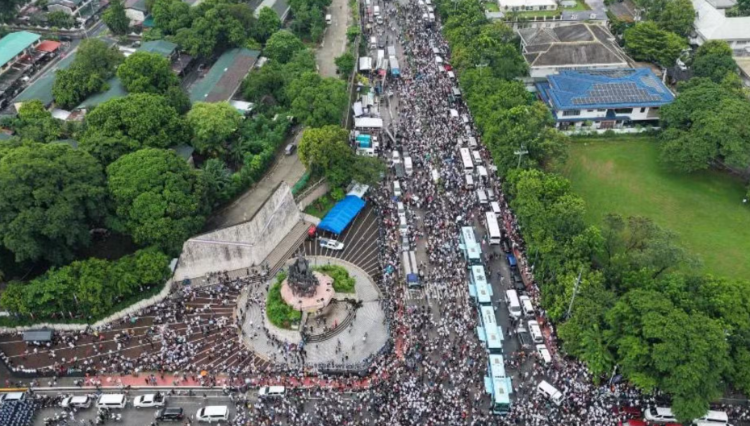
Thousands of devotees from the Iglesia Ni Cristo rallied across Manila's main thoroughfare on Tuesday, bringing significant traffic disruption as they protested against moves to arrest Senator Rodante Marcoleta, a senior church member and high-profile supporter of Vice President Sara Duterte. The demonstration unfolded just a day after authorities announced they would pursue graft charges against the legislator, centring on his alleged failure to disclose 75 million pesos in unused election campaign funds. Police reported an initial crowd of 8,000 people, with expectations that numbers would swell throughout the day, creating congestion stretching kilometres across the capital's main transport arteries and forcing commuters to navigate severely restricted traffic conditions during the morning rush.
The timing of the rally carries significant political weight, as it coincides with preparations for Vice President Duterte's impeachment trial, scheduled to commence on July 6. Marcoleta is widely perceived as virtually certain to vote against conviction during the proceedings, making his potential detention before or during the trial a matter of intense concern for Duterte's political camp. The Iglesia Ni Cristo has historically functioned as a decisive political force in Philippine elections, commanding a substantial voting bloc that has maintained enduring connections with the Duterte political family. This institutional alignment between the church and the vice president's political interests explains the swiftness and scale of the religious organisation's mobilisation in response to the graft charges.
Official announcements from the ombudsman's office revealed that Marcoleta faces accusations concerning the non-disclosure of campaign contributions totalling 75 million pesos, approximately 1.2 million US dollars. The charges represent part of a broader crackdown on financial improprieties within political circles, though critics argue the selective application of such prosecutions reflects deeper political fractures within Philippine governance. Government Ombudsman Jesus Remulla formally declared the intention to press charges, signalling that the legal machinery had advanced beyond preliminary investigations into formal prosecution procedures. This development placed the INC in a defensive posture, compelled to publicly challenge what it characterised as discriminatory application of justice mechanisms against its constituency.
The church's leadership articulated its position through multimedia statements, with INC spokesman Edwil Zabala releasing a video message distributed across Facebook platforms. Zabala framed the rally as a defence of transparency and equal treatment under law, contending that imprisoning Marcoleta would represent an affront to fundamental principles of justice. The organisation declared its commitment to persisting in demanding accountability regardless of administrative or legal obstacles, positioning itself as a guardian of equitable governance rather than merely a sectarian defender of one politician. This rhetorical strategy attempted to elevate the dispute beyond narrow factional politics into a broader discourse about institutional fairness and governmental impartiality.
The Marcoleta situation unfolds within a constellation of legal troubles afflicting various Duterte-aligned politicians. Senator Jose Estrada faces separate corruption charges stemming from his alleged involvement in a massive flood control scheme scandal that captured national outrage and generated widespread demands for accountability. Additionally, Senator Ronald Dela Rosa, another prominent Duterte supporter, has evaded capture following his narrow escape from arrest on an International Criminal Court warrant connected to his operational role in the controversial drug war initiated by former President Rodrigo Duterte. These parallel legal proceedings against multiple figures from the Duterte political network suggest a coordinated effort to address accumulated grievances regarding financial malfeasance and human rights violations.
The broader political environment reflects the dramatic deterioration of relations between Vice President Duterte and President Ferdinand Marcos, erstwhile allies who have since become implacable adversaries. This rift has fundamentally reshaped Philippine political alignments, with the INC previously demonstrating its capacity for massive public mobilisation in defence of Duterte's interests. In November, the church organised a rally numbering in the hundreds of thousands to demand accountability regarding the flood control scandal, whilst simultaneously placing substantial blame for the situation on President Marcos. Subsequently, in January 2025, the organisation orchestrated another major demonstration opposing Duterte's impeachment, mobilising its considerable organisational infrastructure to challenge the legislative process initiated by the House of Representatives.
The impending Senate trial represents the culmination of escalating confrontation between Duterte and the presidential establishment. Conviction requires a supermajority of 16 votes from the 24-member Senate body, creating a mathematical scenario where a handful of defections from what might otherwise represent a solid prosecutorial majority could prove decisive. Marcoleta's presence and voting position thus assume outsized importance to the political calculations surrounding the trial's outcome. The strategic timing of charges against him appears deliberately crafted to either pressure him toward particular voting behaviour or potentially remove him from the Senate chamber entirely before crucial proceedings commence.
President Marcos's decision to cancel a planned media engagement in order to personally monitor the Manila situation underscores the seriousness with which the government regarded this public demonstration. The cancellation signalled executive-level concern about the rally's potential trajectory and the broader political implications of such visible mobilisation by a well-organised religious institution. The episode illustrated how church-based social movements retain considerable capacity to shape political discourse and create logistical complications for governance in the Philippine context, where religious organisations command exceptionally strong organisational networks and command powerful emotional loyalty from adherents.
The rally itself represented more than merely a display of numerical support; it constituted a public performance of institutional power designed to communicate to decision-makers at all levels the potential political costs of proceeding against Marcoleta. By mobilising thousands of demonstrators to snarl metropolitan traffic and broadcast their grievances through dominant media channels, the INC sought to create a political environment wherein prosecuting the senator appeared sufficiently costly to warrant reconsideration. This form of pressure-based politics has proven effective in the Philippine context, where organised religious and social movements retain substantial capacity to influence outcomes through coordinated public action that disrupts normal urban functioning and generates intense media attention.
For Malaysian observers, this unfolding situation illuminates the particular vulnerabilities of Philippine democratic institutions to organised religious and factional pressure, contrasting with regional patterns in Singapore or Indonesia where different institutional configurations produce alternative equilibria. The case demonstrates how the intersection of religious institutions, political patronage networks, and legal systems can generate contests over fundamental questions about equitable governance and selective prosecution. The INC's mobilisation capacity and willingness to deploy it for explicitly partisan purposes raises broader questions about the proper role of religious organisations within democratic systems and the boundaries between legitimate advocacy and problematic factional deployment of institutional resources for narrow political advantage.

