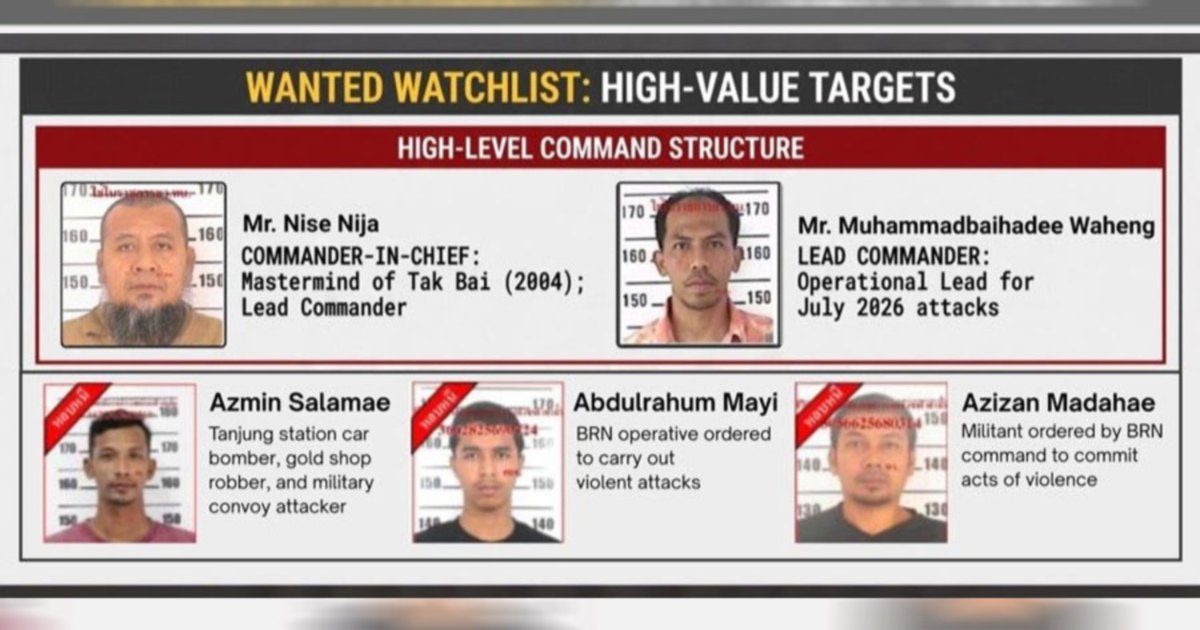
Thai authorities have moved swiftly to pursue accountability for a violent attack on a security checkpoint in the troubled southern province of Narathiwat, issuing arrest warrants for five suspects connected to the July 22 ambush. The incident, which unfolded along Bukit Sami Municipal Road in Tanjong Mas subdistrict, Ra-ngae district, marks another escalation in the complex security situation that has plagued Thailand's far south for years.
The timing of the attack underscores the persistent vulnerability of government security operations in provinces bordering Malaysia, despite ongoing counterinsurgency efforts and enhanced border cooperation. Narathiwat, along with Yala and Pattani, has long been a focal point of separatist insurgency, with various armed groups operating across the porous Thailand-Malaysia frontier. The targeting of a security checkpoint—a symbol of state authority—represents a direct challenge to Thai government control in the region.
For Malaysian observers, the incident carries significant implications for cross-border security dynamics. Narathiwat's proximity to Malaysian states including Kedah and Perlis means that regional instability, militant movements, and smuggling networks operate in close proximity to Malaysian territory. The fluidity of the security environment in southern Thailand has historically created spillover effects on the Malaysian side, affecting everything from drug trafficking routes to the movement of weapons and wanted individuals across international borders.
The arrest warrant issuance reflects Thai law enforcement's determination to dismantle the operational cells believed responsible for the attack. However, identifying and apprehending suspects in Narathiwat remains a considerable challenge, given the complex local dynamics, multiple armed factions operating in the region, and historical difficulties in establishing secure custody. Thai security forces must navigate not only the insurgent threat but also questions of community trust and intelligence gathering in areas where civilian-militant lines are often blurred.
The ambush itself represents a tactically significant event in the southern insurgency. Attacks on security checkpoints typically require sophisticated planning, knowledge of patrol routines, and access to weapons. They are often orchestrated by individuals with military training and organizational backing, suggesting involvement by established militant networks rather than isolated perpetrators. The coordination required to execute such operations successfully indicates that the suspects sought by authorities likely hold positions of operational command within their respective organizations.
Thailand's broader security response must balance aggressive pursuit of perpetrators with longer-term counterinsurgency strategies. Past approaches focusing heavily on military operations without addressing underlying grievances have yielded mixed results. The southern conflict has claimed thousands of lives over two decades, displaced communities, and created cycles of retribution that complicate reconciliation efforts. The arrest warrant campaign, while necessary, represents only one element of a multifaceted challenge that also encompasses intelligence work, community engagement, and regional cooperation.
Malaysia's security establishment has maintained close liaison with Thai authorities on southern Thailand issues, recognizing that regional stability serves mutual interests. Malaysian security forces work alongside Thai counterparts on border security matters, intelligence sharing, and operations targeting transnational criminal networks that exploit the porous frontier. The pursuit of suspects in the Narathiwat attack may therefore involve consultation and coordination mechanisms established between the two countries' security agencies.
The investigation into the checkpoint ambush will likely involve extensive intelligence work, witness interviews, and forensic analysis of the attack scene. Thai police and military intelligence units typically collaborate on such investigations, combining civilian detective work with military strategic reconnaissance capabilities. The identification of five specific suspects suggests that intelligence gathering has already yielded actionable leads, though the actual apprehension phase may prove more protracted depending on the suspects' locations and support networks.
For civilians in Narathiwat and surrounding areas, incidents like the July 22 ambush deepen existing anxieties about personal security. Communities in the conflict zone navigate constant tension between multiple armed actors, government forces, and the risks inherent in living along militarized frontiers. Checkpoint incidents, whether attacks or security operations, disrupt normal economic and social patterns, affecting daily commutes, trade, and community cohesion.
The regional context matters significantly for understanding such incidents. Southeast Asian security challenges increasingly involve transnational dimensions—weapons smuggling, foreign fighter recruitment, financial networks, and intelligence sharing across borders. Thailand's southern insurgency, while rooted in local political and ethnic dimensions, intersects with broader regional security ecosystems that directly concern Malaysia, Singapore, and other Southeast Asian nations concerned about extremism and destabilization.
As Thai authorities pursue their investigation, the operational effectiveness of the arrest warrant campaign will depend on several factors: the quality and reliability of intelligence sources, cooperation from local communities willing to provide information, security force discipline in apprehending suspects safely, and international cooperation where suspects may have fled across borders. Success in identifying and prosecuting the perpetrators could disrupt the operational capabilities of the militant cells responsible, while also sending important signals about state resolve and investigative competence.
The broader implication for Malaysian policymakers and security officials is that southern Thailand's instability remains a persistent regional challenge requiring sustained attention. Cross-border criminality, refugee flows, and security threats do not respect international boundaries, making the health of Thai security operations relevant to Malaysian strategic interests. The pursuit of accountability for the Narathiwat ambush reflects a continuing effort to restore government control and security, though the underlying conflicts driving insurgent activity remain substantially unresolved.

