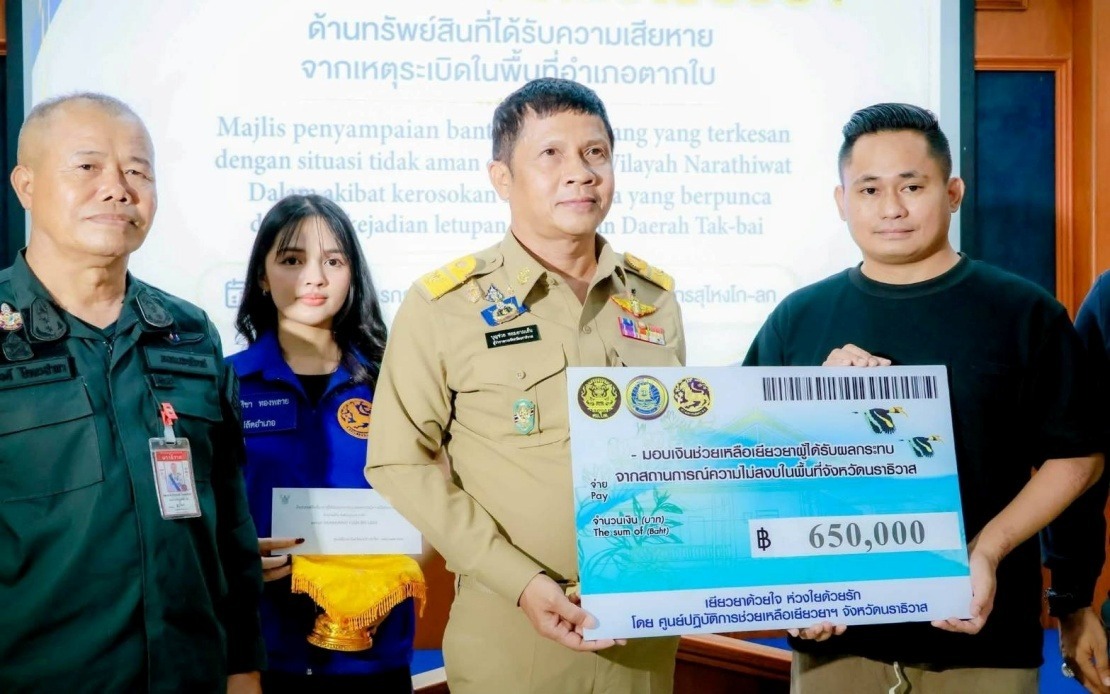
The Thai government has provided 650,000 baht in compensation to one of two Malaysian citizens injured when an improvised explosive device detonated on a roadside in Tak Bai district, Narathiwat province, on June 29. The payment represents an official acknowledgment of the incident and underscores Bangkok's determination to maintain relations with its neighbour while managing security challenges in Thailand's restive southern border region.
Muhammad Yusri Udin, 38, received the compensation cheque during a formal ceremony conducted at the Sungai Golok Customs Office on Friday. The transfer of funds occurred nearly a week after the blast that also injured Abdullah Syarapi Abd Rahman, 45, both Malaysian nationals whose presence in the area had nothing to do with the intended target of the attack. Narathiwat Governor Boonchuay Homyamyen personally oversaw the presentation, emphasizing the gravity with which Thai authorities regard incidents affecting cross-border neighbours.
The bomb was concealed within a roadside drainage channel positioned near the Sapom junction and detonated at approximately 11.40 am local time. Investigators determined that the device was an improvised weapon, consistent with the tactics employed by armed groups operating in Thailand's southern provinces. Thai law enforcement apprehended a 40-year-old suspect and initiated comprehensive investigative procedures, including explosive ordnance disposal operations and forensic analysis at the scene.
Thailand's compensation framework for security-related incidents provides systematic support to both residents and visiting nationals affected by violence in vulnerable areas. The 650,000 baht awarded through this government fund represents coverage for medical expenses and injury-related costs incurred by the affected Malaysian. Governor Boonchuay clarified that this mechanism remains an active instrument for addressing civilian harm across Narathiwat and surrounding districts where militant activity periodically disrupts normal life.
The incident highlights persistent security vulnerabilities along Thailand's Malaysian border, an area where insurgent movements have conducted sporadic attacks for nearly two decades. While the two Malaysians were bystanders rather than deliberate targets, the attack demonstrates the indiscriminate nature of explosive violence in the region. Such incidents carry implications for cross-border travel and commerce, sectors vital to local economies on both sides of the frontier.
Governor Boonchuay articulated Thai authorities' determination to prevent similar occurrences, pledging that security enhancements would continue throughout the province. He stressed that the government will not adopt a passive stance toward threats, indicating that military and police operations would intensify in response to ongoing militant activity. This commitment extends beyond mere rhetoric; it reflects political pressure from Bangkok to demonstrate control over restive southern territories where tourism and investment remain constrained by security perceptions.
Thailand's explicit assurance that visitor safety remains a priority signals awareness of how security incidents damage international perceptions and economic vitality. The governor's remarks directly addressed the confidence deficit that repeated bombings create among potential tourists and investors. By personally presenting compensation and publicly reaffirming protective measures, Thai officials attempt to normalize cross-border movement and demonstrate that incidents, while serious, do not reflect systemic state failure.
For Malaysian nationals, particularly those engaged in trading, travel, or business activities across the border, this compensation demonstrates bilateral cooperation and official accountability. The incident underscores the need for heightened awareness when traversing Narathiwat province, especially in districts like Tak Bai where militant networks remain operationally active. Malaysian authorities likely coordinated with Thai counterparts regarding victim support, reflecting the diplomatic channels that manage cross-border security cooperation.
The apprehension of the 40-year-old suspect provides authorities with investigative leads regarding the broader network responsible for the attack. Thai security agencies have consistently attributed such incidents to rebel groups seeking political leverage through violence. The forensic examination and ordnance disposal operations constitute standard procedures aimed at gathering evidence while preventing secondary explosions from intact devices potentially remaining in the vicinity.
Regional observers note that southern Thailand's security situation remains fundamentally unresolved despite decades of counterinsurgency operations. Periodic bombings targeting civilian areas reflect the limitations of military strategies in addressing underlying grievances and militant recruitment channels. The compensation mechanism, while appropriate and necessary, cannot address structural factors driving violence in border communities where economic opportunity remains limited and historical tensions persist.
The incident and subsequent compensation reveal the complex relationships between ASEAN neighbours managing shared security challenges. Malaysia and Thailand maintain coordinated border security arrangements, intelligence-sharing protocols, and formal mechanisms for addressing transnational incidents. This framework functioned as intended following the June 29 blast, with affected nationals receiving official recognition and financial support within days of the incident.
Looking forward, Malaysian travellers and businesses operating in Narathiwat should maintain awareness of prevailing security conditions in southern Thailand. While individual incidents remain statistically uncommon relative to overall cross-border traffic, the randomness of bomb placements means that ordinary locations can transform into danger zones unpredictably. Official Thai compensation mechanisms provide recourse for victims, but prevention through situational awareness remains the most effective individual protective measure in volatile border territories.

