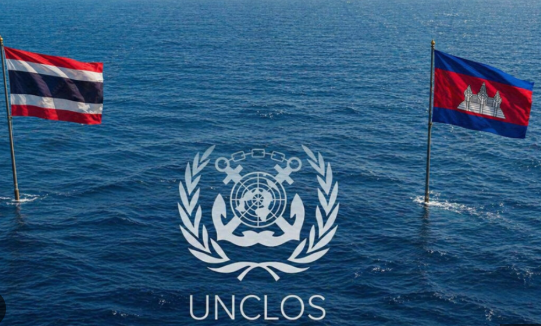
Thailand has taken a carefully calibrated position on its long-standing maritime dispute with Cambodia, formally accepting a compulsory conciliation mechanism under international law while simultaneously limiting the legal weight of any eventual outcome. The Thai government's response to Cambodia's June 2 notification came on June 19, representing a strategic acceptance of the dispute resolution framework established by the 1982 United Nations Convention on the Law of the Sea, or UNCLOS, even as Bangkok emphasises that the process cannot impose binding obligations on either nation.
The conciliation mechanism differs fundamentally from litigation or arbitration, a distinction Thai officials have taken pains to clarify. Rather than functioning as a court proceeding with enforceable judgments, the UNCLOS compulsory conciliation process relies on neutral experts who will listen to both parties, understand the historical context of their claims, and attempt to facilitate a mutually acceptable settlement. This distinction carries significant practical weight in a region where maritime disputes often involve substantial economic interests and questions of national sovereignty that governments are reluctant to place entirely in foreign hands.
Thailand has appointed high-level representation to the conciliation commission, naming Deputy Prime Minister and Foreign Minister Sihasak Phuangketkeow as its Agent and Songchai Chaipatiyut, Thailand's ambassador to Kuwait and a former senior official at the Department of Treaties and Legal Affairs, as Deputy Agent. The composition of the conciliator panel reflects Thailand's emphasis on technical expertise in maritime law. Judge Albert J Hoffmann of South Africa and Judge Rudiger Wolfrum of Germany, both internationally recognised specialists in law of the sea issues, will represent Thailand's interests. These four conciliators, combined with those selected by Cambodia, will choose a fifth member to chair the commission within 30 days of Thailand's formal response.
The timeline for the conciliation process envisages a report with recommendations within approximately 12 months, though both parties may agree to extend this period. Critically, this report will carry no legal force. According to UNCLOS Annex V, the conciliation commission's report, including any conclusions or recommendations it contains, cannot bind the parties to any particular course of action. This non-binding character has become the cornerstone of Thailand's negotiating position, effectively allowing Bangkok to participate in the dispute resolution mechanism while preserving complete freedom of action regarding any proposed settlement.
Understanding Thailand's approach requires examining the broader context of Thai-Cambodian maritime relations and the economic stakes involved. The disputed waters in the Gulf of Thailand are believed to contain significant natural gas deposits and other hydrocarbon resources that could prove valuable for either nation's energy security and economic development. Thailand terminated its 2001 memorandum of understanding with Cambodia in May, citing the lack of substantive progress over 25 years of attempted cooperation under that framework. Prime Minister Anutin Charnvirakul described the termination as a necessary adjustment rather than a hostile move, but the decision signalled Bangkok's dissatisfaction with the existing bilateral arrangement.
Thailand has taken a notably restrictive view of the conciliation's proper scope. While Cambodia's notification apparently encompasses not only maritime boundary delimitation but also provisional arrangements for joint development and equitable sharing of hydrocarbon resources, Thailand insists the process should address only the definition of maritime boundaries under UNCLOS principles. This distinction matters substantially, as joint development frameworks could potentially require Thailand to share resource extraction opportunities or revenues with Cambodia even in disputed zones. By narrowing the scope to delimitation alone, Thailand preserves the possibility of future negotiations on resource-sharing that would occur on Bangkok's terms rather than through a commission's recommendations.
The Thai government has reiterated its preference for bilateral negotiation as the ultimate mechanism for resolving the dispute. Rather than replacing direct talks, conciliation should serve as a supporting framework that helps the two countries identify common ground and clarify their respective legal positions under UNCLOS. This emphasis on bilateralism reflects both Thailand's diplomatic tradition and its desire to maintain maximum flexibility in future negotiations. Bangkok views the conciliation process as a waystation rather than a destination, a way to demonstrate willingness to engage with Cambodia through international legal mechanisms while preserving the option to negotiate the final settlement directly.
Cambodia's decision to initiate compulsory conciliation, announced after Thailand's termination of the 2001 memorandum, represented an escalation of the dispute through recourse to international law. Phnom Penh framed the move as seeking a peaceful resolution through established international mechanisms, signalling that direct bilateral talks had reached an impasse. Thailand's acceptance of the conciliation process, while technically complying with UNCLOS obligations, demonstrates how a state party to the convention can participate in dispute resolution while minimising the practical constraints on its freedom of action. The non-binding nature of recommendations means Thailand incurs minimal risk in engaging with the process.
For Malaysia and other Southeast Asian states monitoring this dispute, Thailand's approach offers instructive lessons about managing maritime disagreements in an era when international law provides multiple forums for dispute resolution. The Thai position illustrates how nations can accept participation in compulsory procedures without surrendering substantive control over outcomes, and how the distinction between binding and non-binding recommendations affects the political calculation of engaging with international mechanisms. The conciliation process may clarify the legal and factual basis for each party's claims, but the ultimate resolution of the Thai-Cambodian maritime dispute will likely emerge from direct negotiation rather than from any commission's recommendations.
The question of how both countries will respond to the conciliation commission's eventual report remains open. Should the commission's recommendations diverge sharply from Thailand's position, Bangkok will face pressure to explain why it rejects proposals from internationally respected experts. Conversely, if the recommendations favour Thailand's interpretation of UNCLOS principles, Cambodia may feel obligated to accept them as a basis for further negotiation. The conciliation process thus creates space for movement while allowing both parties to maintain public positions that current positions are non-negotiable. In this respect, Thailand's emphasis on the non-binding character of the outcome may represent not intransigence but rather diplomatic pragmatism, preserving flexibility for eventual settlement while avoiding the appearance of capitulation.