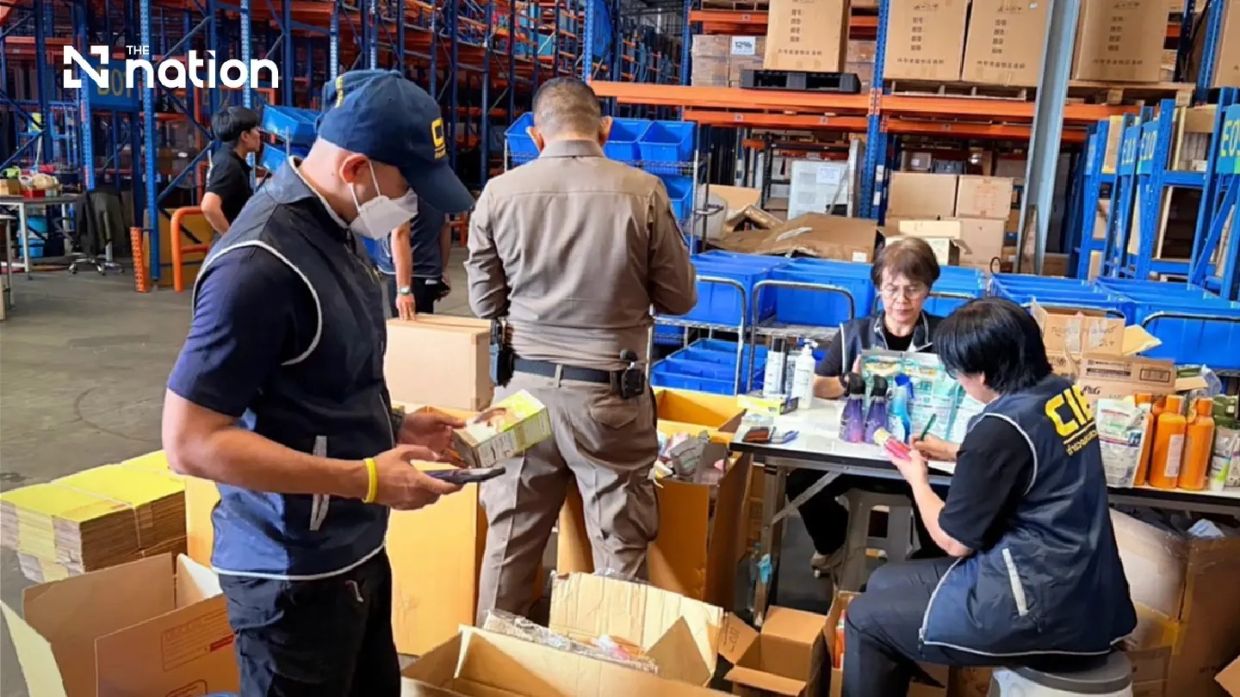
Thai police have shut down a sophisticated warehouse operation in Bang Phli, Samut Prakan province, that was systematically distributing unapproved Japanese cosmetics, dietary supplements and medicinal products to online merchants nationwide. Acting under orders from Pol Maj Gen Kongkrit Lertsittikul, commander of the Consumer Protection Police Division (CPPD), officers conducted a raid on Thursday that netted 83,483 items across 116 distinct product categories. The confiscated goods, valued at more than 8.34 million baht, represent a significant blow to what authorities describe as an organised scheme to circumvent Thailand's stringent consumer safety regulations.
The warehouse raid emerged from mounting complaints that numerous e-commerce platforms were selling cosmetics, supplements and hazardous household substances carrying no Thai-language labels or safety documentation. This proliferation of unlabelled foreign products has raised serious concerns among consumer advocates, who worry that Thai buyers cannot access crucial usage instructions or ingredient information. Investigators meticulously traced the supply chain and discovered that the majority of goods originated from Japan without undergoing mandatory safety inspections or obtaining required certifications from Thai regulatory bodies. The absence of these checks and approvals means consumers faced unknown risks of adverse reactions, contamination or misuse.
What distinguishes this operation is its scale and longevity. The warehouse facility had been functioning as a pseudo-logistics centre for over four years, initially storing imported goods before expanding into comprehensive packing and distribution services for multiple online businesses. Between 200 and 300 items were processed for sale daily, with the operator charging a modest packing fee of 10 to 12 baht per box. This modest fee structure masked what was essentially a high-volume criminal enterprise, generating steady revenue while exposing potentially millions of Thai consumers to health hazards. The sheer operational infrastructure—dedicated staff, systematic daily throughput, packaging facilities—suggests the perpetrators viewed this as a sustainable long-term venture rather than casual smuggling.
The investigation's complexity underscores how digital marketplaces have created new vulnerabilities in consumer protection frameworks. Unlike traditional retail where authorities can monitor physical shopfronts, online platforms operate with minimal oversight. Products funnel through distribution hubs like the Bang Phli warehouse before dispersing across dozens or hundreds of online sellers, making regulatory tracking extraordinarily difficult. Each seller may maintain plausible deniability, claiming they sourced goods legitimately. The warehouse operator thus served as a critical middleman, collecting, storing and logistics-managing goods that individual sellers could then list as their own inventory. This decentralised model effectively shields the supply chain's apex from direct consumer complaints.
The enforcement action reveals deeper concerns about Thailand's porous borders and customs procedures. That Japanese products could enter the country without proper documentation or inspection suggests gaps in import controls. Either goods slipped through official channels with minimal scrutiny, or they arrived via informal networks that bypass customs entirely. For Southeast Asia broadly, this case exemplifies a regional challenge: the growing flow of unapproved foreign products through online channels, often originating from Japan, China, South Korea and other industrialised nations. Malaysia, Indonesia and Vietnam have reported similar issues, as consumers' appetite for affordable cosmetics and supplements collides with weak enforcement across e-commerce platforms.
The legal framework invoked against the perpetrators is formidable. Prosecutors will pursue charges under Thailand's Cosmetics Act, Hazardous Substances Act, Food Act and Drug Act—a multi-statutory approach reflecting the diverse nature of the seized inventory. These laws carry substantial penalties for importing, storing or distributing unapproved products. The severity of charges signals that Thai authorities view this not merely as a commercial violation but as a public health emergency. When thousands of untested foreign cosmetics reach consumers without regulatory oversight, the cumulative risk materialises across demographics: allergic reactions, skin conditions, systemic poisoning from heavy metals or harmful additives, and potential organ damage from adulterated supplements.
Malaysian and regional consumers should recognise parallels to their own market conditions. Online shopping has democratised access to affordable international products, yet regulatory agencies across Southeast Asia remain under-resourced relative to the scale of e-commerce activity. Warehouse operations similar to the Bangkok facility likely exist in Malaysia, Singapore and Indonesia, processing and redistributing foreign goods with minimal scrutiny. The practice exploits regulatory gaps and consumer trust. Shoppers browsing Facebook or Lazada may assume products listed are legitimate; few pause to verify certifications or labels. Unscrupulous operators exploit this assumption, knowing most transactions occur without face-to-face verification.
The CPPD's successful operation demonstrates what targeted enforcement can achieve. By tracing complaints backward through supply chains, investigators identified the warehouse hub rather than pursuing individual online sellers—a far more efficient approach. This intelligence-led strategy disrupted the entire distribution network simultaneously, preventing future sales of the 83,483 seized items. However, sustainability of such enforcement depends on adequate resourcing and inter-agency cooperation. Thailand's CPPD must maintain surveillance of emerging warehouses and coordinate with customs and online platforms to flag suspicious accounts. Regional cooperation would strengthen the effort further; coordinated action across ASEAN nations could disrupt transnational supply chains serving multiple countries.
The case also highlights the responsibility of e-commerce platforms themselves. Lazada, Shopee and Facebook Marketplace Thailand must implement robust vetting procedures for sellers, demand documentation of product legitimacy, and remove listings for unapproved goods. Platforms currently benefit financially from high transaction volumes while externalising health risks to consumers and regulatory costs to governments. Voluntary compliance remains limited; platforms often resist enforcement requests as burdensome. Stronger legislation requiring platforms to verify seller credentials and product certifications would shift incentives. Thailand, and Malaysian regulators contemplating similar measures, should consider mandating that platforms maintain seller documentation and cooperate fully with authorities.
Consumer vigilance offers an additional layer of protection. Buyers purchasing cosmetics, supplements or medicinal products online should verify Thai-language labelling, manufacturer certifications and safety documentation before purchasing. Products offered at suspiciously low prices, especially from unfamiliar sellers, warrant caution. Legitimate sellers typically provide complete product information and certifications; their absence signals potential problems. Reporting suspicious listings to regulatory agencies helps authorities prioritise investigation resources. The CPPD's success began with consumer complaints; sustained public vigilance multiplies enforcement effectiveness.
Moving forward, Thailand's regulatory apparatus must adapt to e-commerce realities. Reactive enforcement after harm occurs is insufficient; the country needs proactive monitoring systems, supplier registries and platform audits. Regional harmonisation of cosmetics and supplement standards would reduce opportunities for regulatory arbitrage, where producers exploit looser rules in one jurisdiction to supply stricter markets. ASEAN could develop mutual recognition agreements for product certifications, streamlining legitimate trade while raising barriers to smuggled goods. The Bangkok warehouse operation, though significant, represents only one node in a vast informal network. Sustained pressure requires systemic institutional change across borders and platforms.

