A Thai female airline crew member's arrest in Australia has unveiled an intricate drug-smuggling operation, with Thai narcotics officials revealing that heroin worth confiscating was concealed using an unusually sophisticated method that hid contraband in only a fraction of the luggage used for transport. The Office of the Narcotics Control Board (ONCB) confirmed on Wednesday, July 1, that Australian counterparts had isolated and weighed approximately 900g of suspected heroin from one of two bags where the drugs were embedded, offering the first concrete measurements in what appears to be a coordinated international trafficking network.
Police Major Suriya Singhakamol, secretary-general of the ONCB, explained that the criminal network had employed a deliberate misdirection strategy, packing twelve bags into a single parcel but placing narcotics in only two. This approach suggests traffickers understood law enforcement detection methods and sought to obscure the actual scope of their shipment by diluting the drug concentration across a larger total volume of legitimate baggage. The initial assessment from Thai authorities suggested the two bags together contained no more than 2kg of substances, though Suriya cautioned that official laboratory confirmation from Australian facilities was still pending and could revise these figures significantly.
The investigation's complexity extends far beyond the individual arrest, as Thai and Australian authorities have launched coordinated operations to dismantle what they believe is a transnational network with tentacles stretching across multiple jurisdictions. The ONCB has established close working relationships with the Australian Federal Police, exchanging intelligence and pursuing leads in both countries simultaneously. This bilateral approach reflects growing recognition among Southeast Asian law enforcement agencies that drug trafficking increasingly transcends borders, requiring collaborative investigation frameworks rather than isolated national responses. For Malaysia, which sits at a critical crossroads for regional smuggling routes, such cooperation models offer potential templates for addressing similar transnational challenges.
A significant breakthrough emerged when delivery personnel came forward to assist authorities. One courier voluntarily approached the ONCB to clarify his uninvolvement after learning he might be suspected, a development that allowed investigators to narrow their search parameters. Through meticulous comparison of CCTV footage, investigators identified multiple inconsistencies between the cooperating rider and the actual suspect. The parcel containing heroin arrived on June 22 at midday, whereas the rider who came forward had delivered a different package the following day at approximately 5pm. Beyond timing discrepancies, the physical packages differed markedly—the drug-containing shipment was a large brown cardboard box, while the innocent rider transported a black plastic container. Additionally, the actual delivery suspect wore a black helmet contrary to the yellow shirt and white helmet combination visible on the willing informant.
Locating the authentic courier has become a priority, as this individual may provide crucial testimony regarding pickup instructions, delivery coordinates, and payment arrangements that could illuminate the network's operational structure. However, authorities acknowledge the suspect may have been deliberately recruited through anonymous channels and possess limited knowledge of upper-level conspirators. The investigation has simultaneously expanded to trace the online architect of the scheme, a Facebook account operating under the name "Rose" that allegedly coordinated delivery logistics. Recognising that digital identities can conceal true operators, the ONCB has committed resources to penetrating the account's anonymity and identifying the actual person directing shipments, a technique increasingly common among sophisticated smuggling enterprises seeking to maintain operational security through layers of intermediaries.
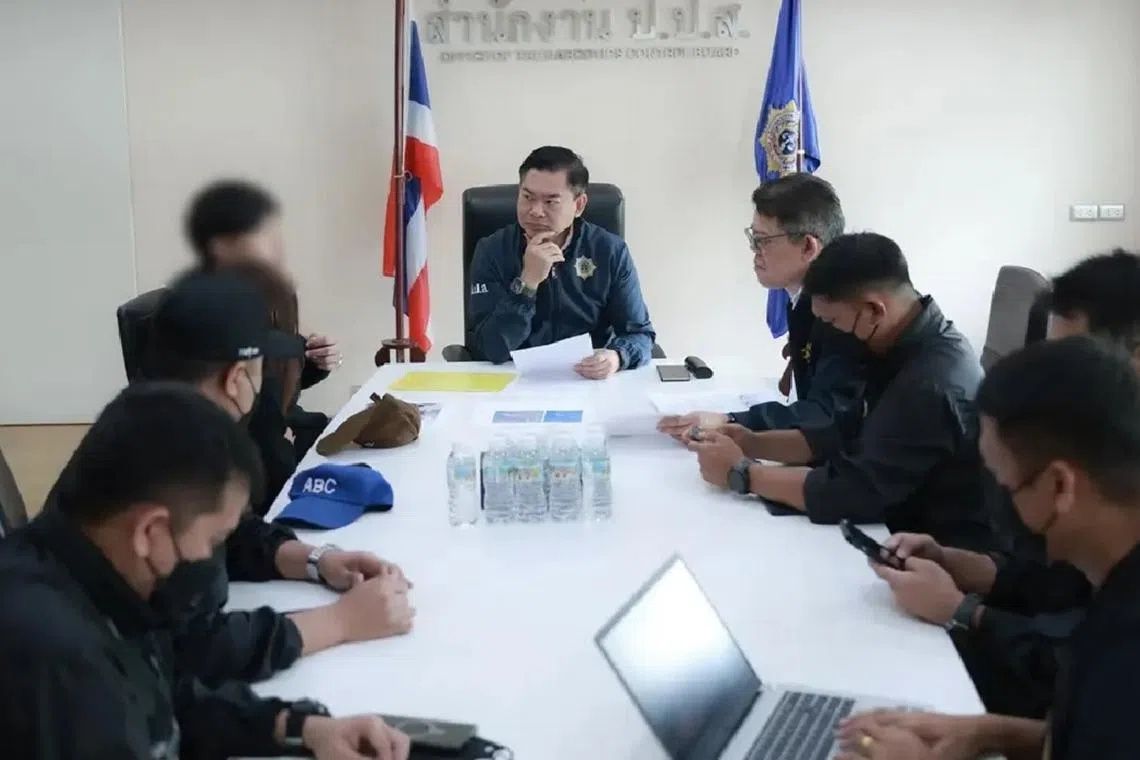
The ONCB's integration of investigation efforts across multiple Thai government agencies reflects institutional recognition that singular departmental approaches prove insufficient against complex trafficking conspiracies. The newly established Task Force Storm coordinates activity among the ONCB, Customs Department, Department of Special Investigation, and international partners including the Australian Federal Police, creating an inter-institutional task force capable of pursuing investigations across bureaucratic boundaries. On July 1 afternoon, ONCB officials met with AFP representatives to exchange detailed operational intelligence, demonstrating the practical execution of this collaborative framework. Such arrangements mirror evolving ASEAN approaches to organised crime, though critics note that sustained funding and political commitment remain inconsistent across the region.
The concealment methodology itself offers insights into trafficking network sophistication and resource allocation. Rather than attempting to smuggle large quantities through a single channel, the operation scattered heroin through multiple bags, reducing per-bag density and potentially evading detection technologies calibrated to identify typical concentration patterns. Whether this sophisticated approach originated from planning conducted in Thailand or in neighbouring countries remains undetermined, highlighting geographical ambiguity in trafficking operations. Officials confirmed that principal drugs in circulation—crystal methamphetamine, heroin, and methamphetamine pills—originate primarily from the Golden Triangle region spanning Myanmar, Laos, and Cambodia, areas where production occurs beyond Thai law enforcement jurisdiction. However, the secondary processes of packaging, concealment modification, and preparation for international transport might occur anywhere along the supply chain, complicating upstream interdiction efforts.
Suriya acknowledged that determining whether the fabric-embedding technique was refined within Thailand or externally remains an active investigative question, as transnational networks frequently distribute operations across jurisdictions to fragment accountability. This geographical distribution of criminal functions represents a persistent enforcement challenge, as Thai authorities can effectively intercept products but cannot always address production or initial preparation stages outside their territorial reach. The complexity of Golden Triangle sourcing, combined with sophisticated intermediate processing, creates a resilient system capable of absorbing disruption at individual points without structural collapse. Understanding these supply chain vulnerabilities has become critical for Southeast Asian policymakers contemplating more effective interdiction strategies.
The investigation's scope continues expanding as authorities pursue the shipment's complete routing, attempting to reconstruct how the parcel moved from origin point through intermediaries to final Australian delivery. Tracing this logistics trail requires cooperation from transport companies, postal services, and international carriers that may have handled the package at various stages. Each handoff represents a potential intelligence-gathering opportunity but also complicates investigation timelines, as individuals involved at earlier stages may lack awareness of ultimate destination or contents. For Malaysia's law enforcement agencies monitoring similar suspicious parcels transiting domestic transport networks, this case demonstrates the value of detailed logistics documentation and international coordination in reconstructing smuggling pathways.

