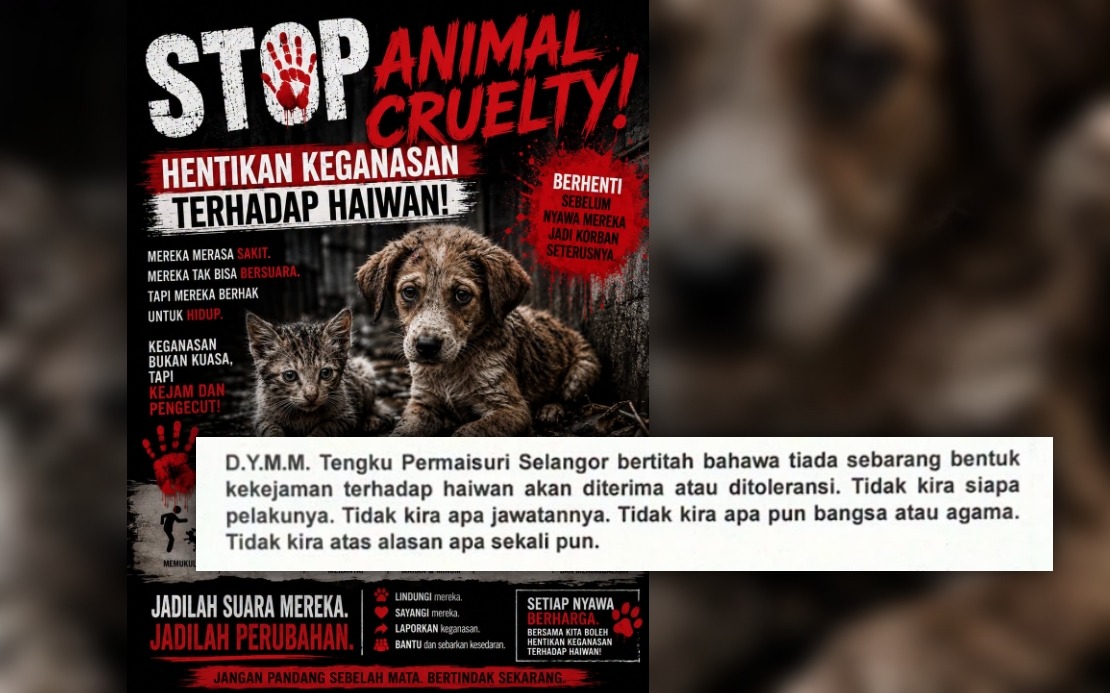
Selangor's royal palace has issued a forceful statement condemning the escalating incidents of animal abuse affecting domestic pets and strays, with Tengku Permaisuri Norashikin expressing profound concern over the troubling trend that has triggered significant public backlash across social media platforms. The pronouncement marks a decisive intervention from the palace on an issue that has increasingly captured public attention and sparked debate about Malaysia's approach to animal protection and enforcement accountability.
Central to the Tengku Permaisuri's intervention is a formal request for the federal government to undertake a comprehensive review of penalties stipulated under the Animal Welfare Act 2015. The palace contends that existing punitive measures remain insufficiently stringent and that enforcement mechanisms lack consistency across jurisdictions and agencies. This call reflects growing recognition that legislative frameworks alone cannot guarantee animal protection without corresponding toughening of consequences for violations and more rigorous implementation at ground level.
The statement fundamentally frames animal cruelty as a matter extending beyond legal compliance into the realm of moral obligation and social values. According to the palace, mistreatment of animals represents not merely a breach of statute but a rupture in the compassion and humanity that underpin civilised societies. This perspective elevates the issue from a technical legal matter into a broader discourse about the character and conscience of Malaysian society and what standards of behaviour communities collectively uphold.
Tengku Permaisuri Norashikin, who holds the position of Royal Patron for the Stray Free Selangor initiative, made unequivocal that no individual, regardless of status, position, ethnicity, or religious affiliation, shall be permitted to perpetrate animal cruelty with impunity. The statement explicitly underscores that this principle applies uniformly across all segments—private citizens, commercial entities, governmental agencies, and enforcement personnel themselves. This universal application proves particularly significant given previous controversies involving animal welfare officers and authorities in abuse cases, signalling the palace's determination that accountability extend to officialdom.
A particularly pointed aspect of the pronouncement addresses enforcement professionals and government personnel directly. The palace stipulates that any officer discovered to have committed animal cruelty offences must undergo thorough investigation and face appropriate prosecution without exception. Simultaneously, the statement emphasises that public trust in enforcement institutions depends fundamentally on professional conduct grounded in integrity and compassion rather than unnecessary brutality. This dual message—accountability for abuse while promoting humane enforcement—addresses concerns about how some animal management operations have been conducted.
The Tengku Permaisuri's recommendation framework proposes cultivating communities genuinely oriented toward animal welfare through collaborative effort involving government bodies, local authorities, relevant agencies, animal welfare organisations, and citizen participation. Rather than imposing solutions unilaterally, this approach recognises that sustainable protection requires coordination across multiple stakeholders and ownership by society broadly. The palace further advocates embedding animal welfare considerations into foundational policy-making on animal management, ensuring compassion shapes decisions rather than functioning as an afterthought.
Educational initiatives feature prominently in the recommended pathway forward. The palace advocates instilling compassion toward animals from childhood onwards through structured education, sustained public awareness campaigns, and community engagement programmes. This approach acknowledges that lasting cultural transformation regarding animal treatment requires investment in younger generations and normative shifts that penetrate community consciousness. By positioning animal welfare as integral to building responsible, caring societies, the Tengku Permaisuri frames the issue as fundamental to civilisational progress rather than peripheral concern.
The palace has proposed adopting the framework of "Compassion. Care. Community." as shared values guiding Selangor's development. This formulation attempts to create a unifying principle across diverse populations and institutions, suggesting that protection of vulnerable creatures should characterise all governmental and social operations. The vision encompasses creating a state where every animal receives protection, respect, and dignified treatment, effectively establishing animal welfare as a measurable indicator of institutional and societal health.
Tengku Permaisuri Norashikin articulates a philosophical position linking societal treatment of animals to fundamental human character. The statement contends that communities failing to extend compassion toward defenceless creatures ultimately erode their capacity for compassion toward fellow humans, suggesting animal cruelty represents a symptom of broader moral decay. This argument carries weight in Malaysian public discourse given emphasis on religious and cultural values stressing kindness toward all creatures as divinely ordained obligations.
The palace's assertion that protecting vulnerability constitutes genuine strength rather than weakness represents an attempt to reshape cultural narratives around compassion. By positioning animal welfare advocacy as reflecting societal maturity and civilisational advancement, the Tengku Permaisuri reframes what might otherwise be dismissed as sentimentality into a marker of social progress. This rhetorical move may prove influential in shifting public perception and strengthening political support for enforcement improvements.
The Tengku Permaisuri's intervention carries particular significance given Selangor's status as Malaysia's most populous and economically developed state. Royal patronage of animal welfare initiatives amplifies the issue's profile and potentially influences policy priorities at federal and state levels. The statement's emphasis on consistent enforcement and universal accountability may catalyse administrative scrutiny of how various agencies handle animal management and cruelty investigations.
Looking forward, the palace has expressed hope that relevant parties will learn from recent distressing incidents and work collaboratively to ensure Selangor maintains standards reflecting core human values of justice and responsibility toward all beings. This framing positions animal welfare advancement as essential to the state's identity and trajectory, connecting it to broader aspirations around governance quality and social cohesion. Whether these recommendations translate into legislative amendments and enforcement reforms will substantially determine whether the royal intervention produces tangible improvements in animal protection outcomes.

