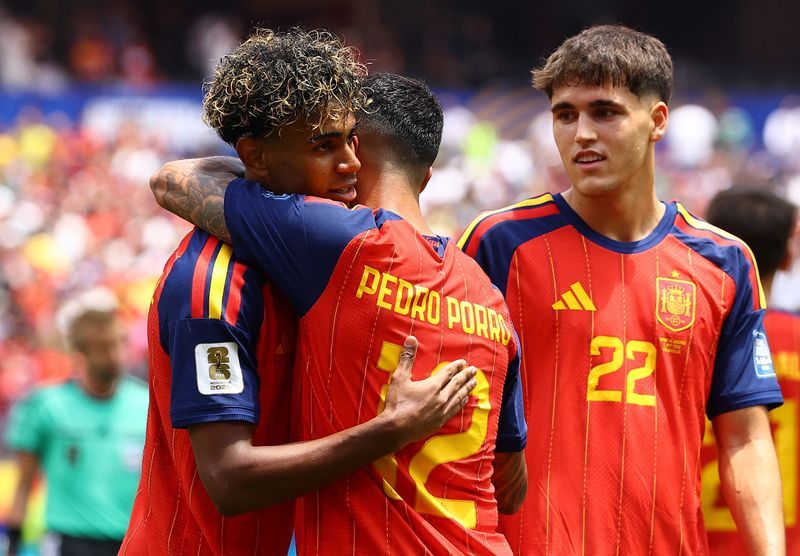
Spain's transformation in the tournament has crystallised around one teenage sensation. With Lamine Yamal finally hitting his stride on the right flank, the reigning European champions dismantled Austria 3-0 in a performance that suggested their early campaign struggles are firmly behind them. The 18-year-old Barcelona prospect, who arrived with a nagging hamstring complaint, has evolved from squad depth into the fulcrum around which Luis de la Fuente's entire system now rotates.
The contrast between Spain's opening fixture and their more recent displays could hardly be starker. When they took the pitch against Cape Verde, the side appeared blunt and laboured, unable to generate the dynamism or creative thrust that had defined their Euro 2024 triumph. That goalless draw raised genuine questions about whether the continental champions could sustain their momentum in tournament football. Yet the narrative has shifted dramatically as Yamal has regained full fitness and accumulated playing time, providing Spain with the outlet they desperately needed in wide areas.
What makes Yamal's contribution particularly fascinating for students of modern football is how he reconciles two seemingly opposed approaches to the game. Spain have historically built their identity on collective possession, midfield dominance, and an almost philosophical commitment to systematic play. Yamal, by contrast, thrives on individual brilliance and one-on-one duels, yet somehow his mercurial qualities enhance rather than undermine the team's structured approach. When he drifts infield, the entire Spanish setup shifts, with Rodri and Pedri finding more space in central areas and the ball moving with the controlled tempo that remains the cornerstone of Spanish football philosophy.
Against Austria, Yamal operated as both a focal point and a catalyst. Opponents recognised he was coming, yet they could not contain him—a paradox that speaks to his technical superiority and decision-making maturity. Spain consistently sought to isolate him in wide positions, trusting his ability to win crucial one-on-one contests that would then unlock space for his teammates. The strategy worked with remarkable consistency, tilting the pitch in Spain's favour throughout the encounter. Yet equally important were the moments when he drifted centrally, drawing defenders with him and creating the gaps that allowed Spain's midfield orchestra to operate more effectively.
The introduction of Álex Baena on the left wing has complemented Yamal's development beautifully. Where earlier lineups with Gavi and Ferran Torres looked pedestrian and disconnected, the current configuration provides Spain with dual attacking corridors. Baena's ability to stretch the pitch and generate width from the opposite side gives De la Fuente's team a second avenue of attack, relieving pressure on Yamal and ensuring Austria's defenders were perpetually stretched across the field.
Beyond the attacking statistics, Spain's defensive solidity has been equally impressive. Austria did not register a single shot on target—a historic achievement in World Cup knockout football that had not been accomplished since Germany's demolition of Argentina in the 2014 final. This defensive control reflects not just superior defending but superior possession and spatial management. When Spain control the ball and dictate tempo, opponents struggle to generate attacking opportunities regardless of their individual quality.
Yamal's performance was particularly notable for what he achieved without necessarily dominating the scoresheet. Named player of the match despite neither scoring nor providing an assist, his influence operated in subtler registers. He attracted pressure from multiple defenders, unsettled Austria's defensive shape with his movement, and created conditions for teammates to operate more effectively. This reflects a maturity beyond his years and suggests Spain have a player who understands that championship football often rewards intelligent positioning and decision-making over raw statistical accumulation.
The broader defensive record also deserves emphasis. Spain have not conceded a World Cup goal since their defeat to Japan in 2022 and maintain an unbeaten run stretching to 34 matches. This consistency at the back, combined with controlled attacking play, positions them as genuine contenders despite the uncertain start to their campaign. The early wobbles now appear to have been born from fitness issues and tournament rhythm rather than fundamental structural problems.
Pedro Porro and Marc Cucurella were exceptional in full-back positions, providing defensive reliability and attacking support in equal measure. Rodri, arguably the world's finest midfielder when operating at his peak, grew increasingly influential as the match progressed, particularly in the second half. Mikel Oyarzabal continued to demonstrate the clinical finishing that has made him invaluable in this tournament. Yet it is Yamal who ultimately embodies Spain's evolution from collective football into a more dimensionally balanced attacking system.
The challenge for De la Fuente lies in maintaining defensive discipline while improving the consistency of midfield control over extended periods. There remain phases in matches where Spain's shape becomes vulnerable, with gaps developing between defensive lines that could be exploited by more dangerous opponents. However, the performance against Austria demonstrates that as the tournament progresses and fitness levels stabilise, Spain are discovering the formula that made them European champions.
For Malaysian and Southeast Asian observers of European football, Yamal's trajectory offers a compelling case study in how elite academies develop technical excellence combined with physical robustness. His ability to perform at international level at just 18 years old, whilst managing injury and integrating into a complex tactical system, speaks to the quality of Barcelona's La Masia academy and the structured pathway Spain's football federation provides for young talent. As the tournament continues, expect Yamal to remain central to Spain's ambitions, a player who combines individual brilliance with collective football in ways that most contemporary wingers cannot achieve.

