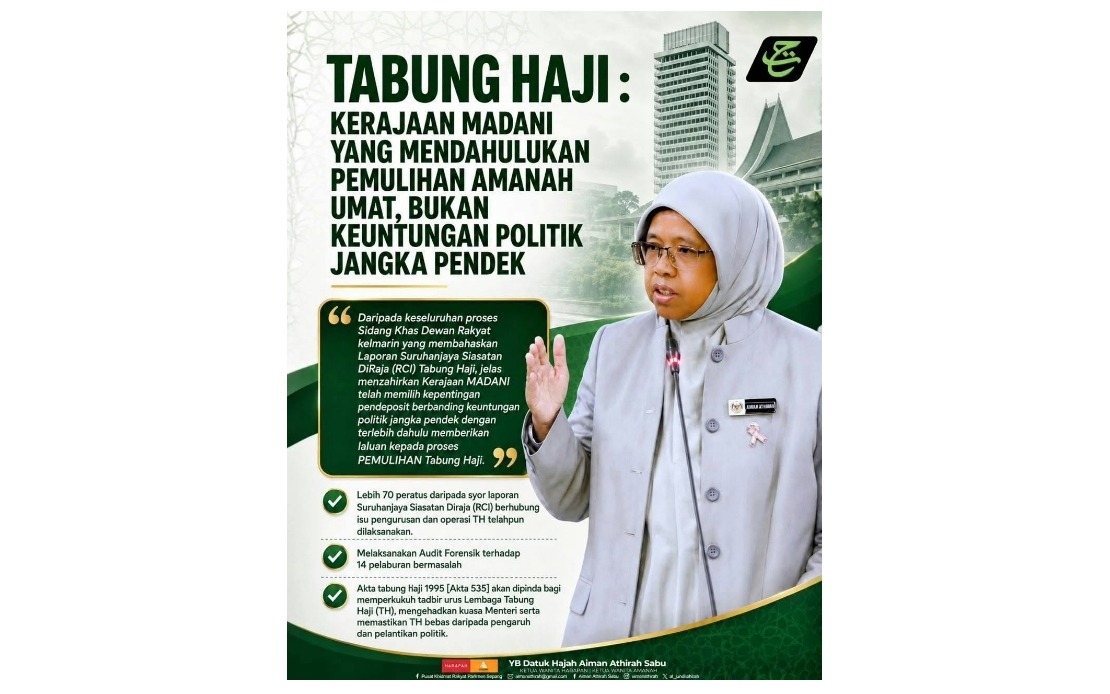
The Malaysian government has consciously chosen to balance transparency with institutional stability in its approach to releasing findings from the Tabung Haji Royal Commission of Inquiry, according to Datuk Aiman Athirah Sabu, Deputy Minister of Housing and Local Government. Speaking on August 12, Aiman Athirah argued that the measured disclosure strategy reflects a commitment to protecting the financial wellbeing of more than 10 million depositors who depend on the Islamic pilgrimage fund rather than seeking immediate political advantage from the controversial report.
The cautious handling of the RCI findings reflects hard lessons learned from 2018, when panic withdrawals totalling more than RM6 billion threatened the institution's viability following revelations of governance lapses. That episode demonstrated how hastily-disclosed information about the fund's troubles could rapidly erode public confidence and trigger a cascade of redemption requests that could have destabilised the entire financial structure. The deputy minister emphasised that Tabung Haji occupies a unique position in Malaysia's financial ecosystem, functioning not merely as an investment vehicle but as a custodian of the aspirations of millions of Muslims saving to fulfil the Hajj pilgrimage—a central obligation of Islamic faith that transcends ordinary commercial considerations.
Aiman Athirah's statement comes as certain political factions, notably Parti Islam Se-Malaysia and Parti Wawasan Negara, have publicly questioned the government's timing in releasing details of the RCI report. Rather than engaging with these criticisms through political posturing, the deputy minister contended that the government's decisions merit assessment based on factual outcomes and institutional responsibility. She pointed to a statement from His Majesty Sultan Ibrahim, King of Malaysia, recognising that the governance issues uncovered represented serious structural weaknesses rather than routine administrative oversights, thereby lending royal validation to the gravity of the inquiry's findings.
During a special sitting of the Dewan Rakyat, Minister in the Prime Minister's Department (Religious Affairs) Dr Zulkifli Hasan disclosed that implementation of recommendations from the RCI had already advanced substantially, with more than 70 per cent of proposed reforms targeting TH's management and operational frameworks having been executed. This figure underscores that the government has not merely shelved the RCI's findings but has actively worked to translate them into institutional reforms. The initiative to conduct forensic audits of 14 investments that performed poorly represents a methodical effort to comprehensively investigate where capital went wrong, identify specific decision-making failures, and prevent similar missteps in future investment strategies.
Second Finance Minister Datuk Seri Amir Hamzah Azizan provided granular detail on the scale of TH's investment debacle, revealing that nearly RM13 billion in losses accumulated from the 14 troubled investments, with seven investments producing complete losses. The government's 2018 rescue operation through Urusharta Jamaah Sdn Bhd absorbed RM10.2 billion of these losses, while TH itself absorbed an additional RM2.6 billion in impairment losses between 2018 and 2025 from investments that remain under active management. These figures contextualise the rationale behind the measured approach—releasing such stark evidence of investment failure without concurrent evidence of institutional reform and recovery could have shaken depositor confidence severely.
The government's commitment to legislative reform constitutes a cornerstone of its rehabilitation strategy for the fund. Aiman Athirah highlighted planned amendments to the Tabung Haji Act 1995 designed to fortify governance frameworks, curtail ministerial discretionary authority, and insulate the institution from political patronage pressures. These structural reforms address the root causes identified in the RCI, moving beyond superficial procedural adjustments toward systemic rebalancing of power and accountability relationships within the organisation. By coupling disclosure of governance failures with concrete legislative measures to prevent recurrence, the government attempts to demonstrate to depositors that the institution is undergoing genuine transformation rather than merely managing public relations.
Critically, the financial metrics indicate that Tabung Haji has successfully stabilised and begun generating recovery momentum. Investment income reached RM4.64 billion during 2025, representing a substantial recovery in earnings capacity. More tangibly for the millions of Muslims saving toward the Hajj, the profit distribution rate expanded from 1.25 per cent in 2018 to 3.5 per cent in 2025, translating into materially better returns for individual depositors. Simultaneously, TH has maintained the pilgrim fee at RM33,000 across three consecutive seasons despite acknowledged increases in operational expenses, demonstrating a conscious commitment to preserving accessibility of the Hajj for average Malaysian Muslims despite inflationary pressures.
These performance improvements constitute the empirical foundation for the government's argument that delaying publication of the full RCI report while implementing reforms has proven strategically sound. Had the report's detailed findings been released before meaningful governance improvements and financial stabilisation were evident, the announcement likely would have catalysed precisely the kind of large-scale withdrawal panic that the government sought to prevent. Instead, by sequencing the disclosure after demonstrating that TH's trajectory has reversed—through improved earnings, higher dividend distribution, maintained accessibility, and enhanced governance structures—the government positioned itself to deliver bad news about past failures within a framework of institutional recovery and forward momentum.
The deputy minister's criticism of certain opposition lawmakers for walking out of the special Dewan Rakyat sitting reflects the government's perspective that the RCI disclosure warrants serious legislative consideration rather than performative political theatrics. She framed the walkout as fundamentally irresponsible given the magnitude of institutional stakes and the millions of ordinary Malaysians whose financial security depends on maintaining TH's stability. This rhetorical positioning attempts to redefine the narrative surrounding the report's release from a question of political transparency into a matter of stewardship of a crucial financial institution serving the Muslim community.
The broader context of this dispute extends beyond the immediate political calculations surrounding the RCI report to encompass divergent philosophies about how government should manage crises affecting critical institutions. The government's approach prioritises sequencing transparency and reform in ways that minimise systemic risk, arguing that responsible governance sometimes demands deferring full disclosure until stabilisation measures are demonstrably working. Opposition voices counter that the public and legislators should have timely access to information about institutional failures, regardless of tactical concerns about depositor behaviour. This fundamental disagreement reflects enduring tensions in Malaysian governance between technocratic risk management and democratic accountability principles.
For Malaysian depositors and the broader financial sector, the implications of this episode extend considerably beyond Tabung Haji itself. The fund's experience illustrates both the vulnerabilities of institutions entrusted with mass savings and the fragility of confidence when governance collapses. The government's decision to invest in comprehensive reforms and forensic investigation demonstrates an acknowledgement that past failures—whether stemming from inadequate oversight, conflict of interest, excessive risk-taking, or misaligned incentives—represented genuine breaches of fiduciary responsibility. The legislative reforms now underway, limiting ministerial power and insulating TH from political appointments, mark a recognition that institutional governance structures must be recalibrated to prioritise depositor protection over political convenience, setting a template potentially applicable to other government-linked financial institutions managing public savings.

