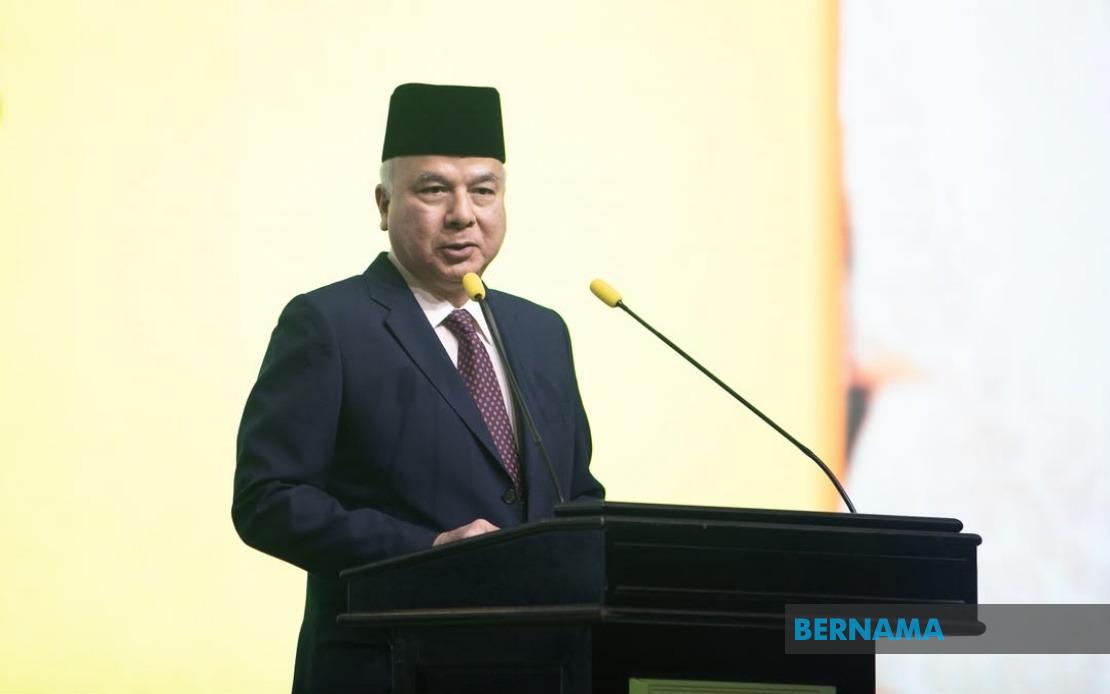
Delivering the keynote address at the 8th World Conference on Islamic Thought and Civilisation in Ipoh, Sultan Nazrin Shah, the Sultan of Perak, articulated a vision of governance that transcends material abundance. His remarks cut to the heart of persistent developmental challenges facing many nations across the Muslim world and beyond: that even societies blessed with natural wealth, skilled populations, and cultural richness will ultimately shortchange their citizens if the scaffolding of institutional strength crumbles, if those in power evade accountability, or if political life becomes corrupted by individual ambition at the expense of collective welfare.
The Sultan's conception of good governance extended far beyond abstract principle. Practically speaking, he explained, it requires the institutional architecture to survive the tenure of any single leader or administration—a safeguard against the concentration of authority that inevitably invites abuse. This institutional durability forms the backbone of systems where governance does not depend on the virtue of particular individuals but on the robustness of the checks, balances, and procedures that constrain power itself. For Malaysia and other developing democracies, where political transitions remain relatively frequent and factional disputes commonplace, such structural resilience remains urgently relevant.
Crucial to this framework is transparency in the raising and deployment of public resources. When citizens understand how their tax contributions are gathered and deployed, they develop confidence that their sacrifices serve the broader community rather than enriching a select few. This transparency breeds legitimacy—the crucial intangible asset that allows governments to command compliance and mobilise public cooperation without relying solely on coercion. In the Malaysian context, where concerns about corruption and fiscal mismanagement have periodically shaken public trust, the Sultan's emphasis on resource accountability speaks directly to contemporary anxieties.
Equally vital is the impartial application of the rule of law, a principle the Sultan stressed with particular force. When courts operate independently and the law binds all citizens equally—whether the powerful or the marginalised—the state ceases to be an instrument of faction and becomes a neutral arbiter. Yet in practice, many nations struggle with judicial capture, where wealthy and connected individuals enjoy de facto immunity while the poor face the full weight of legal sanction. The Sultan's insistence that no one, however elevated, escapes accountability while no one, however humble, is denied its protections, represents an aspirational standard that even established democracies periodically fail to meet.
A third pillar involves fostering a political culture where disagreement flourishes within institutional bounds rather than spilling into violence or constitutional rupture. The Sultan noted, with some irony, that the most politically stable nations globally are often the most argumentative—yet their disputes flow through elections, legislatures, courts, and public debate rather than through coups, street violence, or the threat of force. Political stability, in other words, does not mean the suppression of dissent; it means the channelling of dissent into legitimate pathways. The opposition operates as a constitutional check rather than an existential threat, and power transfers peacefully according to electoral outcomes. For Southeast Asia, where democratic experiments remain fragile and where political transitions occasionally threaten institutional breakdown, this framing offers both reassurance and challenge.
The Sultan identified erosion of these shared institutional rules as the true wellspring of instability. When citizens lose faith in electoral integrity, doubt judicial independence, or suspect that public office serves private interests rather than the public good, the social fabric begins to unravel. Significantly, he emphasised that the vulnerable—the poor, the marginalised, the voiceless—suffer first and most severely when such institutional decay takes hold. This observation carries particular weight in Malaysia and throughout the region, where inequality remains pronounced and where confidence in state institutions remains contested along ethnic and class lines.
Budgets, the Sultan suggested, represent moral documents as much as financial instruments, revealing with unambiguous clarity which populations a government has prioritised. A civil service that treats all citizens equitably, regardless of ethnicity, faith, or political affiliation, embodies state unity in its most tangible expression. Leaders who govern with humility, who listen before legislating, and who understand their authority as temporary stewardship rather than personal possession, cultivate the loyalty and national pride that no propaganda campaign could manufacture. In the Malaysian context, where civil service neutrality has been periodically questioned and where ethnically-coded accusations of favouritism circulate regularly, such leadership qualities acquire heightened importance.
Transitioning to questions of economic development, the Sultan rejected the notion that prosperity can be pursued in autarky. No nation, regardless of its talents or resource endowments, thrives by isolating itself from international currents of trade, investment, and technological exchange. Cooperation between governments, between the state and private sectors, and between authorities and civil society constitutes the essential operating condition for sustainable growth. Economies that marry openness to international commerce with the development of resilient, diversified domestic industries consistently outperform those retreating into protectionism or gambling their futures on a single economic sector. For Malaysia, whose prosperity historically depended on open trade and foreign investment, the Sultan's articulation of this principle reinforced orthodox economic wisdom while acknowledging the political pressures toward insularity that periodically resurface.
Yet the Sultan cautioned that cooperation must not become synonymous with dependency, nor should openness compromise a nation's capacity for self-determination. Balance emerges as the virtue: welcoming foreign capital and technical expertise while systematically building domestic institutional and human capacity. This formulation speaks to anxieties throughout Southeast Asia about whether economic integration with global markets leaves smaller nations vulnerable to external manipulation or whether it provides genuine pathways to development. The Sultan suggested that wisdom lies not in rejecting cooperation but in approaching it strategically, with deliberate attention to building indigenous capabilities rather than locking nations into permanent subordination.
A final and distinctive dimension of the Sultan's address involved Islamic finance—a sector where Malaysia has cultivated genuine international leadership through sukuk markets, takaful insurance products, and Syariah-compliant fund management. Yet the Sultan argued that Islamic finance remains dramatically underutilised as an instrument for economic cooperation. Beyond mere compliance with prohibitions on riba, Islamic finance embodies a philosophy centred on risk-sharing, asset-backing, and equitable distribution of economic gain. Were this philosophy pursued with seriousness, Islamic finance could catalyse cross-border infrastructure investment, facilitate small and medium enterprise financing across the Organisation of Islamic Cooperation, and mobilise patient capital for development challenges—from water security to renewable energy—that plague the developing world. For Malaysia, a nation claiming leadership in Islamic finance, the Sultan's remarks implied that current achievements represent merely the beginning of far more ambitious possibilities.

