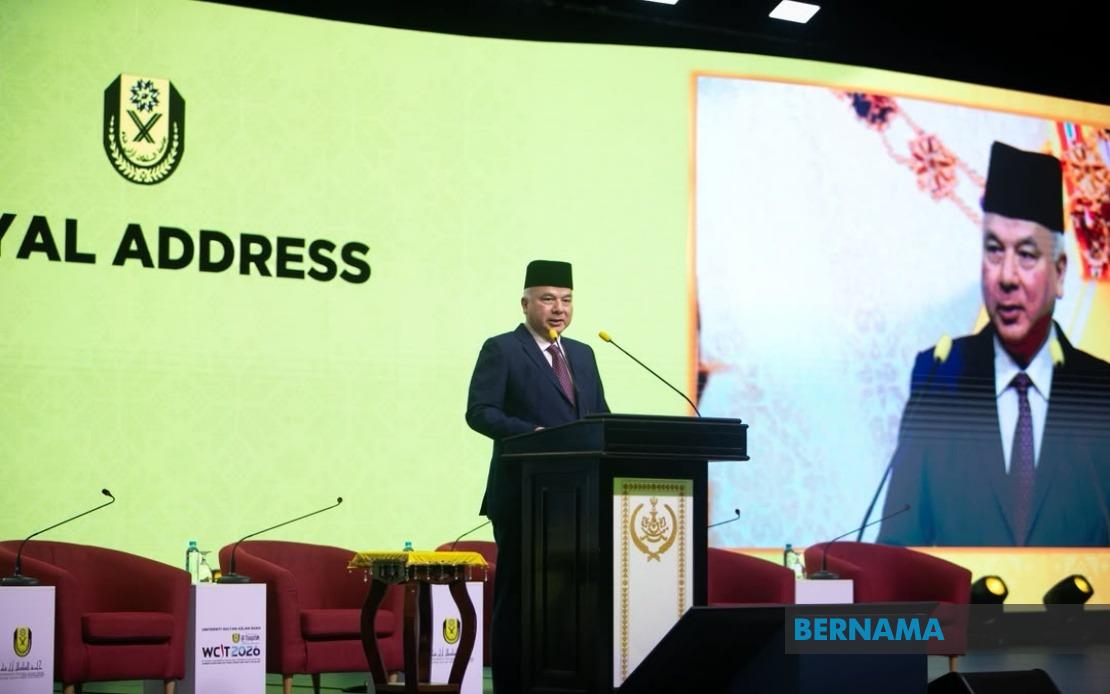
At the 8th World Conference on Islamic Thought and Civilisation in Ipoh, the Sultan of Perak, Sultan Nazrin Shah, has offered a stark rebuttal to conventional security paradigms, arguing that military capabilities and cybersecurity measures, whilst necessary, pale in importance when compared to the binding force of social cohesion within a nation. His intervention carries particular weight in Malaysia's current political environment, where tensions between different communities and competing visions of national identity remain a persistent challenge to governance and social stability.
The Sultan's thesis rests on a fundamental distinction between the appearance of security and its substance. A nation may boast formidable borders and sophisticated defence systems, yet harbour deep fissures in its social fabric that eventually undermine its very foundations. This observation directly challenges policymakers who instinctively prioritize hardware—military acquisitions, surveillance technologies, and security apparatus—over the more difficult and less quantifiable work of building inclusive societies. For Malaysia, a multi-ethnic and multi-religious federation where communal harmony has been both celebrated as a defining characteristic and frequently tested by political manipulation, this message carries urgent resonance.
A particularly significant element of Sultan Nazrin's address concerned the deliberate weaponization of religion in pursuit of narrow political interests. The Sultan cautioned against what he termed the manipulation of faith to justify division over unity, and exclusion over inclusion. This warning appears directed at domestic political actors who have historically leveraged religious sentiment to consolidate support or marginalize opponents. In the Malaysian context, where religious affairs remain deeply intertwined with electoral politics and where periodic controversies erupt over Islamic authority and practice, the Sultan's emphasis on guarding against such manipulation addresses a perennial source of social friction that transcends simple security classifications.
The Sultan articulated a vision of genuine belonging that transcends the often superficial unity promoted through state rhetoric. True national integrity, in his formulation, requires that every citizen—irrespective of ethnicity, religion, or socioeconomic background—perceives themselves as having an authentic and meaningful stake in the nation's future. This conception moves beyond mere toleration of difference towards something more robust: the conviction among all communities that they are genuinely represented in the nation's laws, economic structures, educational institutions, and leadership echelons. For Malaysia, where long-standing grievances regarding economic opportunity and political representation continue to simmer beneath official discourse, this standard presents both an ideal and an implicit critique of existing conditions.
The Sultan further developed his argument by distinguishing between two forms of unity, a distinction with profound implications for how societies maintain cohesion. Unity imposed through coercion—enforced through regulation, state power, and the suppression of dissent—is characterised as inherently brittle, prone to fracturing when pressure is applied or circumstances shift. By contrast, unity rooted in genuine shared belonging and mutual recognition of stake in collective success demonstrates the resilience necessary to weather genuine crises. This framework implicitly rejects authoritarian models of social control, suggesting instead that sustainable stability emerges from the voluntary commitment of citizens rather than their compulsion.
Regarding the institutional foundations necessary to support such cohesion, Sultan Nazrin turned his attention to education as perhaps the most critical investment a nation can make. His remarks moved beyond the conventional emphasis on school building and university expansion to address the deeper question of what education should accomplish in an era of rapid technological and social change. The Sultan advocated for a holistic educational model that neither abandons the humanities and arts in favour of narrow technical training, nor neglects the sciences and mathematics in nostalgic attachment to traditional curricula.
The Sultan's observations on vocational and technical education deserve particular attention in the Malaysian context, where persistent cultural hierarchies continue to privilege academic pathways and university credentials over skilled trades, despite sustained labour shortages in crucial sectors. His call for technical and vocational education to receive equivalent status and investment to academic pathways directly challenges these embedded assumptions, arguing that a young person choosing to become a skilled tradesperson should be valued equally with one aspiring to medicine or engineering. This egalitarian vision of educational prestige could, if implemented, begin to reshape Malaysia's labour market and reduce talent misallocation.
As artificial intelligence increasingly enters the classroom and workplace, Sultan Nazrin identified a fundamental mismatch between educational systems optimized for an industrial economy and the capacities actually required in a knowledge-intensive, AI-augmented future. The rote memorisation and standardized testing that once served economic purposes now become liabilities in a world where information retrieval is instantaneous and costless. Instead, the Sultan emphasized the critical importance of cultivating capacities—critical thinking, ethical reasoning, creativity, and adaptability—that remain distinctly human and beyond the reach of artificial intelligence, at least for the foreseeable future.
The Sultan's invocation of Islamic education as a tradition rooted in both revealed knowledge and rational inquiry adds a specifically religious and intellectual dimension to this educational agenda. By characterizing Islamic learning traditions as naturally aligned with the development of critical thinking and ethical reasoning, the Sultan positions Islamic scholarship not as an antiquated or conservative force but as a framework inherently capable of nurturing the very capacities modern economies require. This framing carries implications for contemporary debates in Malaysia surrounding Islamic education, religious instruction in schools, and the relationship between Islamic authority and scientific knowledge.
The presence of senior government figures at the conference—including Deputy Prime Minister Datuk Seri Fadillah Yusof, Perak Menteri Besar Datuk Seri Saarani Mohamad, and Higher Education Minister Datuk Seri Dr Zambry Abd Kadir—suggests official recognition of these themes' importance, even if implementation lags significantly behind rhetorical endorsement. The challenge facing Malaysian policymakers lies in translating the Sultan's philosophical framework into concrete policies that genuinely enhance inclusivity, reshape educational priorities, and counteract the political incentives that reward the exploitation of religious and ethnic divisions.
For Malaysia and the broader Islamic world, Sultan Nazrin's synthesis of security, social cohesion, and education offers a counter-narrative to both militaristic security paradigms and to extremist ideologies that weaponize religion. By positioning social cohesion as the foundation of durable security and education as the primary means of building such cohesion, the Sultan articulates an agenda that demands both ideological reorientation and sustained institutional investment. Whether Malaysia's fractious political system can sustain the unity of purpose necessary to implement such an agenda remains an open question, but the intellectual framework has been clearly articulated at the highest levels of state.

