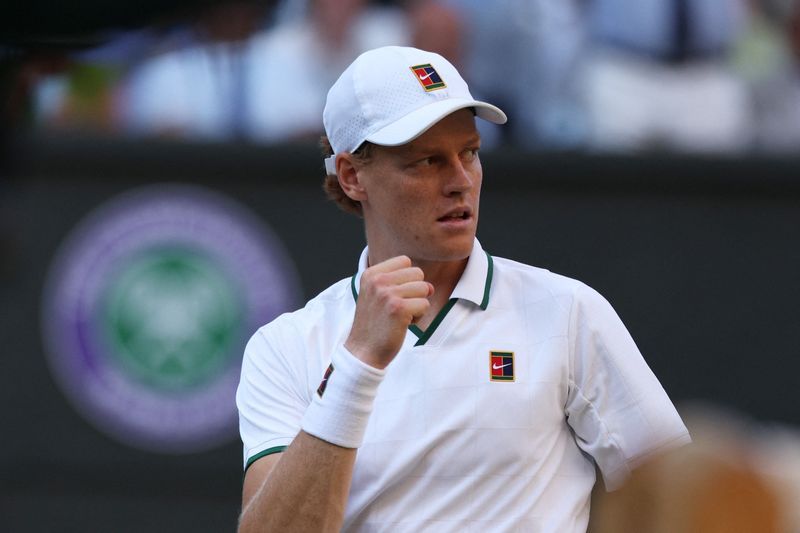
Jannik Sinner cemented his status among tennis's elite by retaining the Wimbledon title on Sunday, overcoming a stern challenge from Alexander Zverev in a four-set final that showcased both players' technical prowess and mental fortitude. The Italian's 6-7(7) 7-6(2) 6-3 6-4 victory delivered his fifth Grand Slam championship and extended a remarkable personal streak against the German to ten consecutive victories, a dominance few rivalries in modern professional tennis can match.
The achievement places Sinner in rarefied historical territory. He becomes only the tenth man in the professional era to successfully defend a Wimbledon crown, a distinction that underscores his evolution into one of the sport's most formidable competitors. At 24, Sinner is building a resume that increasingly demands comparison with his chief rival Carlos Alcaraz, though the Spaniard still holds a modest lead with seven major titles to Sinner's five. The trajectory suggests Sinner is closing that gap with each passing tournament, signalling a potential shift in the balance of power among tennis's young guard.
For Malaysian and Southeast Asian tennis enthusiasts, Sinner's consistent excellence across different surfaces and conditions offers valuable lessons in adaptability. His success at Wimbledon, traditionally viewed as a venue that rewards aggressive serve-and-volley tactics and grass-court specialists, demonstrates how modern champions transcend surface limitations through superior fitness, tactical flexibility, and psychological resilience. The implications extend to the development of emerging Asian players seeking to compete at the highest level globally.
The match itself unfolded with compelling drama across its 12 games in the opening set. Played on a warm, blustery afternoon, the first set became a prolonged contest of wills where neither player could establish meaningful separation. Zverev eventually prevailed in an intense tiebreak, displaying the powerful forehand striking that has long formed the foundation of his game. His animated celebration following that tiebreak victory suggested genuine confidence that he might finally end his frustrating run of Grand Slam final defeats.
However, the second set told a different story. While both competitors maintained their clean ball-striking, Zverev's composure deteriorated visibly as the set progressed. Sinner, meanwhile, grew increasingly animated and engaged, channelling competitive intensity into his performance. The momentum shifted decisively in the second-set tiebreak, where Sinner's superior court positioning and pressure-handling proved decisive. Levelling the match at one set apiece represented a critical juncture, transforming Sinner's defensive posture into genuine offensive ascendancy.
The pivotal moment arrived midway through the third set when Zverev brought up his maiden break point. The German's positioning on a Sinner drop shot left him fundamentally wrong-footed, causing him to slip and tumble to the turf. As Zverev writhed in pain, clutching his right knee with anguish visible across Centre Court, the momentum shifted irreversibly. Though Zverev heroically continued competing, Sinner immediately seized the opportunity by breaking serve in the subsequent game, extending his advantage to 5-3.
Zverev's frustration boiled over as Sinner pounced aggressively, with the German's racket smashing against the court in futile protest. After nearly three hours of intense battle, Sinner had claimed a 2-1 set advantage with the wind clearly at his back. The physical and psychological toll of the injury, combined with Sinner's relentless pressure, had accumulated into an insurmountable burden for the German to bear.
The fourth set became a procession of Sinner consolidation rather than genuine competition. Breaking again for a 4-3 cushion proved sufficient as Zverev's performance level dipped perceptibly. Sinner held firm through an entertaining closing stretch, demonstrating the championship mentality required to convert dominant positions into completed victories. When the final point arrived, Sinner collapsed joyfully onto the threadbare turf, physically and emotionally releasing the tension accumulated throughout the fortnight of competition.
In victory, Sinner displayed the graciousness expected of champions, while acknowledging the unique emotion that Wimbledon inspires in professional players. "There's no better place, honestly, to play tennis," he reflected while cradling the Challenge Cup. His comments about waking on Sunday morning filled with nerves, combined with recognition that future Wimbledon opportunities remain uncertain, revealed the psychological depth that separates elite performers from merely accomplished players. Sinner's respect for the tournament and its traditions, combined with his awareness of transience in professional sport, contributed to an authenticity that resonated with observers.
Zverev, despite the disappointment of a fourth Grand Slam final defeat, responded with admirable sportsmanship. While acknowledging Sinner's continued superiority with characteristic humour—"I don't really like you anymore," he jested—Zverev also demonstrated the maturity required to accept defeat against a superior opponent on the day. His observation that Sinner "showed once again why he's the best player in the world" provided grudging acknowledgement of an uncomfortable truth: the German remains fundamentally unable to crack through against a rival who has now dominated their head-to-head record with unprecedented consistency.
The broader implications for professional tennis extend beyond merely celebrating Sinner's achievement. His defensive success at Wimbledon, combined with continued progress toward Alcaraz's major championship tally, suggests the sport may be entering a period of genuine two-player dominance reminiscent of earlier rivalries. For regional players and emerging talents across Southeast Asia, observing how Sinner methodically dismantles established opponents through superior court movement, tactical intelligence, and mental toughness provides a blueprint for aspiring professionals seeking to compete at sport's highest echelons.
As Sinner consolidates his position among tennis's elite, the question increasingly becomes not whether he will surpass Alcaraz's major championship total, but when. Sunday's victory represented another substantial step along that trajectory, one that few observers believe will ultimately be halted by current opposition. For Zverev and others chasing Grand Slam supremacy, the challenge remains daunting: discovering the tactical or technical innovation required to finally overcome an opponent who has proven essentially unbeatable under the pressures of professional tennis's biggest moments.

