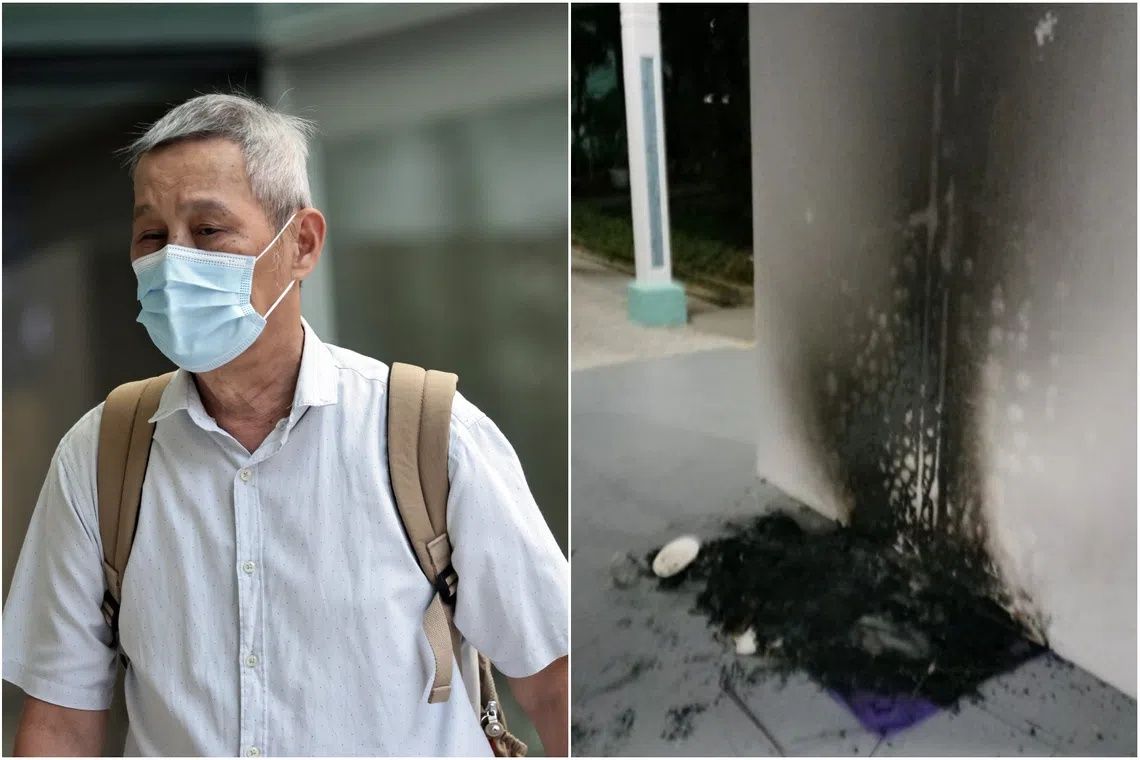
A 68-year-old retiree in Singapore has been sentenced to three months' jail for deliberately setting fire to cardboard shelters constructed for community cats near his residence in Bukit Batok East Avenue 4. Koh Teng Boo pleaded guilty to committing mischief by fire on Tuesday, following incidents that occurred between September and November 2025 and exposed the tensions that can arise when animal welfare initiatives clash with resident concerns in densely populated public housing estates.
The case originated when Koh observed cardboard structures being installed around a pavilion and void deck near his block to serve as shelter for stray cats. These enclosures were supplied with food and water to sustain the animals. Rather than accepting this community initiative, Koh became increasingly frustrated with the arrangement and began voicing objections, claiming the cat houses attracted unwanted birds and potential pests to the area. His concerns also extended to hygiene matters, particularly his observation that residents were disposing of litter inside the structures.
In an attempt to address his grievances through official channels, Koh approached his Member of Parliament to lodge a formal complaint. However, when he perceived that no concrete action was being taken to remove the cat houses, his frustration mounted. This lack of visible progress in response to his petition appears to have been a critical factor that pushed him toward taking matters into his own hands through increasingly destructive means.
The situation escalated in October 2025 when Koh first took direct action against the structures. He removed three cardboard cat houses and disposed of them by throwing them into an incense burner bin, where he ignited them. The resulting fire caused approximately S$900 in damage to the surrounding ground and walls. Rather than serving as a deterrent, the destruction seemed only to encourage replacement of the structures, as Koh noticed fresh cat houses appearing around his block shortly after his initial arson.
Undeterred by the reappearance of the shelters and apparently disheartened by his fruitless meeting with his MP on November 17, Koh resumed his campaign of destruction two days later. In the early morning hours of November 19, approximately 1.30am, Koh set fire to another cat house while returning home after consuming alcohol. He left the burning structure unattended and walked away, with the exact manner and timing of the fire's eventual extinguishment remaining unknown. The next day, emboldened by his actions of the previous evening, Koh set another cat house ablaze during daylight hours. This time, two passing members of the public noticed the flames and intervened to extinguish the fire before it could spread significantly.
Koh's arrest followed shortly after this second incident on November 20. The Jurong-Clementi-Bukit Batok Town Council subsequently determined that repairing the damage to flooring and walls near the burnt cat houses required S$913 in repairs and materials. Though the costs were substantial, Koh demonstrated a measure of responsibility by making full restitution to the town council, which likely influenced the court's sentencing decision.
Under Singapore law, committing mischief by fire with the intent to cause damage to property is a serious offense that carries potential penalties of up to seven years' imprisonment and financial fines. The three-month sentence imposed on Koh represents a relatively moderate outcome within this statutory framework, though it underscores the gravity with which the courts treat deliberate fire-raising in residential areas where public safety is at stake.
The case highlights broader challenges in managing community initiatives within public housing environments across Southeast Asia. Animal welfare concerns, while genuine and increasingly important to modern society, can generate friction when implemented in shared residential spaces without sufficient community consultation or management protocols. The void deck, a characteristic feature of Singapore's Housing and Development Board estates that is also common in Malaysian public housing schemes, serves multiple functions—recreation, informal socialising, and increasingly, sites for community animal care initiatives.
For Malaysian readers and policymakers, this incident offers instructive lessons. The tension between animal welfare advocates and residents concerned about hygiene, pest attraction, and maintenance falls within familiar territory for urban planners and local authorities across the region. The case suggests that unilateral placement of animal shelters without adequate communication, management structures, or oversight mechanisms can generate unexpected conflict and even property damage. A more cooperative approach involving town councils, residents' associations, and animal welfare organizations from inception might prevent such escalation.
Moreover, the case demonstrates that grievance channels, while important, may not always satisfy residents seeking immediate resolution of neighbourhood issues. Koh's recourse to his MP, though a legitimate democratic avenue, did not resolve his specific concerns quickly enough to prevent him from pursuing his own destructive solution. This underscores the importance of rapid response mechanisms and transparent communication from authorities when residents raise facility concerns.
The fact that Koh continued his destructive actions despite clear criminal risk and legal consequences also suggests that underlying frustration with unresponsive governance or inadequate facility management can drive individuals to act irrationally. His consumption of alcohol prior to the second incident may have further impaired his judgment regarding the consequences of his actions.

