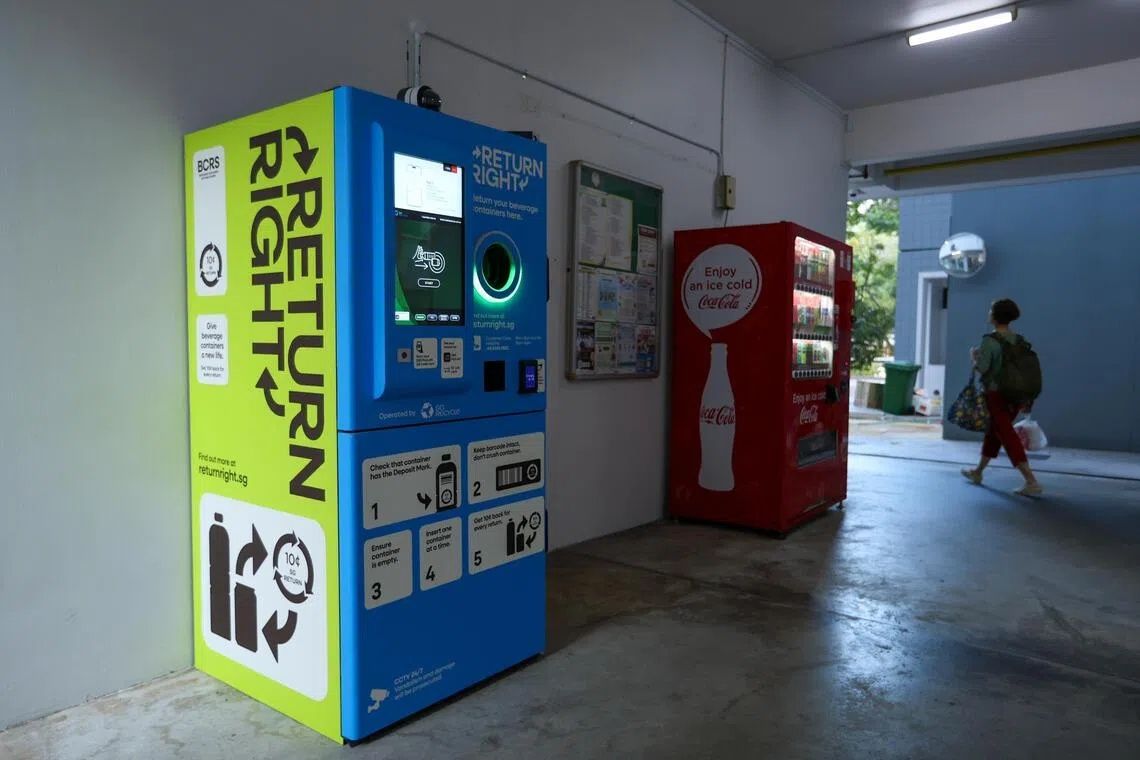
Singapore's National Environment Agency has firmly rejected online accusations of misappropriation and corruption relating to its Beverage Container Return Scheme, asserting that claims circulating on social media stem from misunderstandings about how the refund system operates. The agency released a statement on August 15 through Facebook to address what it described as misplaced allegations regarding deposit handling across the reverse vending machine network that has been processing returns since the scheme's April launch.
Confusion arose following parliamentary comments from Senior Minister of State for Sustainability and the Environment Janil Puthucheary on August 5, in which he reported that over one million successful refund transactions had been processed between April and July for approximately 5.5 million used bottles and cans. Some online commenters misinterpreted this figure as indicating that deposits from only one million containers out of the total 5.5 million had been returned to consumers, suggesting that the remaining four million containers' deposits—worth potentially hundreds of thousands of dollars—had gone unrefunded.
The NEA moved swiftly to clarify the mathematical misunderstanding, explaining that the one million figure represents the number of individual transactions conducted by consumers at the machines, not the quantity of containers that received refunds. The distinction is crucial: under the scheme's mechanics, customers can return multiple containers in a single transaction, meaning that the one million transactions collectively processed the full 5.5 million beverage containers. This means an average consumer returned 5.5 containers per visit to a machine.
With Singapore's deposit scheme charging consumers an additional 10 cents per canned or bottled beverage, the mathematical outcome becomes straightforward. The NEA calculated that approximately S$550,000 (US$429,822) has been refunded in total across all successful transactions, a figure consistent with the 5.5 million containers multiplied by the 10-cent deposit rate. The agency emphasised that no deposits have been withheld or misappropriated, and that the online accusations lack factual foundation.
The Beverage Container Return Scheme represents Singapore's approach to encouraging recycling and reducing beverage packaging waste in landfills. Launched on April 1, the system charges customers upfront but incentivises container returns by offering immediate refunds at reverse vending machines located across the island. The deposit mechanism mirrors successful programmes implemented across multiple countries and regions, though Singapore's implementation has been among the more technologically advanced, utilising automated machines rather than manual collection points.
The scheme's rollout, however, has not been entirely without friction. During its initial months of operation, various users reported technical difficulties, including machines that failed to process refunds immediately and systems that rejected legitimately returnable containers. Some frustrated consumers reported having to contact the scheme operator directly via email to recover their deposits after machines malfunctioned. These technical hiccups, while affecting a minority of transactions, generated complaints and drew scrutiny to the programme's implementation.
Responding to concerns about operational performance, Janil acknowledged in his August 5 parliamentary statement that while the vast majority of transactions and returns had proceeded successfully, a handful of isolated issues had emerged. He noted that the scheme operator worked with machine operators to address and resolve problems quickly when they occurred, suggesting a responsive approach to technical difficulties. This official acknowledgment of isolated problems, however, appears to have been misinterpreted by some online observers as evidence of systematic financial leakage.
The NEA's rebuttal underscores a broader challenge for government agencies in the digital age: online misinterpretations can rapidly generate narratives of malfeasance even when factual errors underlie the accusations. The agency's decision to respond publicly and directly through social media reflects growing recognition that agencies must engage digital spaces where public discussion occurs, rather than allowing incorrect interpretations to circulate unchallenged.
For Malaysian observers, Singapore's experience offers several relevant insights. Malaysia has been considering or piloting its own deposit return schemes in various states, and the Singaporean example demonstrates both the viability of such programmes and the importance of clear communication about scheme mechanics. The refund calculation—one million transactions for 5.5 million containers—illustrates how automated systems can process recycling at significant scale, potentially applicable to Malaysia's own environmental goals. Simultaneously, the confusion over statistics highlights how crucial transparent communication becomes when implementing new financial incentive schemes affecting millions of consumer transactions.
The scheme operator BCRS is required by regulation to submit annual financial reports to the NEA, ensuring accountability and transparency in how deposits are managed and refunds distributed. This regulatory framework aims to prevent exactly the kind of concerns that have surfaced online, and the public rebuttal demonstrates that the agency stands behind its operators' compliance with these requirements. Whether the public clarification will fully dispel online suspicions remains uncertain, but the NEA's response indicates confidence that the scheme operates as intended and all deposits are reaching eligible consumers.

