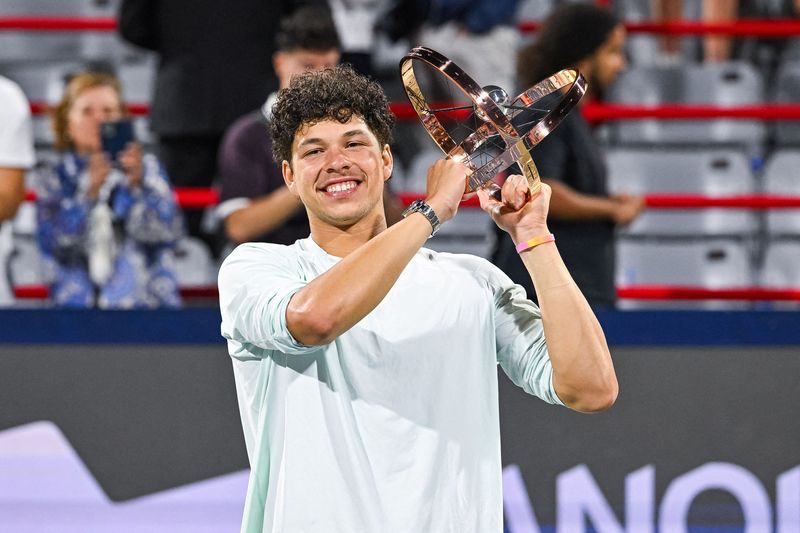
Ben Shelton arrives at the US Open as one of the tournament's most intriguing prospects, armed with the momentum from a dominant run through Montreal that has fundamentally reset his season trajectory. The 23-year-old American, currently ranked ninth in the world, captured the Canadian Open title without dropping a single set, a commanding display that stands in stark contrast to his earlier stumbles at tennis's marquee events. For Shelton, this victory represents far more than another trophy on the mantelpiece; it signals a recalibration of focus and intensity at precisely the moment when it matters most.
The year thus far has been a study in extremes for the young American, a reality he himself candidly described as a "roller coaster." While four titles underscore his undeniable talent and potential, the Grand Slam narrative has been considerably less flattering. At the Australian Open he managed only to reach the quarter-finals, a respectable showing that nonetheless left room for improvement. The French Open proved more troubling, as Shelton exited in the second round, failing to build momentum on European clay. Wimbledon brought perhaps the most stinging disappointment, an opening-round elimination on grass that raised questions about his adaptability across different surfaces and tournament conditions.
Yet Shelton's Montreal performance has provided the psychological reset that could prove transformative at Flushing Meadows. Speaking to reporters immediately after his victory over Brandon Nakashima, the American articulated a palpable shift in his approach and execution. He emphasised improvements in clinical precision, describing his court positioning as sharper and his tactical acumen as more refined. The returning game that had occasionally betrayed him reached elite levels during the Canadian Open run, while his service breaks came with increasing regularity and conviction. These are not marginal gains; they represent the difference between reaching fourth rounds and challenging for titles at major tournaments.
Shelton's ascent carries symbolic weight for American tennis that extends beyond individual performance metrics. Since Andy Roddick claimed the US Open in 2003, defeating Juan Carlos Ferrero in that final, no American man has won the singles championship at Flushing Meadows. The drought now spans more than two decades, a stark contrast to the sport's earlier American dominance. This historical context frames Shelton's journey with particular significance, transforming the upcoming tournament into something approaching a national referendum on American competitiveness in men's tennis at the elite level.
Former US Open champion Andy Roddick, speaking on his podcast "Served with Andy Roddick" in August, identified Shelton as a legitimate contender should the tournament's top seeded players falter. Roddick's assessment gained unexpected weight when Jannik Sinner, the number one-ranked Italian and one of the season's dominant forces, withdrew from the event. Spain's Carlos Alcaraz, the other member of tennis's new power trio, remains in the draw but has occasionally shown vulnerability in hard-court tournaments. These circumstances have created an opening, however narrow, for American aspirations to resurface in Flushing Meadows.
Shelton's previous US Open performance provides additional encouragement for his chances this year. In 2023, he reached the semi-finals, demonstrating both mental fortitude and the tactical sophistication required to navigate deep tournament runs. That run was not a flash of fortune but rather evidence of a player developing the consistency and strategic intelligence necessary to compete against the sport's elite operators. The question now centres on whether he has sufficiently refined his game to ascend that final rung and challenge for the title itself.
The hard-court season has served as Shelton's proving ground this year, a surface where his powerful serve and aggressive court positioning yield maximum advantage. He perceives tangible improvement with each tournament during this stretch, suggesting an upward trajectory precisely timed with the US Open's arrival. His Montreal victory, therefore, appears less as a standalone achievement and more as the culmination of progressive refinement across multiple tournaments. This measured progression contrasts sharply with the feast-or-famine mentality that plagued his earlier season.
Shelton's perspective on the sport's structure and rhythm reveals a maturity beyond his years. He acknowledges that tennis's extended calendar, while demanding, provides constant opportunities for redemption and demonstration of capability. This philosophical stance matters considerably for a player navigating the psychological challenges of inconsistent Grand Slam results. Rather than viewing disappointing early-round exits as career-defining setbacks, Shelton frames the sport's relentless schedule as offering perpetual chances to reset and showcase improvement. Such mental resilience frequently separates contenders from champions in professional tennis.
The American's confidence in his capacity to "unlock another level" of his game speaks to an athlete who views his current trajectory as merely preparatory. At 23, with four titles already secured and a semi-final Grand Slam appearance in his record, Shelton possesses both the résumé and the upside to justify such optimism. The question hovering over his US Open campaign concerns whether Montreal's excellence represents a new baseline or an anomalous peak. Tournament performance will provide the definitive answer.
For Malaysian and Southeast Asian tennis audiences, Shelton's pursuit of US Open glory carries broader implications for the sport's global competitive landscape. An American breakthrough at Flushing Meadows would reinvigorate discussions about regional tennis development and suggest that North American player development programs remain capable of producing world-class talent. Conversely, a disappointing exit would reinforce the current era's reality: that tennis's elite tier has become increasingly concentrated among European and Asian powers. Either outcome will inform how regional academies and governing bodies approach player development strategies for years to come.
The coming fortnight will determine whether Shelton's Canadian success catalyses a sustained elevation in performance or represents merely a tournament victory amid an otherwise inconsistent season. His emergence as a genuine US Open contender would symbolise something larger: the possibility of American tennis reclaiming prominence at its home Grand Slam after two decades of absence. For Shelton himself, this tournament represents perhaps the most significant opportunity of his young career to transform potential into championship reality.

