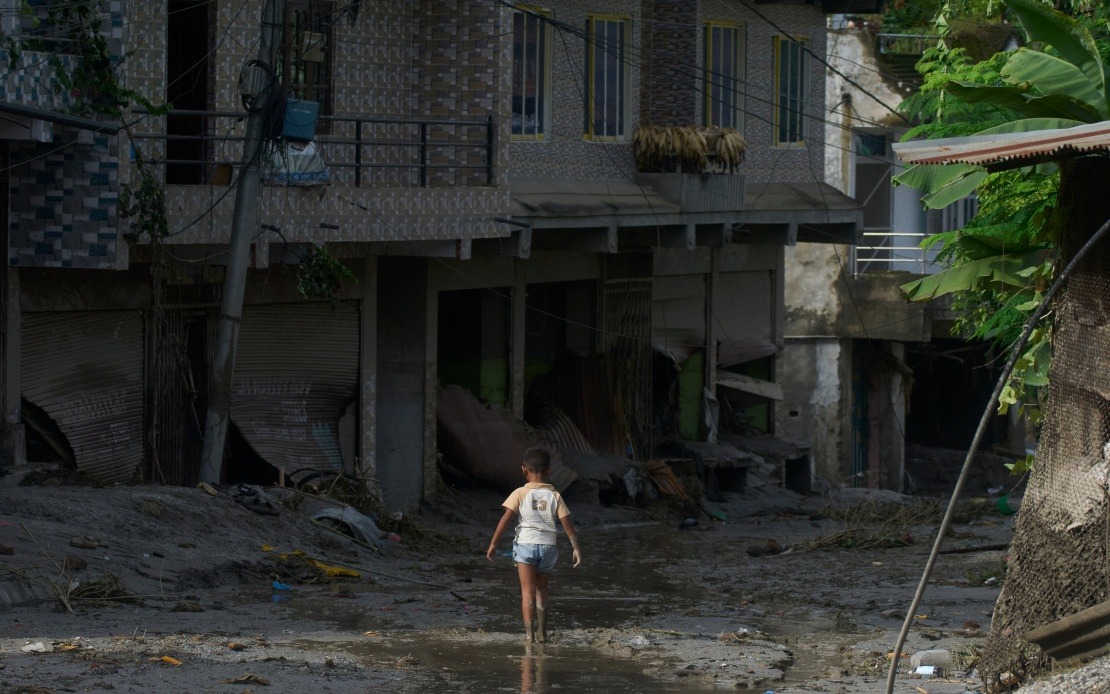
A catastrophic mudslide has struck Gyirong Port, a critical border crossing between China and Nepal in Xizang Autonomous Region, resulting in seven confirmed deaths and 554 people reported missing. The disaster unfolded on Wednesday morning when the landslide descended from the Nepalese side, engulfing the strategic port facility and surrounding areas. This incident represents a significant humanitarian crisis in one of Asia's most geographically challenging and strategically sensitive regions, where infrastructure development and cross-border commerce remain vulnerable to the region's extreme terrain and volatile weather patterns.
The scale of the missing persons toll underscores the sudden and overwhelming nature of the disaster. As of Saturday morning, rescue teams had managed to extract only two local residents alive from the debris, indicating the severe conditions confronting recovery efforts. The Xizang Autonomous Region's emergency management department coordinated the initial response, deploying resources with urgency to address both immediate rescue priorities and longer-term stabilisation needs. For Malaysian observers, the incident illustrates the infrastructure risks inherent in operating major transport hubs in seismically and hydrologically active zones—challenges not unfamiliar to Southeast Asian nations managing similar geographical complexities.
The response mobilisation has been substantial, reflecting the Chinese authorities' assessment of the disaster's gravity. Approximately 2,141 rescue workers have been stationed in the disaster zone, supplemented by 86 specialists with expertise in natural resources management and related technical fields. This combined workforce of over 2,200 personnel represents a comprehensive deployment designed to address multiple simultaneous challenges: locating survivors, recovering remains, securing the site against further collapse, and implementing preventative measures. The deployment speed and scale demonstrate the capacity that centralised emergency systems can muster, though it also highlights how vulnerable even well-resourced regions remain when confronted with major geological events.
Beyond rescue operations, authorities have prioritised geological stabilisation and hazard mitigation to prevent secondary disasters, a critical concern in mountainous border terrain where initial landslides frequently trigger cascading failures. Inspection teams equipped with specialised detection apparatus are systematically examining slopes, roadways, and other infrastructure throughout the surrounding area. This proactive geological survey identifies weak points in the landscape that might spawn additional mudslides or collapses, particularly during the monsoon season when moisture saturation destabilises slopes further. For regional analysts, such secondary disaster prevention reflects lessons learned from previous major landslides across the Himalayas and the Hindu Kush.
Particularly significant is the establishment of a dedicated five-person monitoring station focused exclusively on a barrier lake that formed as a consequence of the mudslide. Such glacial lakes and impoundments created by debris dams present acute risks of catastrophic outburst flooding if the unstable barrier should fail. The formation of Gyirong's barrier lake introduces a time-sensitive element to rescue operations, as rapidly changing water levels could render access roads impassable or trigger additional flooding downstream. This scenario carries implications for Nepal's side of the border as well, making cross-border coordination essential—an area where international cooperation frameworks sometimes prove inadequate during emergencies.
Recovery of transportation infrastructure has commenced, with authorities reporting the clearance and reopening of 1.02 kilometres of road connecting to and through the port facility. This represents a preliminary step toward restoring the border crossing's functionality, though comprehensive reconstruction will require substantially longer timeframes. Gyirong Port's importance as a trade gateway between China and Nepal makes its early restoration a priority for both governments. The port facilitates bilateral commerce, particularly trade flows moving between China's interior provinces and Nepal's markets, making extended closure economically consequential for both nations and, indirectly, for regional supply chains affecting Southeast Asia.
The disaster's occurrence during the monsoon transition period carries meteorological significance. August represents a critical month in the Himalayan weather cycle when moisture-laden air masses interact with topography to generate intense precipitation events. The mudslide's initiation from the Nepalese side suggests that the triggering mechanism likely involved heavy rainfall or rapid snowmelt, conditions that persist through early September across the region. Climate change-related intensification of precipitation extremes in the Himalayan zone raises medium-term concerns about increasing frequency and magnitude of such events, a pattern relevant to all mountain nations in Asia.
For Malaysia and other Southeast Asian nations, this incident provides pertinent reminders regarding infrastructure resilience in mountainous regions and border zones. Several ASEAN members operate critical cross-border transport facilities in challenging topography—the Thai-Lao border crossings, the Malaysia-Thailand highland passes, and various mountain routes in Myanmar all face comparable hazards. The Gyirong mudslide underscores the necessity of comprehensive geological risk assessments, robust early-warning systems, and adequate emergency response capacities for such facilities. Infrastructure developers throughout the region would benefit from examining how Chinese authorities are managing both the immediate crisis and prevention of cascading failures.
The missing persons count presents an ongoing humanitarian dimension that will unfold over coming weeks and months. Mudslide disasters in Himalayan contexts frequently result in complete burials, making recovery operations technically demanding and psychologically severe. Family members of the missing will require sustained support services, while the broader regional population will monitor developments as authorities either locate survivors or confirm fatalities. International media attention to the disaster, particularly from India and Nepal given geographical proximity, reflects the cross-border humanitarian dimensions of major mountain disasters.
Investigations into the mudslide's specific causes—whether geologically inherent instability, construction-related destabilisation, or purely weather-driven triggering—will inform longer-term risk management strategies. Gyirong Port's position at a critical juncture of Chinese, Nepalese, and Tibetan interests makes any major infrastructure disruption consequential for regional geopolitics and commerce. The incident also underscores how environmental hazards in border regions can complicate diplomatic relations, particularly when debris flows, flood waters, or atmospheric pollution cross international boundaries without regard to political boundaries.

