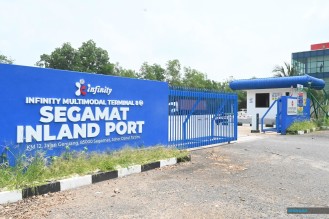
Segamat Inland Port (SIP) is setting an ambitious throughput target of over 6,000 twenty-foot equivalent units (TEUs) by December as it accelerates operations following its reactivation on June 25 after an extended period of near-complete inactivity. During its inaugural month of operations through July, the facility—operated by Infinity Logistics & Transport—processed approximately 1,000 TEUs comprising containerised cargo and bulk shipments, establishing a foundation for future expansion across a four-state industrial hinterland spanning northern Johor, southern Pahang, southern Negeri Sembilan, and Melaka.
The resurrection of this transport infrastructure represents a strategic pivot within Malaysia's broader logistics ecosystem. Transport Minister Anthony Loke Siew Fook formally inaugurated the port and framed its reopening as integral to the government's Road to Rail initiative, a policy designed to strengthen rail transport capacity in partnership with Keretapi Tanah Melayu Bhd. The timing reflects growing recognition that Malaysia's road networks—particularly in industrialised regions—face mounting pressure from freight movements, and inland rail terminals offer a complementary solution to congestion and safety concerns inherent in trucking-dependent supply chains.
According to SIP manager Samuel Ho, the facility's reactivation addresses multiple policy objectives simultaneously. Rail freight proves measurably safer than road transport, which exposes cargo movements to vehicular accidents and delays caused by traffic congestion. More striking from a sustainability standpoint, a single cargo train journey displaces approximately 80 container trucks from highways, delivering substantial reductions in diesel consumption and associated carbon emissions. These factors underscore why the government has prioritised rail terminals as nodes within a modernised national transport strategy.
For nearly a decade following its 1997 establishment, SIP languished as an underutilised asset, hamstrung by operational constraints inherent to single-track railway configurations. Under single-track systems, freight scheduling must accommodate passenger train priority, yielding only about one cargo dispatch and collection cycle per week. The completion of double-tracking infrastructure extending to Johor fundamentally transformed SIP's operational capability. The facility now accommodates up to four weekly freight movements, enabling more reliable connections with major maritime gateways including Port Klang, Port of Tanjung Pelepas, and Johor Port in Pasir Gudang. This expanded scheduling flexibility removes a critical barrier that previously deterred shippers from routing containerised cargo through the inland terminal.
The economic implications extend well beyond container volumes. Ho articulated a vision positioning SIP as a catalyst for regional industrial development, particularly across northern Johor districts such as Batu Pahat and Kluang where manufacturing and warehousing sectors remain underexploited relative to their geographic potential. By offering reliable rail-based cargo movement at competitive throughput rates, the port reduces logistics costs for facility operators and manufacturers, potentially attracting capital investment in surrounding industrial zones. The demonstration effect of operational rail logistics infrastructure frequently influences site selection decisions for multinational manufacturers evaluating Southeast Asian production locations.
Employment generation constitutes a secondary but significant outcome. The first operational phase, occupying 20.23 hectares adjacent to Segamat Railway Station, has already created over 200 jobs for local workers across security, cargo handling, and logistics functions. Project developers anticipate further employment growth as SIP advances through its planned three-phase expansion. This localized job creation targets communities in less-industrialised regions, distributing economic benefits beyond Klang Valley and Penang corridors that traditionally concentrate Malaysian logistics employment.
The projected reduction of 18,000 lorry movements monthly—encompassing both standard trucks and articulated trailers—carries substantial implications for road safety and congestion management. These vehicle movements, if sustained on public highways, generate measurable externalities including accident risks, pavement deterioration, and traffic delays affecting all road users. Shifting this cargo volume to rail networks, which operate on dedicated rights of way, insulates general traffic from freight-related congestion while reducing accident probability for freight operators themselves. For a country grappling with rising highway fatalities and urban congestion, inland port development represents a structural solution rather than a temporary palliative.
SIP's operational model incorporates knowledge-transfer components reflecting evolving best practices in Southeast Asian logistics. Management is collaborating with Universiti Tun Hussein Onn Malaysia (UTHM) to provide fieldwork exposure and conduct operational studies on rail-based inland ports. This academic engagement establishes research capacity within Malaysian institutions, developing indigenous expertise in inland port management rather than relying exclusively on imported operational knowledge. As regional competitors develop similar facilities, local technical competency becomes increasingly valuable for competitive positioning.
The facility's three-phase development structure indicates government commitment to sustained investment despite the port's historical underperformance. Phase one's success in attracting cargo and processing volumes will determine whether phases two and three materialise on projected timelines. International precedent suggests inland port viability depends critically on establishing sustainable relationships with major shipping lines and regional manufacturers, relationships that develop gradually through demonstrated reliability and cost competitiveness rather than through announcement alone.
From a regional perspective, SIP's reactivation signals Malaysia's intention to compete more assertively in logistics infrastructure development. Singapore's port dominance and regional logistics hub status partly reflects infrastructure investments and operational efficiency advantages. Thailand and Vietnam have prioritised inland terminal networks as components of broader supply chain modernisation strategies. Malaysia's rehabilitation of SIP, if executed successfully, demonstrates commitment to similar thinking and positions the country as serious about capturing freight volumes currently routed through competing regional hubs. Whether SIP achieves its 6,000 TEU target and sustains subsequent growth remains dependent on managing operational execution, maintaining competitive rate structures, and cultivating stable partnerships with maritime carriers and industrial clients across its four-state service area.

