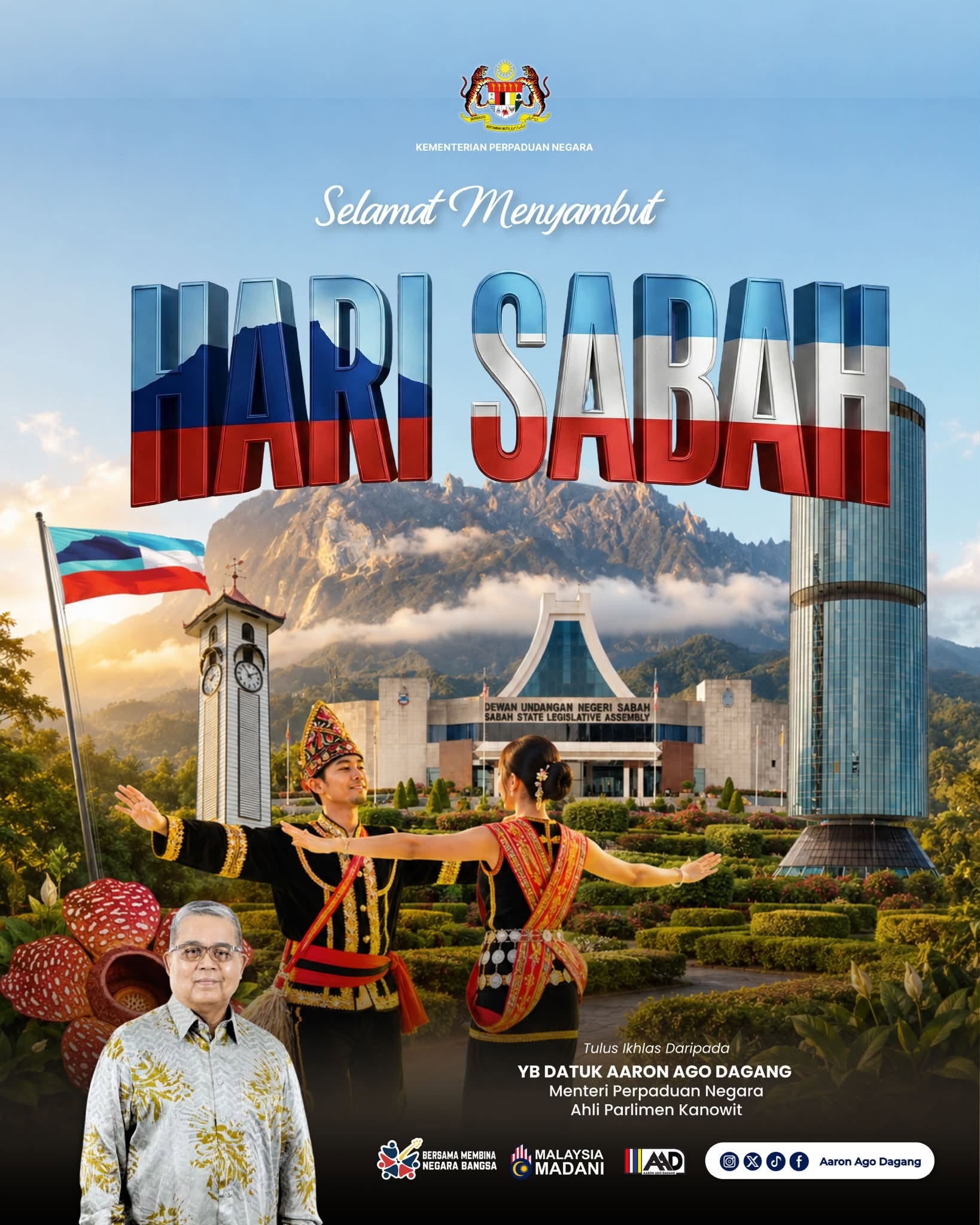
National Unity Minister Datuk Aaron Ago Dagang has offered a forceful articulation of Sabah's value to the broader Malaysian project, positioning the state's extraordinary ethnic composition not as a challenge to be managed but as a strategic asset to be celebrated and preserved. Speaking on Sabah Day, marked annually on August 31, Aaron emphasized that the state's identity rests upon a foundation of remarkable cultural pluralism that extends across dozens of distinct communities, each contributing irreplaceable elements to the tapestry of regional and national life.
Sabah's demographic landscape encompasses 35 distinct ethnic groups and 217 recognized sub-groups, a figure that underscores the profound complexity of social composition across the state. Beyond mere numbers, these communities maintain vibrant traditions spanning language, costume, musical expression, dance forms, and inherited customs that have accumulated and evolved over centuries. The Kadazan, Dusun, Bajau, Murut, Rungus, Bisaya, Lotud, and Lundayeh peoples represent only the most prominent of these communities, each bringing specialized knowledge systems, artistic practices, and social structures that collectively define what contemporary Sabah has become.
The minister's framing of this diversity carries particular significance in the contemporary Malaysian context, where questions of social cohesion and national identity remain contested terrain. Aaron's argument pivots away from viewing cultural difference as inherently divisive, instead proposing that harmony emerges precisely when communities consciously choose to understand, respect, and accept one another across lines of distinction. This perspective addresses a recurring concern in plural societies: whether diversity constitutes strength or vulnerability. The minister's position suggests that the answer depends fundamentally on the quality of interpersonal and institutional relationships rather than on objective demographic facts alone.
The historical context underpinning Sabah's contemporary status as a Malaysian state extends back through multiple epochs of governance and sovereignty. August 31 carries particular resonance because it marks the date when Sabah achieved self-governance, culminating a complex colonial period encompassing administration by the British North Borneo Company, disruption by Japanese occupation during World War II, and subsequent British rule. This historical sequence shaped institutions, legal frameworks, and collective memory in distinctive ways, producing patterns of governance and social organization that distinguish Sabah from other Malaysian states. The transition to self-governance represented a culminating moment in anti-colonial struggle and the assertion of local agency.
Fifteen days after achieving self-governance on August 31, Sabah formally joined the Federation of Malaysia on September 16, 1963, an act that simultaneously expanded the federation's territorial scope and introduced new communities into the Malaysian political project. This founding moment carries symbolic weight that extends beyond institutional mechanics; it represented the choice of Sabah's leadership to bind the state's future to a broader peninsular and Asian political order. The relatively recent integration of Sabah into Malaysia—less than a century in comparative historical terms—means that questions of loyalty, identity, and regional versus national belonging retain particular urgency and remain actively negotiated within Sabah's contemporary political discourse.
Aaron's invocation of historical sacrifice and generational responsibility signals implicit recognition that maintaining national unity requires active commitment rather than passive inheritance. He acknowledged that previous generations devoted energy, ideas, and personal sacrifice to the development of Sabah, implicitly suggesting that these contributions risk being forgotten or undervalued if contemporary citizens fail to engage meaningfully with their state's historical narrative. This rhetorical move attempts to create a sense of custodial obligation—the notion that present-day Sabahans bear responsibility for preserving and transmitting the achievements of their predecessors to future generations.
The minister articulated a forward-looking agenda positioned as complementary to historical preservation rather than opposed to it. He called upon contemporary Sabahans to advance the state through progress in education, economic development, technological adoption, and general modernization, while simultaneously maintaining vigilance concerning the protection of Sabah's distinctive history, cultural expressions, and collective identity. This dual imperative—modernize while preserving—reflects a common challenge faced by subnational communities seeking to benefit from integration into larger political and economic systems without experiencing cultural erosion or subordination to dominant groups.
The declaration of August 31 as Sabah Day by the state government in 2024 represents an institutional formalization of what had previously been observed through informal or symbolic means. The establishment of an official state day creates a recurring opportunity for the kind of public articulation and celebration that Aaron offered, establishing an annual ritual through which dominant narratives about Sabah's character and role within Malaysia can be reinforced, contested, or reframed according to contemporary political circumstances and intellectual fashions. Such commemorative occasions typically involve complex negotiations between state-sponsored narratives and grassroots community expressions of identity.
The minister's emphasis on mutual understanding as prerequisite for harmony carries implications extending beyond Sabah's borders. As Malaysia navigates questions of religious freedom, immigrant integration, and the status of indigenous communities across multiple states, Sabah's example of coexisting ethnic pluralism offers both model and cautionary tale. The relative success of interethnic accommodation in Sabah—whatever the actual extent of that success—demonstrates that Malaysian diversity need not inevitably produce conflict, though neither does it automatically generate consensus or eliminate sources of tension and competition for resources.
For Malaysian policymakers and citizens elsewhere in the federation, Aaron's statements suggest that Sabah occupies a distinctive position within Malaysia's multiethnic architecture. The state's unusually high concentration of indigenous communities and relatively recent incorporation into the Malaysian state create particular dynamics. The minister's framing implies that Sabah's experience of ethnic coexistence possesses lessons applicable to broader national challenges, particularly if one accepts his underlying premise that diversity represents strength rather than burden when managed through appropriate institutional arrangements and cultivated attitudes of mutual respect.

