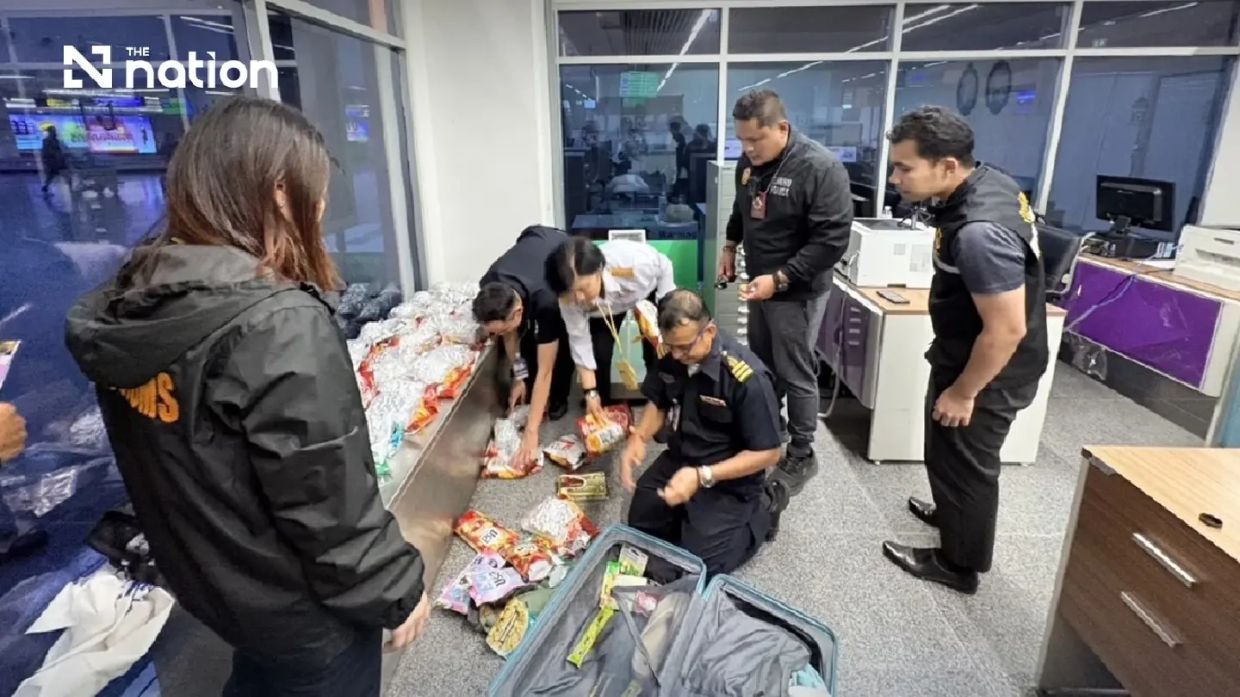
A Russian traveller has been arrested at Phuket International Airport following the discovery of a substantial quantity of cannabis in his baggage as he prepared to depart Thailand. The 30-year-old suspect, identified as Sergei Chalabari, was detained on Wednesday at the international departure terminal after customs officers uncovered the narcotic materials during a routine luggage inspection conducted by Rawin Kanokakorn and his team at Mai Khao subdistrict in Thalang district.
The confiscated drugs represented a significant narcotics haul for the airport's customs division. Officers searching two blue BP WORLD wheeled suitcases belonging to the Russian national discovered 35 vacuum-sealed packages of cannabis flowers with a combined weight of 11.4 kilogrammes. Additionally, the customs team located 12 packages of cannabis resin weighing 6.2 kilogrammes in total. The two suitcases themselves, which weighed approximately 8 kilogrammes, were also seized as physical evidence in what authorities classify as an attempted export violation.
During the initial interrogation at the airport, Chalabari acknowledged ownership of both the luggage and its entire contents without reservation. This admission by the suspect facilitated the formal charging process, with authorities moving swiftly to register charges related to attempting to export controlled substances without adhering to Thailand's customs regulations. The straightforward nature of his confession likely streamlined the preliminary investigation phases and strengthened the prosecution's position.
The interdiction reflects Thailand's multi-layered approach to combating drug trafficking through its major transportation hubs. Phuket International Airport, serving as a crucial gateway for international travel in Southeast Asia and particularly for Russian and Eastern European tourists, has become increasingly vigilant in monitoring outbound passenger baggage. The detection of such a substantial cannabis quantity underscores the effectiveness of coordinated customs operations, particularly when officers exercise thorough inspection protocols on randomly selected passengers and their belongings.
Following the airport detention, Chalabari was transferred to Sakhu Police Station where investigators assumed responsibility for advancing the legal case. The transfer protocol ensured that evidence chain integrity was maintained throughout the handover process. Police authorities, including officers from the investigation division led by Pol Lt Col Rattanawut Nukaew, received the suspect and contraband materials to proceed with formal criminal documentation and case preparation for potential prosecution.
The operation benefited from hierarchical coordination between multiple enforcement agencies. Pol Col Salan Sankhisasanakun, superintendent of Sakhu Police Station, oversaw the procedural aspects, whilst customs officials including Nucha Jeeradit, chief of the Phuket Airport Customs House, and Thanomjit Burirak directed the detection and seizure operations. This inter-agency cooperation has become standard practice at Thailand's primary airports, where customs authorities work alongside police investigation units to maximize detection and prosecution capability.
The incident highlights persistent challenges facing Thailand regarding narcotic smuggling through air terminals. Although Thailand has implemented increasingly stringent baggage screening measures and trained personnel to identify concealment techniques, individuals continue attempting to exploit departure channels. The vacuum-sealing methodology employed in this instance represents a common tactic intended to mask odours that might otherwise alert detection dogs or experienced officers. That customs personnel successfully identified and catalogued the materials demonstrates ongoing professional competency within Thailand's aviation security framework.
For Malaysian and regional observers, the arrest carries implications regarding transnational drug trafficking patterns affecting Southeast Asia. The presence of Russian nationals attempting cannabis export from Thailand suggests potential supply chain connections linking Southeast Asian production or transit operations with Eastern European markets. Such movements underscore the region's persistent role in global narcotics networks and the necessity for enhanced cooperation between ASEAN nations and international partners in monitoring suspicious traveller behaviour and identifying potential smuggling routes.
The formal charge facing Chalabari addresses the procedural violation of bypassing customs declaration requirements rather than mere possession, though Thai legal frameworks typically carry substantial penalties for attempted drug export offences. Prosecution will proceed through the Thai judicial system, likely resulting in imprisonment and additional fines if conviction is secured. The case demonstrates Thailand's determination to prosecute international travellers found violating narcotics laws, regardless of nationality.
This apprehension contributes to Thailand's wider drug enforcement narrative, particularly at critical infrastructure points where foreign nationals concentrate. Phuket's position as a premier tourist destination hosting hundreds of thousands of international arrivals annually creates both operational challenges and opportunities for law enforcement. Systematic baggage inspection protocols, intelligence sharing between security agencies, and investment in detection technologies continue generating seizures that disrupt trafficking networks and deter would-be smugglers from attempting similar operations through Thai aviation channels.

