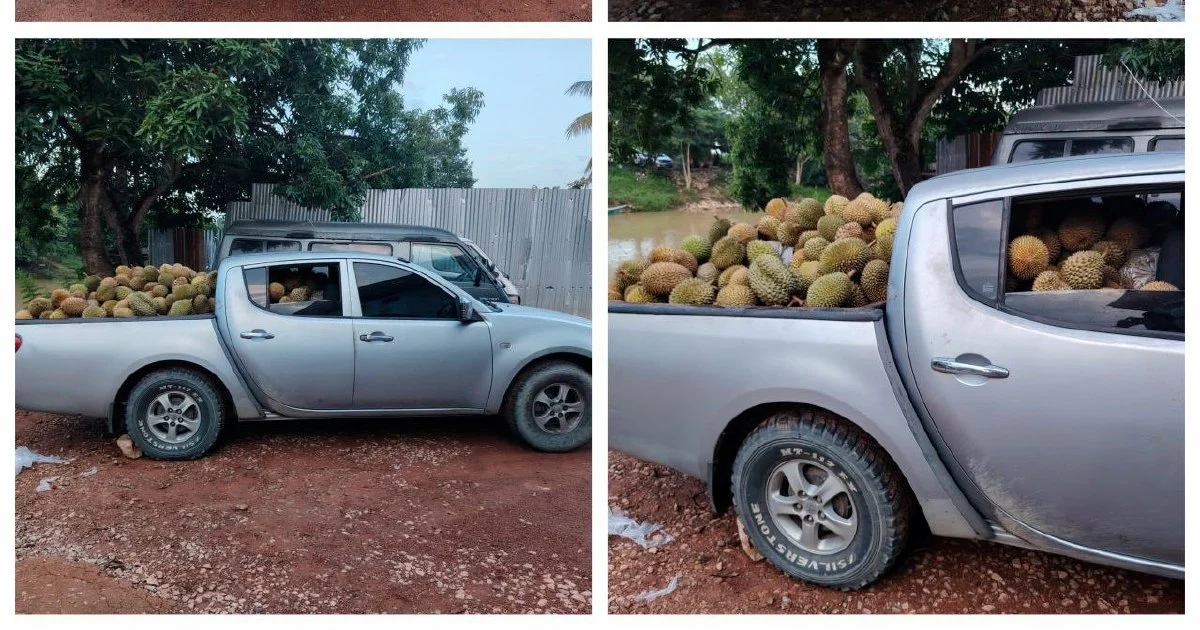
A young man's quest for modest supplementary income has ended in legal jeopardy after authorities intercepted him ferrying three-quarters of a tonne of suspected contraband durians through Rantau Panjang. The 22-year-old was operating under the impression that his part-time driving arrangement would yield a daily return of between RM60 and RM70, yet the seizure of the illicit tropical fruit cargo has transformed what appeared to be straightforward gig-economy work into a criminal liability.
The interception occurred during late-night enforcement operations at Rantau Panjang, a location strategically positioned along smuggling routes in the northern peninsula. Authorities discovered the haul of 700 kilogrammes of durians, which they suspect had originated from illicit cross-border sources. The scale of the seizure underscores the systematic nature of agricultural contraband operations, which frequently exploit casual workers and small-time transporters who may lack awareness of the serious legal implications involved.
The case exemplifies a persistent challenge across Southeast Asia's borders: the sophisticated logistics networks underpinning illegal fruit trade. Unlike high-profile drug or wildlife smuggling operations, durian trafficking often receives less attention from policy makers and the public alike. Yet the economic consequences are substantial, affecting legitimate domestic producers and creating unfair market competition when smuggled produce circumvents tariffs, quality inspections, and quarantine protocols. Malaysian durian farmers, particularly those in leading producing regions, face erosion of their competitive position when cheaper contraband fruit floods local markets.
Rantau Panjang, situated in Kelantan state near the Thai border, represents a critical pinch point for transnational trafficking in agricultural commodities. The porous nature of maritime and land boundaries in this region has long presented enforcement challenges. Traffickers exploit the difficulty of conducting comprehensive inspections at all crossing points, selecting routes and timing to maximise the probability of transit success. Young, seemingly low-risk drivers such as the detained individual are frequently recruited for these operations precisely because they attract less suspicion than seasoned smugglers.
The remuneration structure allegedly offered to this driver—RM60 to RM70 per journey—reveals the operational economics of smuggling networks. Such wages, while modest compared to legitimate commercial transport rates, represent an attractive proposition for economically vulnerable individuals seeking immediate cash returns. Organisers deliberately target workers facing financial pressure or limited employment prospects, insulating themselves from direct legal exposure while building redundancy into their supply chains through disposable labour. When arrests occur, the network sustains minimal disruption.
This particular apprehension illuminates the gap between enforcement efforts and the underlying demand drivers sustaining the trade. Consumers seeking bargain-priced durians at informal markets may unknowingly facilitate smuggling operations, whilst casual labourers attracted by quick earnings become unwitting foot soldiers in larger criminal enterprises. Neither party necessarily understands the agricultural health implications of bypassing quarantine screening, which is designed to prevent the introduction of pathogens and pests harmful to Malaysia's farming sector.
From a regional perspective, durian smuggling reflects broader patterns of agricultural trade disputes across Southeast Asia. Thailand, a major durian producer competing with Malaysia, represents both a source region and a transit point for contraband fruit destined for Malaysian and Singaporean markets. The trade friction between producing nations occasionally erupts into diplomatic tensions, particularly when quality disputes or dumping allegations surface. Individual arrests, while symbolically important for demonstrating enforcement capacity, address symptoms rather than structural economic drivers.
Authorities pursuing agricultural smuggling face resource constraints that criminals exploit routinely. Mobile enforcement operations, intelligence-sharing protocols, and technology-assisted border monitoring remain unevenly developed across the region. The arrest at Rantau Panjang likely represents a fraction of successful trafficking operations, suggesting that interdiction rates remain far below the volume of actual smuggling activity. This enforcement gap perpetuates the perception among traffickers that risks remain manageable relative to potential profits.
The incident also raises questions about worker protections and vulnerability. The arrested driver, presumed to be from a lower-income demographic willing to accept precarious gig-economy positions, had limited ability to verify the legitimacy of the employment he was undertaking. Many such workers lack formal employment contracts or clear understanding of goods being transported, rendering them particularly susceptible to exploitation and criminally liable nonetheless. Support mechanisms for vulnerable workers caught in trafficking situations remain underdeveloped across Malaysian criminal justice frameworks.
Moving forward, addressing durian smuggling requires multi-layered approaches encompassing intelligence gathering on trafficking networks, economic development programs reducing youth vulnerability to illicit recruitment, and regional cooperation agreements that establish harmonised enforcement standards. Consumer education campaigns highlighting the risks of purchasing cheap agricultural products from informal sources could reshape market incentives. Meanwhile, agricultural producers require transparent support mechanisms enabling them to compete against contraband goods without depending on enforcement alone.
The case also demonstrates that tackling cross-border criminality demands sustained coordination between Malaysian agencies and regional partners. Intelligence regarding trafficking methods, logistics chains, and recruit networks must flow continuously across borders. Thailand's authorities, as both neighbours and potential source country, represent crucial partners in dismantling operations that originate within their jurisdiction. Bilateral agreements addressing agricultural trade disputes and enforcement cooperation remain essential for meaningful progress.

