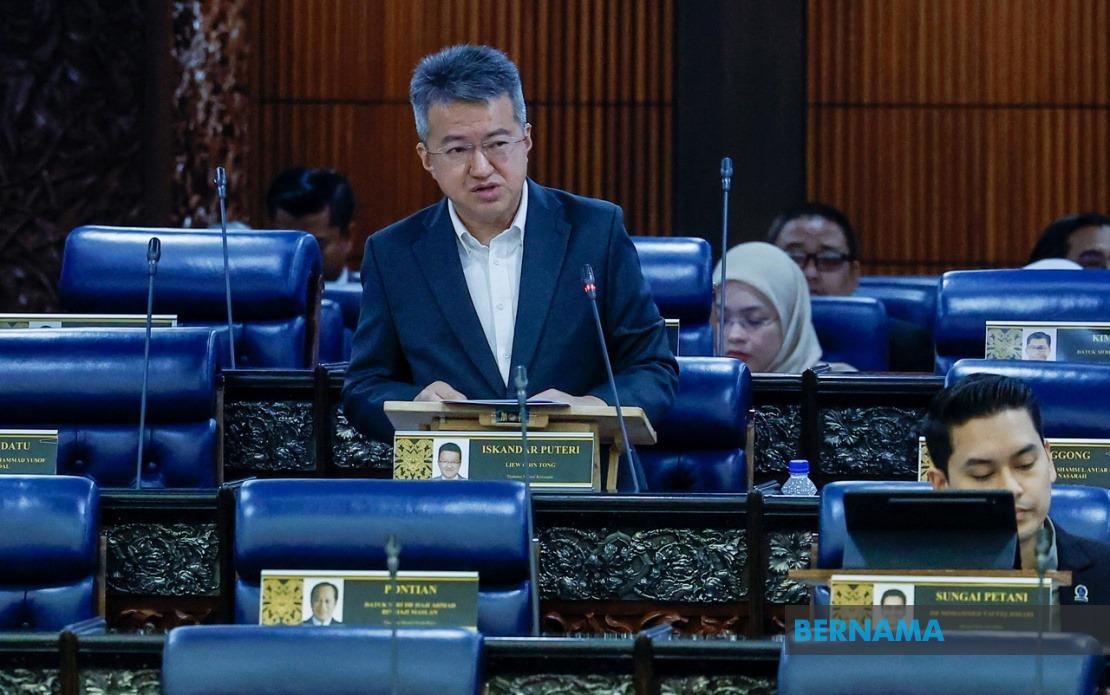
The federal government has moved to reassure Sabah that the RM1.5 billion boost to the state's interim special grant will not come at the expense of its allocations for development and operations under the current year's federal budget. Deputy Finance Minister Liew Chin Tong delivered the clarification during parliamentary proceedings on July 14, addressing longstanding concerns about how increased special grants might affect broader infrastructure investment in the state.
Prime Minister Datuk Seri Anwar Ibrahim had previously announced the special grant increase in May, a significant move reflecting ongoing federal commitments to Sabah under the country's federal structure. Liew's statement sought to dispel any notion that this additional funding represented a reallocation of resources already earmarked for development purposes, emphasizing instead that the two funding streams operate independently within the federal budget framework.
The assurance carries particular weight given Sabah's historical significance within Malaysia's federal arrangement. As one of the two Malaysian states on Borneo island alongside Sarawak, Sabah has distinctive constitutional protections regarding special grants, enshrined under Article 112C of the Federal Constitution. These provisions date back to the Malaysia Agreement and reflect the bargain struck when Sabah and Sarawak joined the federation in 1963. The debate around special grant levels thus touches on fundamental questions of inter-state equity and constitutional obligations.
Looking at concrete figures, Liew highlighted that Sabah's development allocation has risen from RM6.7 billion to RM6.9 billion this year, with funding directed toward major infrastructure initiatives. The Pan Borneo Highway project, which spans both Sabah and Sarawak, represents the most visible manifestation of federal development commitment to East Malaysia. Alongside this flagship project, federal investments continue flowing toward rural road networks, electricity infrastructure in underserved areas, and water supply systems essential for development in remote communities.
Public service expansion has also received attention, with budgets allocated toward constructing and refurbishing hospitals, clinics, and healthcare facilities across the state. Educational infrastructure forms another priority, with funds dedicated to upgrading dilapidated schools that have long constrained learning environments in rural districts. Similarly, federal contributions toward police station infrastructure improvements support law enforcement capacity, reflecting broader governance concerns across the state.
Electricity subsidies merit particular attention in understanding federal support mechanisms. Despite handing over regulatory authority for electricity supply to the Sabah state government in 2024—a significant devolution of power—the federal government has committed to maintaining subsidies that keep electricity costs manageable for ordinary Sabahans. The projected subsidy allocation for 2026 reaches RM880 million, representing a substantial ongoing commitment that protects household and business energy costs from market fluctuations.
Rural water supply has received enhanced attention, with allocations climbing from RM103.5 million in 2025 to RM143 million in the current year. This nearly 40 percent increase responds to persistent challenges in delivering clean water infrastructure to dispersed rural populations across Sabah's vast geography. For a state where many communities remain geographically isolated and lacking basic utilities, such increases carry outsized developmental significance.
Cost-of-living assistance programs administered through the Sumbangan Tunai Rahmah (STR) and Sumbangan Asas Rahmah (SARA) schemes provide direct cash support to eligible Sabahans, with combined allocations estimated at RM1.2 billion. These programs target households struggling with inflation and rising living costs, offering immediate relief that complements longer-term infrastructure investments.
The procedural dimension of special grant payments deserves scrutiny, particularly given constitutional complexities. Liew emphasized that both the federal government and Sabah state government must adhere to processes and procedures established under Article 112D of the Federal Constitution, following precedents set in 2022, 2023, and 2025. This bureaucratic precision reflects the legally contentious nature of Sabah's special grant arrangements, where disputes have occasionally escalated to court proceedings.
The federal government's position on Article 112C remains nuanced. While respecting the constitutional principle establishing special grants for Sabah, the government has filed an appeal challenging certain aspects of a Kota Kinabalu High Court ruling on the matter. This apparent contradiction—simultaneously honoring the constitutional principle while contesting judicial interpretation—reflects genuine tension between federal fiscal management and Sabah's constitutional rights. For Malaysian observers, the situation illustrates how constitutional provisions designed decades ago continue generating modern disputes requiring careful negotiation.
Future special grant mechanisms represent an area where federal and state governments envision ongoing engagement. Both parties have committed to negotiating new frameworks for determining special grant amounts going forward, working within the constitutional parameters of Articles 112C and 112D. Such negotiations carry implications extending beyond Sabah alone, as they will likely influence federal-state fiscal relationships and set precedents potentially affecting Sarawak and other states seeking greater financial autonomy.
For Southeast Asian observers, Sabah's fiscal arrangements exemplify broader regional patterns where federation member states negotiate for resources and recognition of distinctive constitutional status. Malaysia's approach—combining constitutional protections with pragmatic negotiation—contrasts with more adversarial federal-state arrangements elsewhere in the region. The emphasis on development spending continuity suggests the federal government views infrastructure investment as integral to maintaining political stability and economic development in East Malaysia, a region critical to Malaysia's broader development aspirations.

