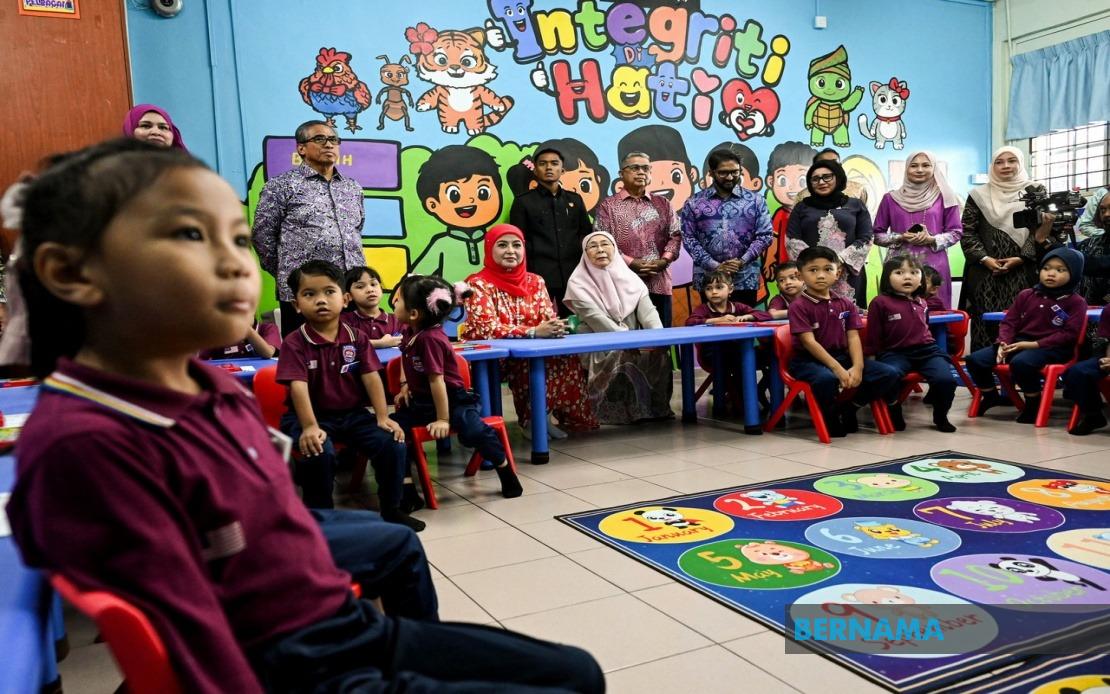
Her Majesty Raja Zarith Sofiah, Queen of Malaysia, officially inaugurated the Children's Integrity Module (MIKa) this morning at Tabika Perpaduan Taman Bukit Cheras in Kuala Lumpur, signalling the royal household's backing for a significant shift in early childhood education philosophy across the nation.
The Queen arrived at 9.45 am to receive a formal welcome from National Unity Minister Datuk Aaron Ago Dagang, Chief Secretary to the Government Tan Sri Shamsul Azri Abu Bakar—who simultaneously chairs the Malaysian Institute of Integrity (IIM)—and Bandar Tun Razak MP Datuk Seri Dr Wan Azizah Wan Ismail. The participation of these senior officials underscored the programme's importance to Malaysia's governance agenda. Following the ceremonial launch, Her Majesty proceeded to observe classroom activities firsthand, engaging directly with young learners and witnessing practical demonstrations of how the module's teaching methodology operates in real educational settings.
The MIKa curriculum represents a departure from traditional rote-learning models, focusing instead on embedding ethical principles into the formative years when children's moral foundations are being established. The module targets the two-to-six age bracket, a developmental window considered crucial for shaping attitudes towards honesty, responsibility and trustworthiness. Rather than treating integrity as an abstract concept confined to secondary or tertiary education, the programme anchors moral education in everyday interactions and play-based learning activities suitable for toddlers and kindergarten pupils.
Tan Sri Shamsul Azri explained that the Malaysian Institute of Integrity conceived MIKa as a systematic response to a fundamental premise: that integrity cannot be legislated into existence, but must be cultivated as an ingrained habit from childhood. His remarks at the launch highlighted a philosophical position increasingly common among policymakers across Southeast Asia—that preventing corruption and malpractice is more efficient than prosecuting it after the fact. By beginning this cultural shift in preschools rather than waiting for adulthood, Malaysia aims to create what he termed a "generation that is honest, trustworthy, responsible and highly principled."
The development process for MIKa drew upon considerable expertise, involving thirty-five early childhood education specialists since 2024. This investment in rigorous curriculum design distinguishes the initiative from ad-hoc moral education efforts. The module received collaborative support spanning multiple government ministries, statutory agencies, universities, and organisations working in the early childhood education sector—a coordination indicative of how seriously the government treats this expansion of the integrity framework into younger age groups.
Among Malaysian policymakers and educators, enthusiasm for such programmes reflects growing concern about societal attitudes towards ethics and accountability. The emphasis on starting integrity training at ages two to six acknowledges that parental influence remains paramount but that institutional reinforcement through quality education can amplify these messages. Teachers in participating centres will employ age-appropriate methodologies, likely incorporating storytelling, role-play, and experiential learning rather than formal instruction.
The scale of MIKa's ambitions extends well beyond the pilot phase. Tan Sri Shamsul Azri announced targets to embed the module across Malaysia's entire early childhood ecosystem by 2030, encompassing more than 31,000 childcare centres, kindergartens, and preschools. Such a rollout would constitute one of the most comprehensive integrity-focused educational initiatives in the Southeast Asian region, potentially influencing hundreds of thousands of children annually.
Implementing MIKa at this scale presents logistical challenges that should not be underestimated. Training educators to deliver the module consistently across diverse socioeconomic and geographic contexts—from urban childcare chains to rural community-based preschools—requires sustained funding, quality assurance mechanisms, and ongoing professional development. The programme's success will ultimately depend on how effectively it translates from policy statements into daily classroom practice across such a heterogeneous landscape.
The role of parents as partners in this integrity initiative deserves particular attention. Tan Sri Shamsul Azri explicitly acknowledged that schools cannot succeed in character formation without reinforcement at home, where children spend the majority of their waking hours. This recognition suggests the government recognises that MIKa must function as part of a broader ecosystem of family values, community norms, and institutional practices rather than as a standalone intervention.
For Malaysia, the timing of this initiative reflects broader governance priorities. Following years of high-profile corruption scandals and institutional reforms aimed at strengthening accountability, embedding integrity education from the earliest ages represents a long-term strategy to reshape cultural attitudes. By comparison, similar programmes in other Southeast Asian nations remain limited in scope, making Malaysia's comprehensive approach potentially influential for the region.
The Queen's presence at the launch carried symbolic weight, positioning the integrity agenda within the framework of national values and royal patronage. Such ceremonial endorsement reinforces the programme's legitimacy among education stakeholders and families, while signalling that character development deserves status comparable to academic subjects in the national education hierarchy.
As MIKa rolls out across Malaysian preschools, educators and policymakers will face ongoing questions about measurement and impact. How can integrity education outcomes be meaningfully assessed in young children? Will classroom exposure to integrity values demonstrably influence behaviour in later years? These evaluative challenges, while complex, remain critical to refining the programme and ensuring resources are deployed effectively. The next decade will reveal whether this ambitious investment in early childhood integrity education yields measurable improvements in societal attitudes and institutional ethics.

