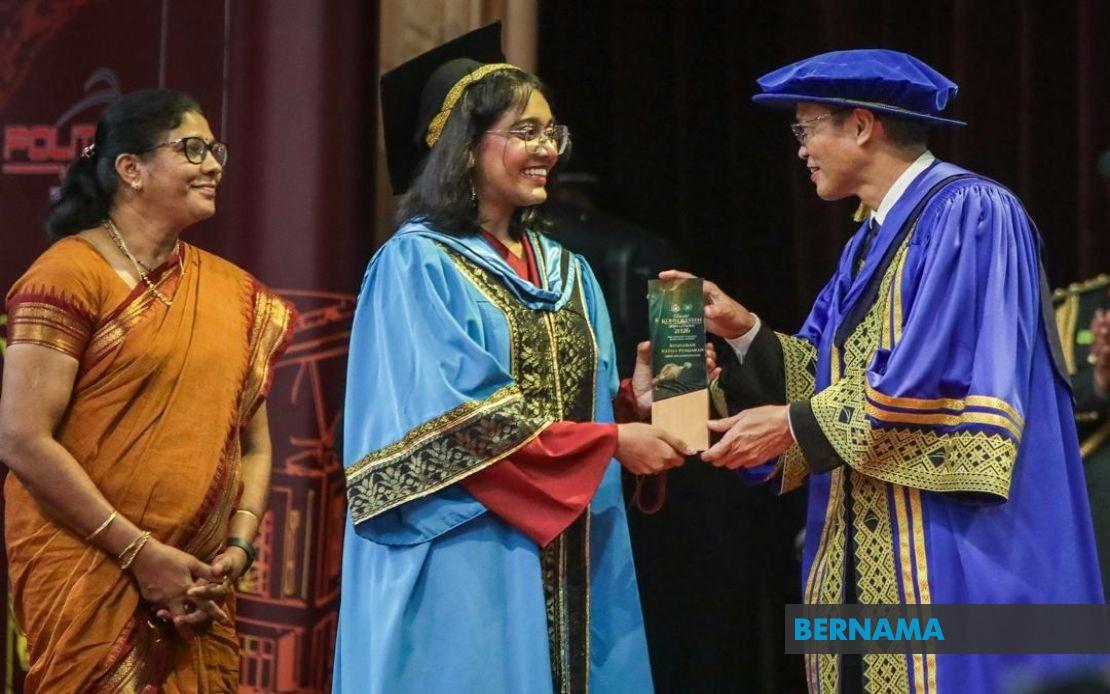
Teerti Ganapathi Rao's journey through her Diploma in Digital Technology at Politeknik Tuanku Syed Sirajuddin (PTSS) in Arau reveals the often-untold stories of Malaysian students navigating personal hardship alongside academic demands. The 22-year-old was recognised at the 2026 Northern Zone Polytechnic and Community College Convocation Ceremony with both the Director-General's Award and the Academic and Co-Curricular Excellence Award, achievements that carry profound significance given her circumstances. Her cumulative grade point average of 3.61 stands as testament not merely to academic capability, but to the psychological fortitude required to maintain focus when facing devastating personal loss.
The timing of her father's death—during her Semester Two examinations in 2023—placed Teerti at a crossroads that many students never recover from. Rather than abandon her studies, she pressed forward, drawing strength from her father's longstanding counsel to complete her diploma. This parental guidance became her psychological anchor, transforming what could have been a terminal setback into a defining moment of her educational trajectory. Speaking to reporters after the ceremony, Teerti described her initial disbelief upon learning of her selection, acknowledging that she had harboured doubts about her eligibility given the turbulent period she had endured.
Her academic recognition within PTSS's Department of Information and Communication Technology (JTMK) extended well beyond the convocation awards. Throughout her three-year programme, Teerti received the Head of Department's Award for three consecutive semesters—the first, third, and fourth—indicating consistent performance rather than isolated achievement. This pattern of excellence suggests that her initial setback did not derail her academic trajectory but instead became an isolated incident within an otherwise stellar record. For Malaysian polytechnic students facing similar circumstances, Teerti's example demonstrates that one semester of difficulty need not define an entire educational experience.
Beyond classroom performance, Teerti developed comprehensive competencies through extracurricular involvement that positioned her as a well-rounded graduate. Her participation in the Student Representative Council (MPP) afforded her direct exposure to leadership challenges, communication demands, and collaborative problem-solving—skills increasingly valued by employers across Malaysia's technology sector. She leveraged these experiences through research contributions, presenting collaborative work at Universiti Putra Indonesia alongside PTSS peers, and undertaking meaningful capstone projects that addressed real operational challenges.
Her final-year project, the Koop Printing System, exemplifies the practical orientation of PTSS's digital technology curriculum. Rather than developing abstract technical demonstrations, Teerti created a functional system designed to enhance the efficiency of cooperative printing service management—a direct response to identified workplace inefficiency. This project-based learning approach, increasingly adopted across Malaysian polytechnics, bridges the gap between classroom theory and professional practice, preparing graduates for immediate workplace contributions.
Teerti's linguistic capabilities further distinguish her profile as a candidate for advanced studies and international collaboration. Beyond Bahasa Melayu and English, she demonstrates professional proficiency in Mandarin and Tamil, while maintaining competency in Telugu—a reflection of Malaysia's multicultural fabric and her personal background. Additionally, she possesses foundational knowledge of French, Japanese, and Korean, suggesting intellectual curiosity that extends beyond mandatory curricula. In an era of globalised technology sectors and regional integration initiatives, such linguistic versatility enhances graduate marketability across Southeast Asia and beyond.
Her father's influence emerges as a central theme in understanding Teerti's achievement trajectory. As the youngest of four siblings, she recalls contemplating a foundation programme rather than pursuing her diploma—a choice that would have delayed her entry into tertiary education and potentially derailed her academic momentum. Her father's persistent encouragement to complete her diploma, maintained until his death, provided the motivational framework that enabled her to persevere through her most difficult examination period. This dynamic illustrates how parental expectations, when supportive rather than coercive, can fundamentally shape educational outcomes.
Looking forward, Teerti embodies the aspiration-driven trajectory characteristic of high-performing Malaysian polytechnic graduates. Her application to pursue a Bachelor's degree in Information Technology (IT) at Universiti Malaya—her first preference—reflects strategic ambition to progress from diploma-level credentials to university-validated qualifications. Her stated intention to eventually pursue doctoral studies signals her commitment to positioning herself within Malaysia's growing knowledge economy and potentially contributing to technology sector advancement through research and innovation.
Teerti's engagement with information technology began at age 16 through an unconventional pathway—introduced to computers and coding via video gaming communities where she connected with peers sharing similar interests. This origin story reflects how digital native Malaysians increasingly discover technical vocations not through traditional career guidance counselling but through leisure activities and peer networks. Her subsequent recognition that the field presents ongoing intellectual challenges yet becomes accessible through methodical, conceptual learning demonstrates a mature understanding of professional development applicable well beyond technology sectors.
The 2026 Northern Zone Convocation Ceremony, graced by Tuanku Syed Sirajuddin Jamalullail, the Raja of Perlis, processed 6,104 graduates from polytechnics and community colleges across Perlis, Kedah, and Penang. This scale of graduation reflects the substantial role Malaysian polytechnic institutions play in workforce development across the northern regions. Teerti's recognition within this cohort underscores PTSS's commitment to identifying and honouring students who transcend conventional measures of success by demonstrating resilience, adaptability, and perseverance alongside academic excellence.
For Malaysian educators and policymakers, Teerti's achievement offers valuable perspective on student support structures. Her story suggests that while institutional awards and academic recognition matter, the most transformative influence often emerges from personal relationships and familial encouragement. As polytechnics and community colleges expand their counselling and student support services, institutions would benefit from recognising that students facing significant personal adversity require not merely academic scaffolding but also psychosocial support that acknowledges the emotional dimensions of educational persistence during traumatic circumstances.
Teerti's trajectory from a grieving student struggling through examination periods to a decorated graduate represents the resilience embedded within Malaysian youth. As she awaits confirmation of her university placement and contemplates postgraduate prospects, her journey serves as an inspiration to other polytechnic students navigating their own intersecting personal and academic challenges, demonstrating that excellence remains achievable even when life presents devastating obstacles.

