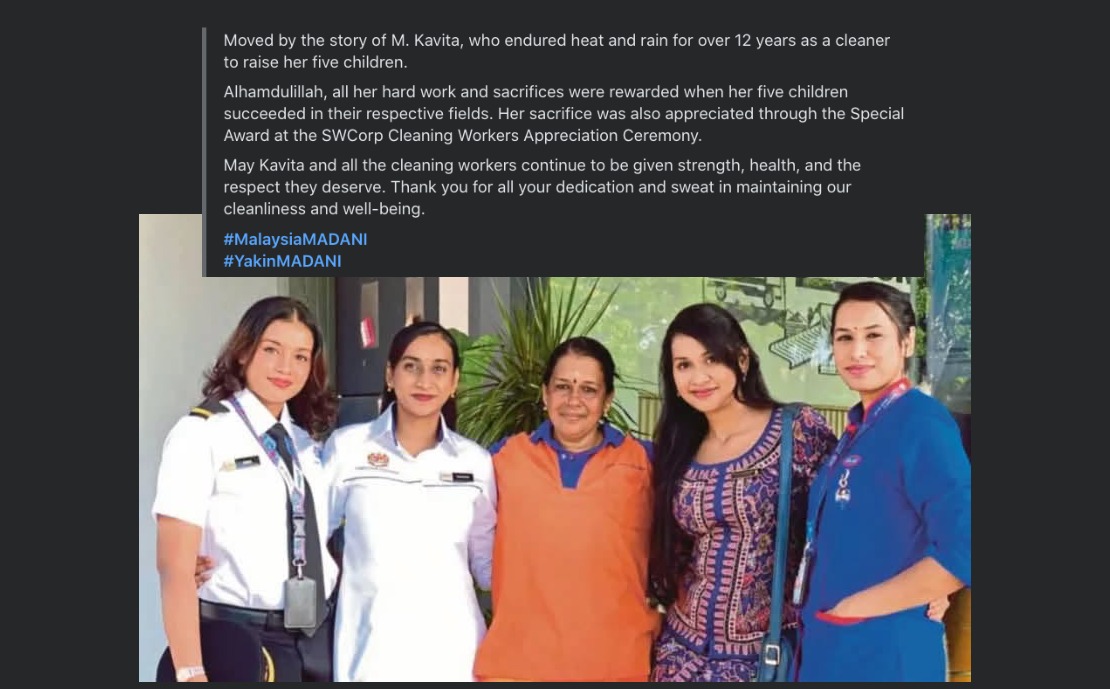
Prime Minister Datuk Seri Anwar Ibrahim has publicly commended the remarkable story of M. Kavita, a street sweeper whose relentless commitment to her family while maintaining her duties has emerged as an inspiration to the nation. In a Facebook post circulated on Monday, Anwar highlighted how Kavita's more than 12 years of unrelenting labour across varying weather conditions enabled her to nurture and support five children, all of whom have subsequently established successful careers in their respective professions.
The narrative of Kavita's perseverance resonated deeply with the Prime Minister, who emphasised that her sacrifices have yielded tangible and meaningful outcomes. Rather than viewing her occupation as a limitation to her aspirations for her children, Kavita transformed her role as a street sweeper into an opportunity to instil values of diligence and determination in her offspring. This accomplishment stands as a testament to the reality that socioeconomic circumstances need not constrain familial success or personal achievement.
Anwar's acknowledgement underscores an important societal conversation regarding the dignity and significance of essential workers who form the backbone of urban maintenance infrastructure. Street sweepers and sanitation workers typically labour in conditions that demand physical resilience and mental fortitude, yet their contributions frequently go unacknowledged in formal recognition systems. By elevating Kavita's story through his platform as Prime Minister, Anwar has directed national attention toward the often-invisible workforce that maintains public cleanliness and environmental health across Malaysian cities.
The touching narrative gained widespread momentum across social media platforms when Kavita's four daughters orchestrated a surprise celebration for her fiftieth birthday at her workplace in Seremban last month. The moment transcended typical birthday celebrations when the daughters revealed themselves dressed in their professional uniforms, representing their respective career paths. Among them were a pilot, a cabin crew member, and a staff nurse, each embodying different sectors of Malaysia's economy and professional landscape. The emotional reunion captured genuine human connection and family pride, ultimately reducing Kavita to tears of joy as she witnessed the culmination of her years of persistent effort.
This viral moment prompted SWCorp Malaysia to formally recognise Kavita's contributions to the nation through a Special Award presented during the Cleaning Workers' Day Appreciation ceremony. The recognition represents an institutional acknowledgement that extends beyond Anwar's personal commendation, signalling a broader shift toward honouring the essential service sector workers. Kavita, employed by SWM Environment in Seremban, exemplifies the qualities that sustain Malaysia's urban infrastructure and communal wellbeing.
Anwar's message specifically addressed the collective contribution of all street sweepers and sanitation workers, expressing gratitude for their dedication in maintaining clean, hygienic surroundings. He articulated that these workers deserve not merely financial compensation for their labour, but also societal respect and acknowledgement of their value. The Prime Minister's invocation of blessings for continued health, strength, and dignity reflects a humanistic approach to recognising workers across all employment tiers, acknowledging that their wellbeing directly impacts the quality of life for all Malaysians.
The timing of this recognition carries particular significance as Malaysia continues navigating post-pandemic recovery and socioeconomic restructuring. The emphasis on essential workers has gained prominence globally, yet domestically, the celebration of individuals like Kavita serves to reorient national consciousness toward the contributions of those in foundational occupations. Her story challenges conventional narratives about what constitutes professional success and validates the cumulative impact of dedication, regardless of job title or salary level.
For Southeast Asian readers, Kavita's journey reflects broader patterns within the region where families transcend economic barriers through sheer determination and investment in children's education. Her accomplishment resonates across the region, where similar narratives of working-class parents facilitating their children's upward mobility remain prevalent yet persistently underreported in mainstream discourse. The story simultaneously highlights the gender dimension of care work and sanitation labour, fields predominantly populated by women throughout Southeast Asia who manage domestic responsibilities alongside formal employment.
The Prime Minister's public endorsement carries policy implications as well, potentially influencing how government agencies and private enterprises calibrate recognition programmes for essential service workers. By positioning Kavita as worthy of national-level commendation, Anwar has implicitly signalled that street sweepers merit inclusion within broader conversations about workforce dignity and social welfare considerations. This positioning may encourage corporate and governmental initiatives to improve working conditions, compensation structures, and career progression opportunities within sanitation and cleaning sectors.
Kavita's narrative ultimately transcends her individual achievement to represent a collective acknowledgement of the often-invisible contribution that millions of Malaysian workers provide daily. Her children's professional accomplishments—spanning aviation, healthcare, and presumably other sectors—represent Malaysia's human capital development originating from unexpected quarters. The story affirms that excellence and aspiration exist across all socioeconomic strata, awaiting recognition and celebration.

