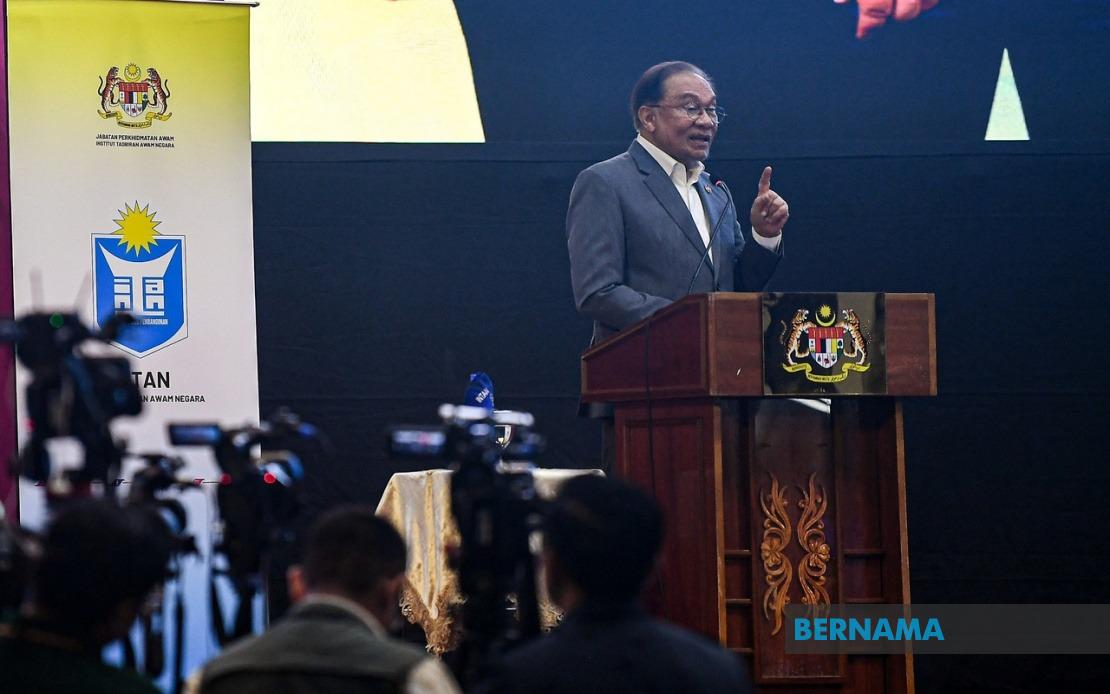
Prime Minister Datuk Seri Anwar Ibrahim has issued a pointed challenge to Malaysians, warning against the persistence of colonial-era thinking that continues to position Western systems, institutions and cultural frameworks as the gold standard for national development. Speaking at a gathering with civil servants from the Central Zone at Universiti Islam Selangor, Anwar framed the ongoing struggle against this mentality as integral to the true realisation of Malaysian independence, nearly seven decades after the nation's formal break from British colonial rule.
Anwar's remarks underscore a persistent tension within Malaysian society, where despite formal decolonisation, significant segments of the educated middle class and policymaking elite continue to orient their thinking and institutions towards Western models. The Prime Minister characterised this phenomenon as a form of psychological colonialism, wherein outward markers of independence mask an internal continued subordination to external intellectual and institutional frameworks. He emphasised that the responsibility of the post-independence generation extends beyond merely enjoying the freedoms won by their predecessors, but rather demands active construction of a distinctly Malaysian identity rooted in local values, cultural heritage and homegrown solutions to national challenges.
The Prime Minister's critique focused particularly on younger Malaysians who have never experienced colonial rule directly, yet who continue to internalise hierarchies that privilege Western knowledge systems over indigenous ones. He highlighted the paradox of individuals who maintain Malaysian citizenship and identity while simultaneously viewing their own cultural, educational and economic systems as inherently inferior to Western counterparts. This observation carries particular weight in the Malaysian context, where English-medium education remains a marker of prestige and where many elite families deliberately cultivate anglophone cultural orientations, often at the expense of proficiency in Malay or other local languages.
Anwar's concern extends across multiple domains of national life. Within education, he noted that many Malaysians continue to regard English-medium instruction as superior to instruction in Malay, despite the constitutional role of Malay as the national language. The economic sphere presents similar tensions, with Western capitalist models frequently treated as the only viable development pathway, despite Malaysia's own distinct economic history and regional context. Political and governance structures present another arena where blind adoption of Western parliamentary practices proceeds without adequate consideration of Malaysia's own constitutional traditions, federal structure, and the unique role of the constitutional monarchy in the Malaysian system.
The gathering itself reflected the Prime Minister's commitment to embedding these values within the civil service, which remains the institutional backbone of governance and policy implementation. By addressing civil servants directly alongside Chief Secretary to the Government Tan Sri Shamsul Azri Abu Bakar and Director-General of the Public Service Tan Sri Wan Ahmad Dahlan Abdul Aziz, Anwar sought to establish this philosophy as an operational principle guiding state institutions. The civil service, which inherited many structures and practices from the colonial administration, represents a crucial site where this intellectual decolonisation must occur if it is to have meaningful impact on policy and programme implementation.
The Prime Minister's argument carries significant implications for Malaysia's regional positioning in Southeast Asia. As other nations in the region navigate similar tensions between global integration and local identity assertion, Malaysia's approach to this question could set precedents for how developing democracies balance modernisation with cultural preservation. The appeal to self-reliance and indigenous frameworks also resonates with broader narratives of South-South cooperation and the assertion of Global South agency in a world order historically structured around Western dominance. For Malaysian policymakers, academics and intellectuals, Anwar's remarks constitute a call to systematically examine which borrowed institutions and practices genuinely serve national interests versus those retained merely out of habitual deference to external models.
The critique also addresses a particular vulnerability within Malaysian intellectual and policy circles, where Western credentials and frameworks often carry disproportionate weight relative to indigenous expertise. Malaysian scholars publishing in Western-dominated academic journals, Malaysian policymakers attending international forums dominated by Western institutions, and Malaysian professionals seeking validation within Western professional bodies all operate within systems that inherently privilege external over local knowledge. Anwar's challenge implicitly asks whether Malaysia has adequately invested in developing indigenous capacity for knowledge production, policy analysis and institutional innovation, or whether it remains in a position of consuming intellectual products manufactured elsewhere.
Implementing this vision presents substantial practical challenges. Malaysia's integration into global economy, education systems and communication networks means that disconnecting from Western influences entirely is neither feasible nor necessarily desirable. The question becomes not one of wholesale rejection but of conscious, critical adoption combined with simultaneous strengthening of indigenous alternatives. This requires long-term institutional investment in developing world-class Malaysian universities and research institutions, strengthening Malay as a medium for technical and scientific discourse, and creating spaces where Malaysian intellectual traditions can be recovered, reinterpreted and applied to contemporary problems.
The Prime Minister's remarks also reflect frustrations within government regarding the implementation of national policies that encounter resistance rooted in colonial-era attitudes toward authority, language and governance. Civil servants educated primarily in English may struggle with policies emphasising Malay-medium administration; policymakers oriented toward Western legal traditions may resist institutional innovations grounded in Malaysian constitutional traditions. By articulating this challenge directly to the civil service leadership, Anwar appears to be signalling that ideological realignment is a prerequisite for effective policy implementation across multiple domains of government activity.

