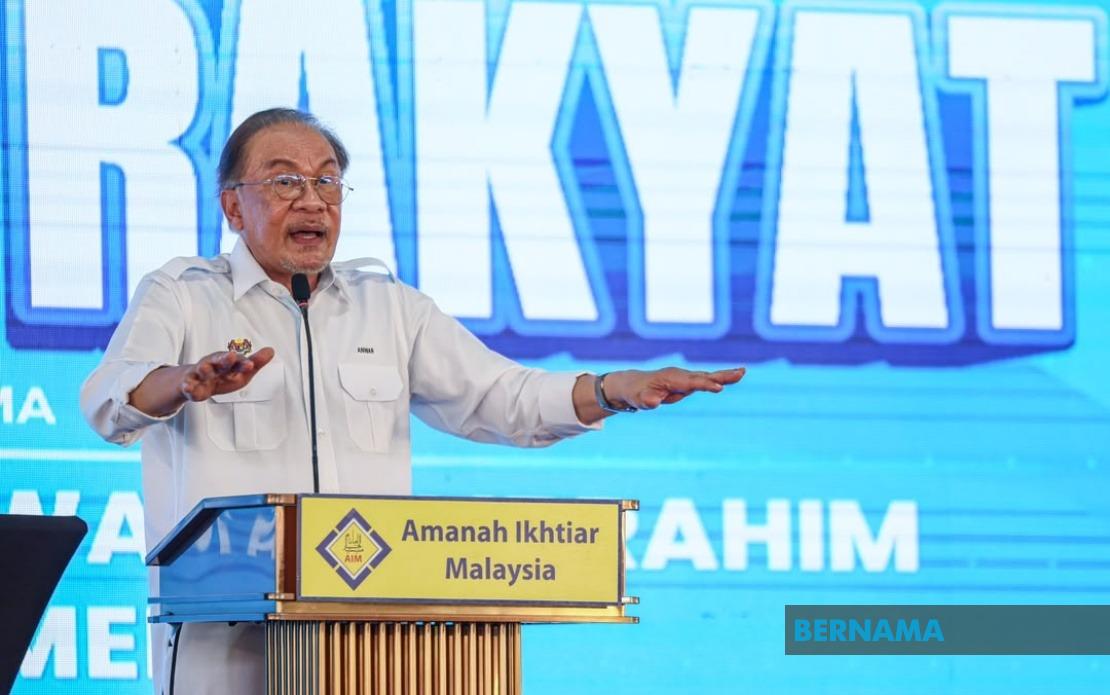
Prime Minister Datuk Seri Anwar Ibrahim has attributed mounting political pressure against his government to the success of his administration's relentless anti-corruption measures, arguing that opposition parties are coordinating their efforts specifically in response to his firm stance against graft and the misuse of public office. Speaking at a campaign rally for the Senggarang state constituency during the Johor state election campaign in Batu Pahat, Anwar suggested that the convergence of various political forces against his government reflects anxiety among those with vested interests in the status quo. His characterisation of the opposition alliance as a reaction to integrity enforcement represents a significant rhetorical framing of contemporary Malaysian politics, positioning his administration's anti-corruption agenda as the defining point of contention.
The Prime Minister emphasised that the MADANI Government maintains an uncompromising posture towards individuals who embezzle public funds or exploit their positions for personal enrichment. This principled stance, he argued, has generated discomfort among certain political quarters who either harbour their own governance vulnerabilities or fear electoral consequences from voters increasingly concerned with institutional accountability. Anwar's assertion underscores a fundamental tension in Malaysian politics: the degree to which anti-corruption drives reshape coalition dynamics and electoral calculations. By framing opposition activity as a defensive response to his administration's integrity measures, Anwar positioned himself as the champion of institutional reform, a narrative that carries significant weight among voters fatigued by historical corruption scandals.
Anwar has consistently maintained that neither he nor his administration has exploited their positions for personal material gain. Despite numerous official visits to Johor throughout his tenure as Prime Minister, he stated unequivocally that he has neither acquired land, secured commercial projects, nor obtained shareholdings in the state. This declaration serves multiple purposes: it establishes a personal brand of integrity that contrasts with historical patterns of elite self-enrichment in Malaysian politics, and it creates a benchmark against which other leaders can be measured. For Malaysian voters increasingly sceptical of leadership claims, such specific denials carry weight precisely because they are falsifiable—voters and investigative journalists can verify whether such assertions withstand scrutiny. Anwar's emphasis on his own conduct reflects understanding that anti-corruption messaging requires demonstrable personal alignment with stated principles.
The Prime Minister appealed to Johor voters to grant Pakatan Harapan the opportunity to govern the state, framing state-level political alignment with federal leadership as essential for effective policy implementation. This argument reflects a pragmatic recognition that development projects and welfare programmes function most efficiently when state and federal governments operate within the same political framework, reducing bureaucratic friction and enabling coordinated resource allocation. In the Malaysian context, where federal-state relations have historically generated significant tensions and opportunities for obstructionism, Anwar's emphasis on alignment carries particular resonance. The proposal essentially asks voters to consider not merely local governance competence but the broader ecosystem of intergovernmental cooperation that affects service delivery and public welfare.
While acknowledging Johor's receipt of multi-billion ringgit development investments, Anwar highlighted persistent gaps between aggregate resource inflows and household-level material welfare. The observation that billions in development spending coexist with unaffordable housing and inadequate infrastructure reflects a critical limitation of conventional development metrics. Many Johor residents experience infrastructure projects and investment announcements as abstract statistics bearing little relationship to their lived experience of housing insecurity, transportation challenges, and unequal access to religious facilities and social services. Anwar's acknowledgment of this disconnect implicitly critiques development models that prioritise headline-grabbing megaprojects over the granular infrastructure needs that directly shape daily quality of life. His assertion that Johor's prosperity should translate into broad-based material improvement rather than concentrated wealth accumulation represents a challenge to incumbent state governance.
A significant dimension of Anwar's remarks involved defending Pakatan Harapan's partnership with the Democratic Action Party, a coalition arrangement that remains contentious among voters concerned about communal representation and Islamic governance priorities. Anwar stated unequivocally that throughout his three-and-a-half years as Prime Minister, DAP cabinet ministers have never obstructed programmes benefiting Malays or Islam. This claim addresses a persistent anxiety in Malaysian electoral discourse: that non-Malay, non-Muslim coalition partners might translate governmental participation into pressure to deprioritise or dilute policies aligned with Malay-Muslim interests. By offering his record as empirical evidence, Anwar attempted to reframe the coalition partnership as compatible with rather than corrosive to communal interests. The specificity of his assertion—that he could provide documentation of DAP's voting record on such matters—reflects awareness that such concerns require concrete demonstration rather than rhetorical dismissal.
Anwar's observation about the exceptional enthusiasm demonstrated by PH supporters in Senggarang, particularly their willingness to wait through extreme heat for his campaign appearance, carries implications for electoral momentum and grassroots engagement. In Malaysian electoral contexts, turnout and demonstration of volunteer enthusiasm often correlate with voter mobilisation capacity and campaign morale. Anwar's emphasis on this phenomenon, while possibly reflecting genuine observation, also serves a rhetorical function: it suggests that popular sentiment runs in his favour and that opposition efforts to undermine his government work against genuine democratic preference. The willingness to endure physical discomfort for political participation indicates emotional investment in electoral outcomes that transcends routine voting behaviour. This observation, whether presented as empirical fact or campaign narrative, contributes to framing the upcoming Johor election as a contest between incumbent momentum and opposition coordination.
The Johor state election, scheduled for July 11 with early voting on July 7, has attracted 172 candidates contesting 56 state seats, representing a significantly competitive electoral environment. The concentration of political activity in Johor reflects the state's demographic and economic significance within Malaysia: with one of the largest state populations and substantial economic activity, Johor elections carry implications extending beyond state boundaries. Electoral outcomes in Johor influence both national political calculations and the confidence of coalition partners regarding their electoral viability. Anwar's campaign presence across multiple Johor constituencies indicates federal leadership's direct engagement with state-level electoral contests, a pattern that reflects the integrated nature of Malaysian federalism where state and national politics prove increasingly inseparable.
The broader political context surrounding Anwar's anti-corruption messaging involves consideration of which political forces he specifically referenced in his allusions to coordinating opposition parties. Malaysian politics encompasses multiple established coalition blocs as well as diverse single-party formations, each with distinct ideological positioning and grassroots support networks. The term "certain political parties joining forces" encompasses sufficient ambiguity to encompass Barisan Nasional components, Perikatan Nasional formations, and potentially smaller splinter movements. This ambiguity reflects either deliberate vagueness designed to maintain maximum coalition flexibility or genuine uncertainty about opposition coordination specifics. The specific identification of opposition parties would require Anwar to articulate which groups he views as primarily motivated by anti-corruption enforcement anxiety rather than other policy disagreements or electoral competition.
An analytical dimension frequently underemphasised in Malaysian political coverage involves the question of whether anti-corruption enforcement genuinely drives opposition coordination or whether coalition competition follows conventional electoral logic independent of corruption concerns. Historical evidence suggests that Malaysian political coalitions form primarily around power contestation, communal representation, and resource distribution rather than exclusively around governance ethics. While anti-corruption messaging has achieved unprecedented political salience in recent years, particularly following the 1Malaysia Development Berhad scandal and subsequent institutional reforms, opposition parties may coordinate against incumbents for conventional reasons rather than specifically in response to integrity enforcement. Anwar's framing of opposition activity exclusively through the lens of anti-corruption anxiety potentially obscures other legitimate grounds for coalition competition.
For Malaysian observers and Southeast Asian regional analysts tracking institutional development, Anwar's emphasis on anti-corruption enforcement represents a significant evolution in how Malaysian political leadership frames governmental legitimacy. Rather than emphasising development infrastructure, communal advancement, or traditional patronage networks, Anwar positions institutional integrity as the defining governmental achievement and distinguishing feature. This rhetorical shift, whether reflecting genuine commitment or strategic messaging, indicates recognition that Malaysian voters increasingly prioritise accountability and transparency in leadership evaluation. The degree to which Anwar's government delivers measurable corruption reduction and institutional reform will substantially determine whether his current anti-corruption narrative achieves lasting political significance or remains primarily a campaign positioning tool. The Johor election results will provide preliminary indication of whether this framing resonates with voters sufficiently to generate electoral advantage.

