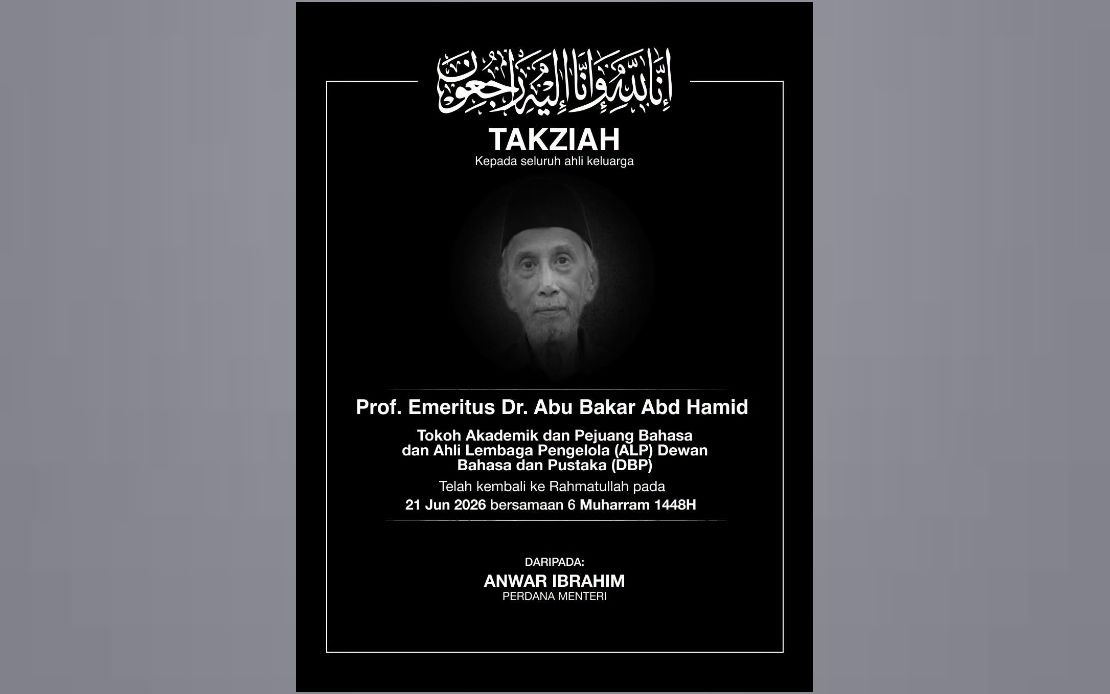
Prime Minister Datuk Seri Anwar Ibrahim has expressed deep sorrow following the death of Professor Emeritus Datuk Abu Bakar Abd Hamid, one of Malaysia's most influential literary scholars and academics. The prominent intellectual passed away on June 21 at his home in Petaling Jaya, Selangor, after experiencing sudden breathing difficulties. He was 93. Anwar's tribute, shared on Facebook, underscored the profound impact Abu Bakar had on Malaysian intellectual life and his own formative years as a student.
Abu Bakar's contributions to Malaysian letters and higher education spanned more than half a century, establishing him as a cornerstone figure in the nation's cultural and academic development. His work helped define and elevate Malay literary discourse during pivotal decades when the country was nation-building and establishing its intellectual foundations. Beyond his scholarly endeavors, Abu Bakar served as a bridge between generations of students and practitioners of Malay language and literature, fostering a tradition of rigorous academic enquiry that continues to influence Malaysian universities today.
The late academic's most visible institutional achievement was his instrumental role in the establishment of Universiti Kebangsaan Malaysia (UKM). In 1968, Abu Bakar served as joint secretary of the committee tasked with founding what would become one of Malaysia's premier higher learning institutions. UKM subsequently evolved into a world-class research university with particular strength in Malay studies, a legacy directly shaped by visionaries like Abu Bakar who understood the importance of preserving and advancing indigenous knowledge systems alongside international academic standards.
At Universiti Malaya (UM), Abu Bakar held the position of deputy vice-chancellor in 1987, a role that placed him at the forefront of strategic decision-making during a transformative period for Malaysian higher education. His tenure coincided with the expansion and modernization of UM's facilities and academic programs. His leadership reflected a commitment to academic excellence tempered with deep concern for the welfare of students and the preservation of Malaysian cultural values within increasingly globalized institutions.
Prior to his university roles, Abu Bakar's scholarly contributions had already earned him recognition across Malaysia's intellectual circles. He received numerous prestigious awards throughout his lifetime, a testament to the breadth and depth of his influence on Malay literature and language studies. These accolades reflected not merely academic achievement but recognition of his role in shaping how Malaysia understood and valued its own literary traditions during periods when such work was sometimes overshadowed by emphasis on scientific and technical education.
From 1996 to 2000, Abu Bakar served as chairman of the Board of Governors of Bernama, the Malaysian National News Agency. This appointment positioned him at the intersection of literature, journalism, and national communication policy. His leadership of Bernama's governance during these formative years of rapid media transformation influenced how the nation's principal news agency evolved, reflecting his broader commitment to elevating standards of intellectual rigor and cultural awareness across multiple sectors.
Anwar's personal connection to Abu Bakar as a former student adds emotional resonance to his tribute. The Prime Minister recalled not only Abu Bakar's formal teaching role but his character as an educator who embodied a passion for knowledge that extended far beyond classroom instruction. This portrait of Abu Bakar as someone who inspired through intellectual enthusiasm and personal example reflects a pedagogical approach increasingly rare in contemporary academia, where efficiency often takes precedence over mentorship.
In his Facebook message, Anwar emphasized that Abu Bakar was cherished not merely as a professor dispensing information, but as a living embodiment of scholarly values and intellectual integrity. The Prime Minister's reference to Abu Bakar's profound love of knowledge suggests a mentor whose influence transcended his specific field, shaping how entire cohorts of students approached learning and intellectual responsibility. Such figures, once they pass, leave behind not just published works but generations of scholars and leaders who carry forward the philosophical orientation they transmitted through their teaching.
Abu Bakar's death represents a significant loss for Malaysia's literary community at a moment when discussions about the future of Malay language and literature increasingly compete with globalization pressures and English-language dominance in education. The passing of scholars of his stature, who built institutions and mentored generations, reminds the country of the need to invest in preserving and advancing indigenous intellectual traditions. His legacy encompasses both tangible institutional achievements and the less visible but equally important work of cultural transmission through dedicated teaching.
The scholar was buried at Bukit Kiara Muslim Cemetery on June 24, following Islamic funeral rites. His contributions to Malaysian society extend beyond his published works and institutional roles; they are embedded in the careers and intellectual formations of countless students and colleagues influenced by his example. As Malaysia continues to navigate questions about cultural identity, national education priorities, and the balance between globalization and the preservation of local knowledge systems, the work and legacy of figures like Abu Bakar Abd Hamid remain powerfully relevant and worthy of reflection.