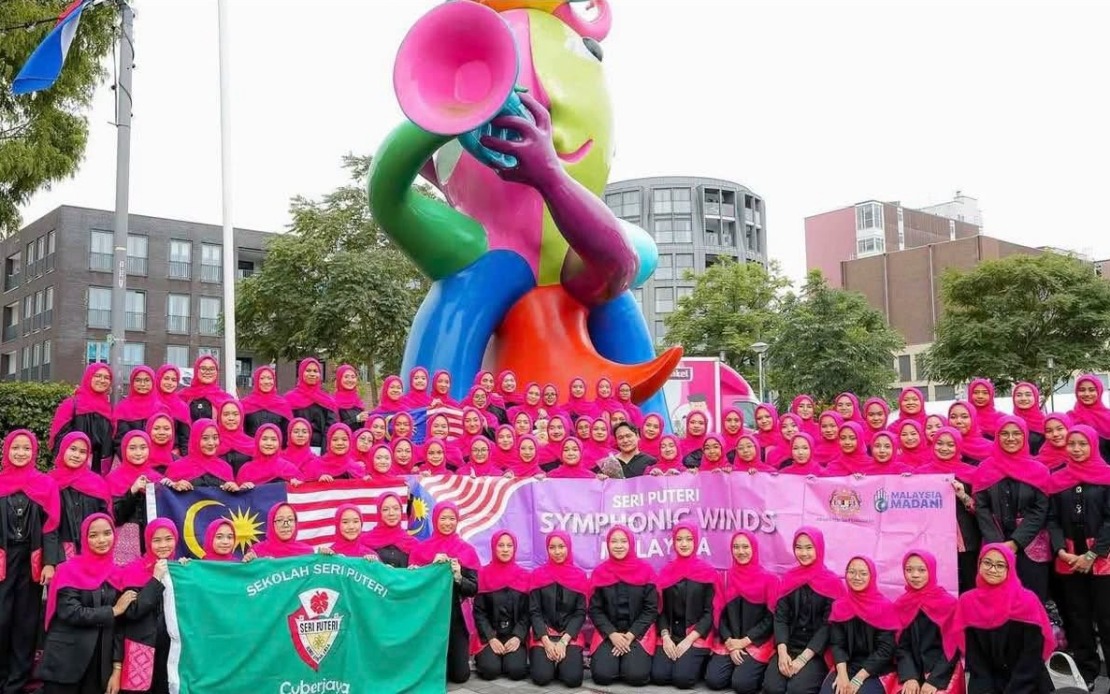
Prime Minister Datuk Seri Anwar Ibrahim has lauded the Seri Puteri Symphonic Winds Orchestra for their exceptional performance at an international music competition, where the ensemble clinched the Gold With Distinction award in the Youth Wind Band category at the World Music Contest held in the Netherlands. The recognition represents a significant achievement for Malaysia's youth arts community and underscores the calibre of musical talent being cultivated within the country's education system.
In his public acknowledgment shared via social media, Anwar emphasised the broader significance of the orchestra's accomplishment, framing it not merely as a personal or institutional success but as a source of national inspiration. He expressed confidence that the award would galvanise Malaysians across all sectors to pursue their endeavours with sustained commitment, disciplined approach, and resolute determination. The Prime Minister's comments reflect a government perspective that champions excellence in the arts as integral to national development and cultural standing.
Anwar's congratulatory message carried an implicit call for continued achievement, encouraging the orchestra to build upon this international validation with even more ambitious goals. Such public endorsements from the highest political office signal the government's investment in recognising and nurturing creative excellence among young Malaysians. The symbolic value of a Prime Minister's acknowledgment often extends beyond the immediate recipients, sending a message to educational institutions and parents about the importance of supporting arts education alongside traditional academic pursuits.
The Seri Puteri Symphonic Winds Orchestra, based at Sekolah Seri Puteri, has demonstrated remarkable consistency in competing at elite international platforms. This latest World Music Contest victory comes approximately a year after the ensemble secured a Gold Award at the 11th World Orchestra Festival held in Vienna, Austria, during late July last year. The back-to-back international successes suggest a well-established training infrastructure and a commitment to artistic excellence that extends beyond domestic recognition.
Government financial backing has provided tangible support for the orchestra's development. In April of this year, Anwar announced a monetary contribution of RM100,000 directed towards the SPWinds ensemble, framed as institutional support for programming and activities that foster comprehensive student development through artistic achievement. This contribution was declared during his attendance at a concert performance titled "Winds of Glory: AM:PM Amir Masdi & SPWinds in Concert," staged at the Putrajaya International Convention Centre on April 25.
The timing and amount of the government grant reflect strategic investment in youth cultural development. The RM100,000 allocation, while not enormous in absolute terms, carries substantial significance for a school-based ensemble seeking to fund training programmes, international competition entries, instrument acquisition and maintenance, and performance opportunities. Such funding can make the difference between maintaining a competitive ensemble and expanding its capacity to engage in world-class preparation.
For Malaysian readers and the broader Southeast Asian context, the SPWinds achievement represents a visible data point in the region's emerging cultural competitiveness. While East and Southeast Asia are renowned for producing elite musicians and orchestras, Malaysian ensembles winning international competitions in Europe demonstrate that high-quality arts education transcends economic categorisation. The Netherlands-hosted World Music Contest represents a particularly prestigious platform, attracting ensembles from wealthy European nations alongside participants from across the globe.
The intersection of political endorsement and arts achievement in this narrative reveals how governments increasingly recognise cultural soft power. Prime ministerial recognition of youth orchestra victories serves multiple functions: it validates investment in music education, provides morale reinforcement for young musicians navigating demanding artistic paths, and projects an image of Malaysia as a nation invested in holistic youth development rather than purely technical or commercial training.
The implications for Malaysian schools and music programmes are worth considering. Public acknowledgment at the highest governmental level can influence parental attitudes toward arts education, potentially encouraging more families to support children's musical development. It also signals to educational administrators that excellence in music commands national attention, potentially influencing resource allocation decisions within schools competing for budgetary support.
For the SPWinds orchestra members themselves, the combination of international validation and Prime Ministerial recognition provides powerful motivation for sustained dedication to their craft. Young musicians often face social pressure to prioritise conventional career paths; institutional and political affirmation of artistic achievement helps counterbalance those pressures by demonstrating that musical excellence receives recognition at the highest levels of society.
Looking forward, the orchestra faces the perpetual challenge facing elite youth ensembles: member attrition as individuals progress to university and adult life. Maintaining competitive standards across generational transitions requires continuous recruitment, training, and institutional commitment. The government's financial contribution and the Prime Minister's public support provide important scaffolding for institutional stability.
The World Music Contest victory also positions Malaysia within global cultural networks and conversations around musical excellence. International competition success generates invitations for performances and cultural exchanges, potentially opening doors for the ensemble and its individual members to pursue further international opportunities in education and professional music careers. Such pathways contribute to developing Malaysia's human capital in creative fields.

