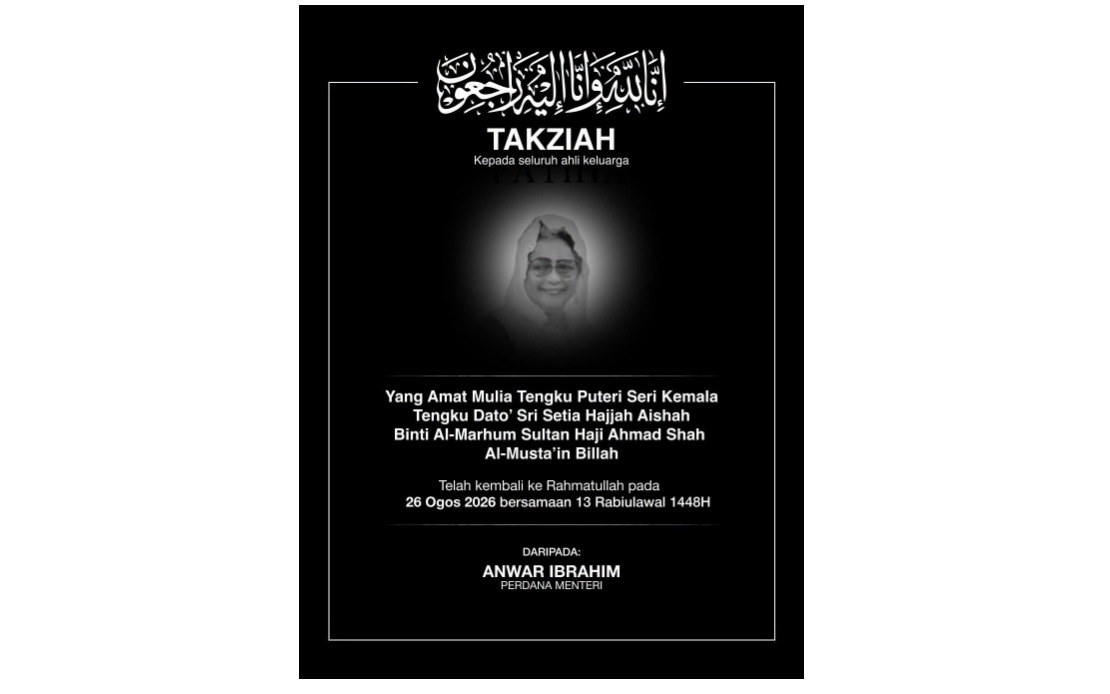
Prime Minister Datuk Seri Anwar Ibrahim has expressed his deepest sympathies to the Pahang Royal Family following the death of Tengku Puteri Seri Kemala Tengku Datuk Seri Aishah, elder sister to Sultan Al-Sultan Abdullah Ri'ayatuddin Al-Mustafa Billah Shah. The PM conveyed his condolences through a statement posted on his social media platform, extending formal respects to the reigning monarch and the broader royal household during this period of mourning.
Tengku Datuk Seri Aishah passed away at a medical facility in Kuala Lumpur on the evening of August 26, with her death pronounced at 9.15 pm. The loss of a senior member of the Pahang royal lineage marks a significant moment for the state's ruling institution, which holds considerable cultural and constitutional importance within Malaysia's federal system. As the sister of the current Sultan, Tengku Datuk Seri Aishah occupied a distinguished position within the royal hierarchy and was known within court circles.
In his condolence message, Anwar invoked religious sentiment appropriate to Islamic tradition and Malaysian royal protocol, praying that Allah's mercy would encompass Tengku Datuk Seri Aishah's soul and that her transgressions would be forgiven. Such expressions reflect the deeply ingrained Islamic framework within which Malaysia's constitutional monarchy operates, where the Sultan holds the position of head of Islam in his respective state. The Prime Minister's choice to employ such language demonstrates awareness of both the personal grief of the royal family and the spiritual dimensions of their loss.
The PM additionally extended prayers for spiritual strength to be granted to Al-Sultan Abdullah, the reigning Sultan, as well as to Tengku Ampuan Pahang Tunku Azizah Aminah Maimunah Iskandariah and the entire Pahang Royal Family. Such gestures serve multiple functions within Malaysian political culture—they acknowledge the human dimension of loss while reinforcing the bonds of respect between the executive branch and the constitutional monarchy. The explicit naming of family members reflects protocol and shows that the Prime Minister's office had coordinated appropriately with royal advisors regarding the composition of his statement.
Arrangements for the final rites proceeded according to royal and Islamic custom. The deceased's remains were scheduled for interment at the Pahang Royal Mausoleum situated in Pekan, the state capital, on August 27. This location holds historical significance as the traditional burial ground for members of the Pahang royal house, connecting Tengku Datuk Seri Aishah's passing to centuries of dynastic continuity. The choice of burial site underscores the institutional memory and ceremonial dignity accorded to senior royals in Malaysia's constitutional framework.
For Malaysian readers, the significance of such condolence statements extends beyond mere courtesy. The relationship between the federal government under the Prime Minister and the state sultanates forms a cornerstone of Malaysia's unique constitutional arrangement, where sultans retain religious authority and ceremonial prominence while the Prime Minister exercises executive power at the national level. Public expressions of sympathy from the PM reinforce this delicate balance and demonstrate respect for the institution of the monarchy—a matter of considerable importance given Malaysia's historical commitment to constitutional monarchy as a unifying force.
The Pahang sultanate itself holds particular weight within Malaysian politics and history. As one of the larger states with a substantial population and economic interests, Pahang's royal household maintains significant influence over state governance and regional affairs. The current Sultan has been in his position since January 2019, following the abdication of Sultan Ahmad Shah, whose reign had spanned several decades. The death of the former Sultan's daughter thus carries echoes of recent dynastic transitions and shifts in Pahang's political landscape.
Within the Southeast Asian context, Malaysia's approach to royal mourning and state ceremonial reflects broader regional patterns where constitutional monarchies maintain public respect despite varying degrees of actual political power. The formal condolence from Anwar, appearing prominently on social media, serves to disseminate awareness of the death beyond immediate court circles and among the general Malaysian population. This democratization of royal information, while respectful of tradition, acknowledges contemporary communication patterns.
For the broader Malaysian polity, such moments of national mourning and official condolence present opportunities for reflection on institutional stability and continuity. The smooth succession of sultans in recent years and the dignified handling of royal transitions reflect Malaysia's institutional maturity, despite periodic political controversies. The Pahang Royal Family's response to this loss will likely be observed closely as an indicator of the state's stability during a period when several Malaysian states have experienced recent royal transitions or succession questions.
The role of religious observance in Malaysian state ceremonies, as evidenced by the PM's invocation of Islamic prayers and mercy, also highlights how constitutional monarchy in Malaysia remains intertwined with Islamic faith and practice. This integration distinguishes Malaysia's system from purely secular constitutional arrangements found elsewhere in the region, and reflects the country's foundational commitment to Islam as a unifying spiritual framework for the monarchy itself.

