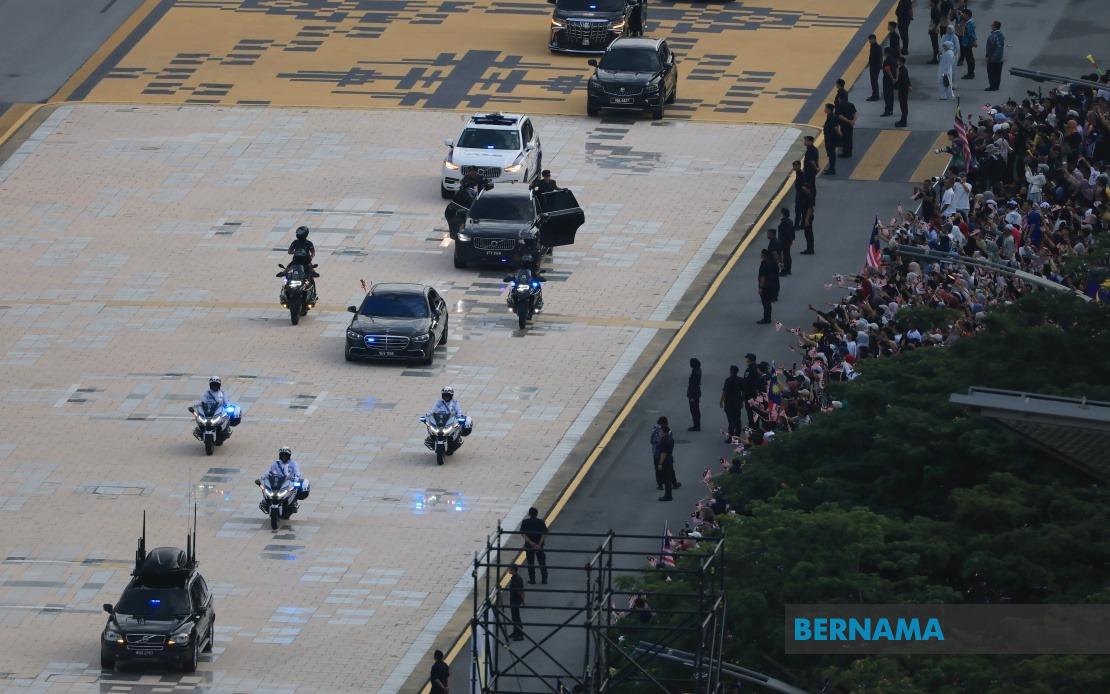
Prime Minister Datuk Seri Anwar Ibrahim and his cabinet colleagues participated in Malaysia's 69th National Day observance on Saturday at Dataran Putrajaya, marking a significant gathering of the nation's political leadership alongside tens of thousands of citizens who assembled to commemorate the occasion. The event underscored the continued importance the government places on this annual celebration of national identity and cohesion, drawing senior officials across multiple ministerial portfolios to demonstrate unified commitment to the country's commemorative traditions.
Anwar, who concurrently serves as Finance Minister, arrived at the royal stage accompanied by his wife Datuk Seri Dr Wan Azizah Wan Ismail at 7.53 am as the formal proceedings commenced. The timing and ceremonial protocol reflected the dignity accorded to the nation's highest executive office, with the Hormat Perdana song providing the musical backdrop for the leadership's entrance onto the stage, symbolising the continuity of Malaysia's constitutional framework and democratic traditions.
Deputy Prime Minister Datuk Seri Dr Ahmad Zahid Hamidi preceded the Prime Minister's arrival, reaching the venue at 7.45 am. This staggered arrival sequence, typical of high-level state ceremonies, ensured proper protocol observance while allowing security and logistical arrangements to function seamlessly throughout the morning proceedings. The attendance of the nation's second-highest ranking executive official further underscored the event's political significance and the administration's organisational priorities.
The cabinet representation extended across numerous government portfolios, reflecting the broad-based nature of the celebration. Communications Minister Datuk Seri Fahmi Fadzil attended in his ministerial capacity while also fulfilling his role as chairman of the main organising committee for the 2026 National Day and Malaysia Day (HKHM) celebrations, indicating early engagement with planning for the next major commemorative cycle. Home Minister Datuk Seri Saifuddin Nasution Ismail and Defence Minister Datuk Seri Mohamed Khaled Nordin were similarly present, alongside additional cabinet colleagues whose portfolios span critical governance functions.
Beyond the immediate ministerial circle, the gathering included deputy ministers, various dignitaries and foreign diplomatic delegations, illustrating the event's significance within Malaysia's international relations framework. The presence of foreign representatives added a multilateral dimension to the proceedings, acknowledging Malaysia's integration within the broader community of nations and its commitment to demonstrating stable, institutionalised governance to the international audience.
The scale of the 69th National Day celebration reflected substantial logistical coordination and resource deployment. Nearly 10,819 participants drawn from 76 separate contingents marched or performed throughout the event, while 22 distinct marching bands contributed musical dimensions to the procession. The physical spectacle extended beyond traditional parade elements to include 11 specially decorated vehicles, 328 military and civilian assets spanning land, sea and air capabilities, 112 working animals employed in ceremonial functions, and notably, 22 electric vehicle assets that highlighted the government's environmental consciousness within the context of national celebration.
This comprehensive representation of national institutional capacity, from defence forces to civilian organisations to emerging sustainable transport technologies, conveyed multiple layers of national messaging. The visible demonstration of state capability, organisational coordination and institutional depth served functions beyond mere ceremony, communicating both domestic cohesion and international standing during a period when Malaysia navigates complex regional and global dynamics.
The event operated under the thematic framework "Malaysia MADANI: Kesejahteraan Dinikmati," connecting the immediate celebration to the broader governance philosophy the Anwar administration has articulated. This thematic anchoring connects national commemoration to contemporary policy objectives and societal aspirations, framing Independence Day not merely as historical retrospection but as orientation toward future national development trajectories. The MADANI framework has become central to the government's communications strategy, and its integration into National Day messaging reflects deliberate efforts to link citizenship traditions with contemporary governance narratives.
For Malaysian audiences, the presence of near-complete cabinet representation at Dataran Putrajaya carried particular significance in the context of political dynamics following the 2022 general elections. The unified appearance of competing political coalitions within the government structure signalled continuity of the Unity Government coalition despite periodic strains that characterised the preceding year. National Day ceremonials, by their nature non-partisan and ceremonially binding, provided institutional expression of political unity that media reporting and routine parliamentary exchanges sometimes obscured.
The magnitude of participant numbers and asset deployment also reflected budgetary commitments and administrative priorities within a government managing significant fiscal constraints and competing development agendas. The decision to maintain comprehensive, large-scale National Day celebrations despite economic pressures communicated government commitment to sustaining national institutions and public morale even within constrained fiscal environments. This messaging held particular resonance given widespread public discussion of cost-of-living pressures and infrastructure development debates.
Regionally, Malaysia's National Day observance carries implications beyond domestic commemoration. As Southeast Asia's oldest functioning independence commemorative tradition—predating most neighbouring nations' independence dates—Malaysia's annual National Day celebration implicitly communicates institutional longevity and political stability to a region where state-building processes and governance legitimacy remain ongoing concerns. The regular, well-organised nature of these celebrations reinforces perceptions of institutional capacity that extend beyond the specific occasion.

