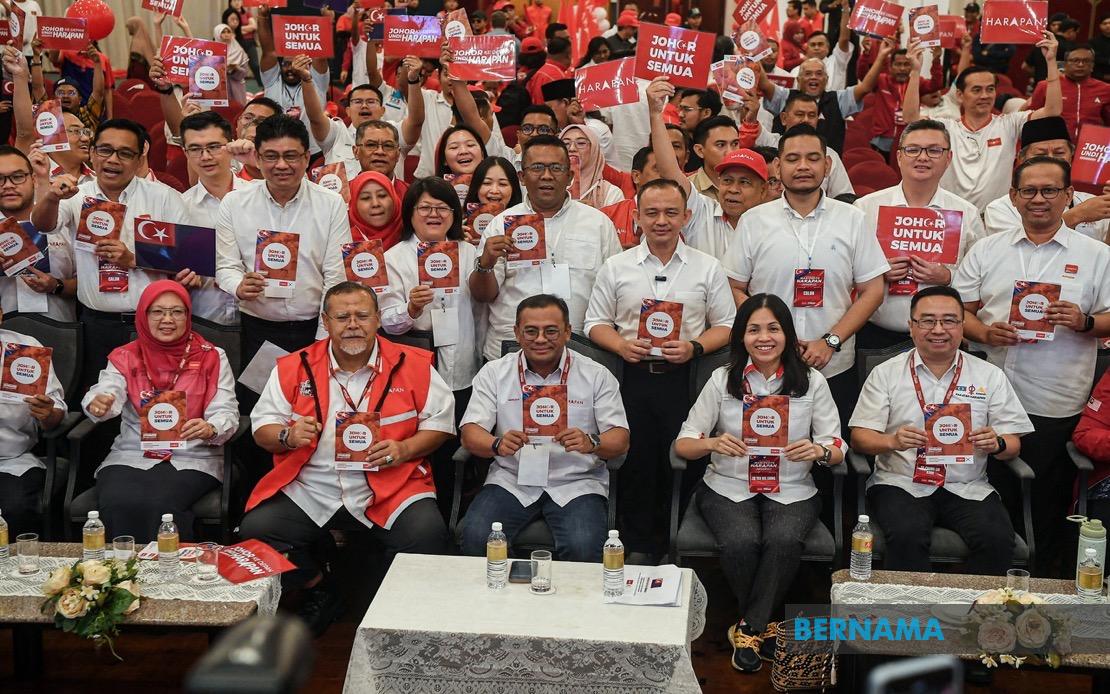
Pakatan Harapan launched its election manifesto for the upcoming 16th Johor state election on Wednesday with a pledge to address tangible concerns affecting voters across all demographics. Titled 'Johor Untuk Semua' (Johor For All), the platform represents a deliberate attempt to move beyond campaign rhetoric by anchoring its promises in documented economic realities and demonstrated public concerns. Johor DAP chairman Teo Nie Ching, who served as Deputy Communications Minister, stressed that the coalition's proposals are neither aspirational fiction nor hollow pledges, but carefully calibrated responses to challenges the state actually faces.
The manifesto encompasses ten substantive policy offerings designed to appeal across generational and socioeconomic lines. Among these are a dedicated Johor Health Scheme modelled on successful initiatives elsewhere in the country, financial assistance programmes targeting first-time property buyers struggling with down payment requirements, and a RM500 million allocation specifically for youth empowerment initiatives. Education improvements round out the platform's emphasis on human capital development, reflecting broader regional concerns about workforce readiness and skills gaps. These commitments collectively suggest a coalition attempting to address cost-of-living pressures while simultaneously investing in long-term productivity gains.
Teo emphasized that successful implementation hinges fundamentally on securing robust support from the federal government and maintaining institutional coordination across multiple agencies. This caveat carries considerable significance for Malaysian voters accustomed to state-federal tensions that have historically complicated policy rollout. The Deputy Communications Minister's explicit acknowledgement that federal cooperation remains essential reveals the practical constraints within Malaysia's federal system, where state governments frequently lack either budgetary autonomy or regulatory authority to unilaterally deliver promised services. This transparency about interdependencies arguably enhances rather than diminishes the manifesto's credibility.
The border efficiency promise deserves particular attention given Johor's unique position as Southeast Asia's primary land crossing between Malaysia and Singapore. The manifesto commits to reducing waiting times at the Johor-Singapore checkpoints by half, a target reflecting the massive economic and social costs imposed by current congestion. Daily commuters, trucking operations, and tourism flows all suffer from bottlenecks that effectively subtract hours from productive time. Teo indicated confidence that coordinated efforts with the Home Ministry could achieve this reduction, though previous cross-border initiatives have frequently encountered implementation delays and technical obstacles.
The healthcare component draws explicitly on Selangor's precedent with similar schemes, providing voters with concrete evidence of feasibility rather than theoretical possibilities. Selangor's success in operating a subsidized health programme demonstrates that comparable initiatives can function within Malaysia's federal healthcare framework and state budget constraints. This precedent carries genuine persuasive power for Johor voters who might otherwise dismiss health expansion pledges as fiscally unrealistic. The ability to point to another state's operational programme substantially raises the credibility threshold, transforming the proposal from abstract promise into demonstrated capability.
The manifesto's youth development funding allocation reflects recognition that Johor's demographic profile includes substantial numbers of young people facing limited economic opportunities in some districts. A dedicated RM500 million youth fund addresses both employment creation and skills development, two interconnected challenges that have animated political discourse throughout Malaysia. Youth unemployment and underemployment have consistently featured in post-election analyses as decisive factors in voter preference shifts, particularly among first-time voters evaluating competing platforms.
The emphasis on affordability assistance for first-time homebuyers acknowledges the severe housing accessibility crisis affecting younger Malaysians across most states. Property prices in Johor have escalated substantially over the past decade, outpacing income growth and rendering homeownership increasingly unattainable for ordinary workers. A state government able to materially reduce financial barriers through deposit assistance programmes could tangibly improve housing accessibility without requiring wholesale restructuring of property markets. This targeted approach reflects recognition that blanket price controls prove counterproductive while means-tested assistance addresses actual constraints.
Education sector strengthening addresses concerns that have animated policy debates across Malaysia regarding curriculum adequacy, teacher training, and infrastructure quality. Johor's education system serves both as a provincial network and a training ground for educators deployed nationally, making state-level improvements relevant beyond Johor's borders. The manifesto's education commitments likely encompass facility upgrades, teacher professional development, and curriculum modernization, though specific details remain to be detailed in subsequent campaign materials.
The July 11 election date creates a compressed campaign timeline for coalition candidates to articulate how these manifesto commitments would function in practice. Early voting commencing July 7 means that persuasion efforts must crystallize quickly into voter decisions. The manifesto's emphasis on proven models and deliverability rather than transformative promises positions Pakatan Harapan as the continuity choice, contrasting with any opposition platform emphasizing radical reform. Whether Johor voters prioritize proven implementation capacity or desire more ambitious restructuring will substantially influence electoral outcomes and post-election coalition formation in the state assembly.
The manifesto's calculated moderation distinguishes it from the more expansive pledges sometimes offered during campaign seasons. By grounding commitments in documented economic realities and pointing to precedent elsewhere in Malaysia, Pakatan Harapan appears to be learning from previous elections where unfulfilled promises damaged credibility. This represents a maturation of campaign strategy reflecting recognition that voter sophistication has increased and trust in political assurances has declined. Whether this approach resonates with Johor voters will become apparent once polling concludes.

