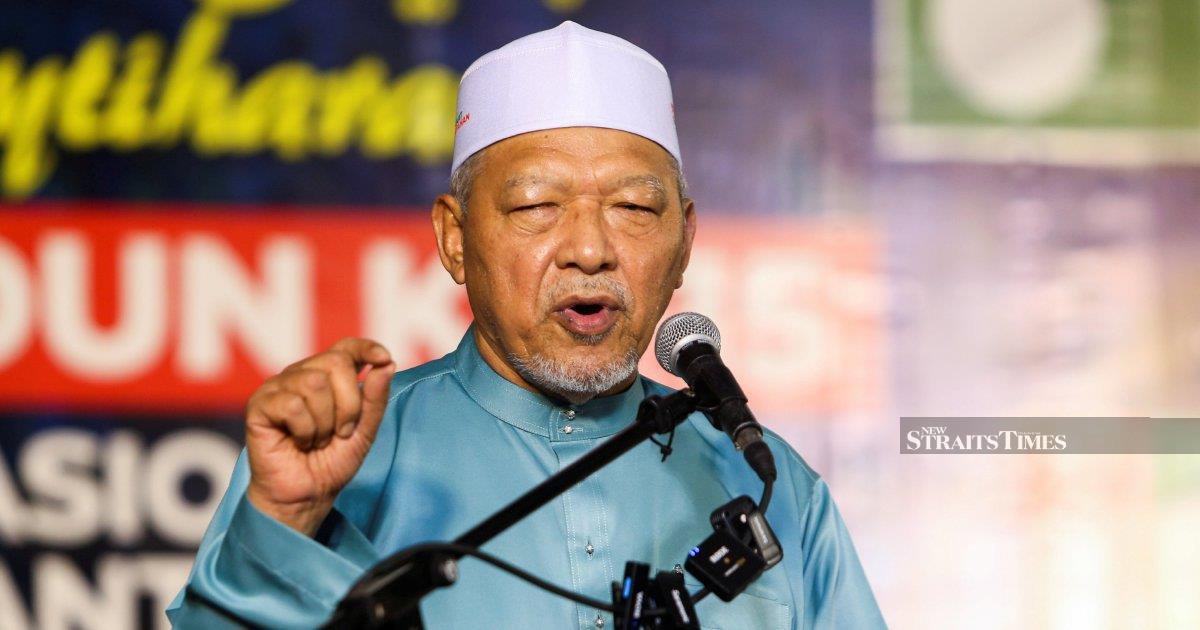
In a significant development for Malaysia's evolving political landscape, PAS president Tan Sri Abdul Hadi Awang has formally endorsed collaborative electoral arrangements with Barisan Nasional spanning multiple state contests and beyond. Speaking in Tumpat, Hadi articulated his assessment that the nation faces what he termed a "dangerous" political situation that necessitates strategic coordination between the two major coalition partners ahead of crucial ballots in Johor, Negri Sembilan, and the subsequent Melaka election cycle.
The agreement represents a deepening of ties between PAS and BN at a moment when Malaysia's political terrain continues to shift following the watershed 2022 general election. Rather than pursuing independent candidacies that might fragment the opposition vote, Hadi's decision to formalise electoral pacts signals PAS leadership's confidence that greater cohesion with BN offers a more viable pathway to securing state administrations. This calculation reflects a pragmatic reassessment of competitive dynamics and the costs of political fragmentation across multiple battlegrounds simultaneously.
For Malaysian observers tracking the broader regional alignment, Hadi's move carries implications extending beyond routine state-level politics. The deepening coordination between PAS and BN suggests that both formations view an alternative political force as sufficiently threatening to warrant disciplined electoral strategy. This recalibration has reshaped the three-cornered contests that characterised Malaysian politics for over a decade, potentially establishing clearer bipolar competition in coming electoral cycles.
Johor, traditionally a BN stronghold, represents the immediate testing ground for these arrangements. As the nation's southern economic engine and a state where BN maintains deep institutional roots, Johor contests have historically served as bellwethers for national sentiment. The inclusion of Johor within the PAS-BN pact framework suggests both formations intend to present a consolidated front rather than contest as rival coalitions, fundamentally altering voter choice configurations in the state.
Negri Sembilan presents a distinct challenge. The state has seen competitive three-cornered battles between BN, Pakatan Harapan, and other formations, requiring careful seat allocation to maximise combined vote efficiency. PAS's willingness to coordinate electoral positioning in Negri Sembilan indicates the party leadership believes that fragmented opposition candidacies pose greater electoral risk than concentrated partnership. Such calculations rely on sophisticated vote-share analysis and demographic assessment of swing constituencies.
The Melaka arrangement extends these electoral understandings into the medium term, suggesting that PAS and BN envision sustained collaboration beyond immediate state contests. This temporal dimension matters considerably for political planning and resource allocation. Candidates and party machinery require certainty about electoral positioning to mount effective campaigns, and forward commitments facilitate such organisational preparation across multiple cycles.
Hadi's framing of these arrangements as responses to a "dangerous" political threat warrants careful examination. The specific nature of this perceived threat remains open to interpretation, though Malaysian political observers typically contextualise such language within ongoing tensions between competing coalitional visions and ideological orientations. What Hadi identifies as dangerous, alternative political forces naturally characterise as necessary democratic contestation. Understanding this language requires recognising how different political actors perceive existential challenges to their respective visions for Malaysia's future governance.
For ordinary Malaysian voters, these elite-level realignments have tangible consequences. Electoral pacts directly reduce candidate choices within constituencies, effectively narrowing the range of competitive options available at polling stations. While such arrangements may improve organisational efficiency and prevent vote-splitting among allied parties, they simultaneously restrict voter agency and preference expression. The trade-offs between coalition-building effectiveness and democratic choice represent perennial tensions in multi-party systems experiencing frequent realignment.
The timing of Hadi's announcement also reflects broader PAS strategy regarding its position within Malaysia's constitutional arrangements. By aligning with BN through formalised electoral understandings rather than through merger or formal coalition restructuring, PAS maintains organisational autonomy whilst gaining partnership benefits. This flexibility proves valuable should political circumstances shift unexpectedly, as Malaysia's recent political history amply demonstrates. The party preserves options whilst committing to coordinated electoral strategy.
Regional implications deserve consideration as well. Southeast Asia's larger states have witnessed competing electoral pacts and coalition recalibration in recent years, reflecting common challenges around political polarisation and vote fragmentation. Malaysia's particular evolution toward clearer bipolar competition may influence political science analysis of coalition dynamics across the region, particularly regarding how religious and ideological difference shape voter aggregation and elite coordination.
The PAS-BN understanding also carries significance for federal governance prospects. Should these electoral pacts succeed in delivering control across multiple states, they would strengthen the combined formation's position for negotiating future national arrangements. State-level victories provide leverage for federal discussions, making these apparently localised electoral arrangements integral to longer-term power calculations and constitutional governance.
Looking ahead, the success of these arrangements will depend substantially on execution quality and grass-roots acceptance. Coordinated electoral strategy functions effectively only when party activists and voters genuinely support unified candidacies rather than viewing them as elite imposition. Should local party members harbour resentment about candidate selections or seat allocations, such discontent could manifest in reduced campaign enthusiasm or voter dissatisfaction, potentially undermining the very electoral objectives these pacts intend to serve.

