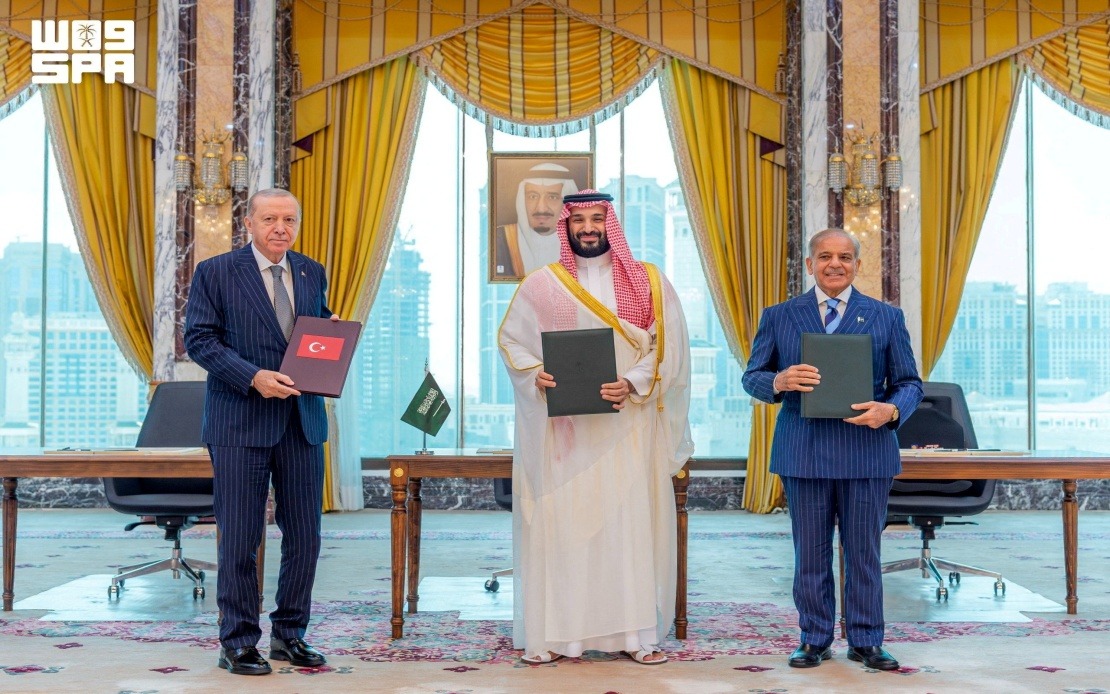
Pakistan, Saudi Arabia and Türkiye have formally established a trilateral defence compact designed to guarantee collective security among the three nations, with the accord signed during high-level talks in Makkah. Saudi Crown Prince Mohammed bin Salman bin Abdulaziz Al Saud, Pakistan Prime Minister Shehbaz Sharif and Turkish President Recep Tayyip Erdogan executed the Joint Defence Agreement at Al Safa Palace following their summit on Friday, cementing what officials describe as a historic step toward regional stability and deterrence.
The agreement's centrepiece is a binding commitment that treats an armed attack on any single signatory as an attack upon all three nations, creating a unified defensive posture against external aggression. This mutual guarantee represents the most formal security arrangement to date among the three countries and elevates their partnership beyond bilateral defence ties into a cohesive strategic framework. The clause establishing this collective response mechanism underscores the nations' determination to present a united front in addressing security threats emanating from their respective regions and the broader geopolitical landscape.
Beyond the defensive guarantee, the pact explicitly encompasses expanded military cooperation across multiple domains. The accord provisions envisage deepening defence ties through joint exercises, technology sharing, intelligence collaboration and harmonisation of military capabilities. This multifaceted approach signals ambition extending well beyond symbolic solidarity, targeting operationalised interoperability among Pakistani, Saudi and Turkish armed forces. For Malaysia and other Southeast Asian nations tracking regional security developments, the agreement demonstrates how major powers consolidate influence through institutionalised defence relationships rather than transactional military deals.
Pakistan brings particular strategic weight to this arrangement as a nuclear-armed state commanding one of Asia's largest standing armies. The nation's geographical position spanning South Asia and Central Asia, combined with its historical military relationships with both Saudi Arabia and Türkiye, makes it indispensable to any meaningful regional security architecture. Pakistan's inclusion signals that the pact aspires toward influence extending across multiple regions rather than remaining confined to the Middle East or Eastern Mediterranean, where Türkiye maintains significant interests.
Türkiye contributes critical capabilities as a NATO member bridging Europe and Asia, commanding substantial conventional military assets and maintaining strategic interests spanning the Eastern Mediterranean, Black Sea and Central Asia. The country's positioning at the intersection of multiple regions enhances the pact's potential reach and relevance. Turkish military expertise and technological sophistication complement Pakistan's manpower and Saudi Arabia's financial resources, creating a complementary arrangement where each nation's strengths buttress collective capabilities.
Saudi Arabia's role as the dominant regional power in the Gulf and custodian of Islam's holiest sites adds religious and geopolitical dimensions to the compact. The kingdom's substantial defence budget and emerging military modernisation programme position it as the financial engine driving enhanced capabilities. Holding the pact's signing ceremony in Makkah rather than a neutral venue carries symbolic weight, framing the agreement within an Islamic solidarity narrative that resonates across Muslim-majority populations throughout the region and beyond.
Official messaging from Saudi Arabia's deputy public diplomacy minister Rayed Krimly emphasised that the arrangement neither threatens neighbouring countries nor escalates regional tensions, an important clarification given the complex security environment across the Middle East and South Asia. This assurance addresses concerns from nations potentially viewing the alignment as hostile positioning. The statement underscores that the three signatories frame their cooperation as defensive deterrence rather than aggressive capability-building, though observers worldwide will inevitably assess whether the pact tilts regional military balances.
This trilateral agreement builds upon an existing bilateral framework established between Pakistan and Saudi Arabia in September of the previous year, which similarly committed both nations to mutual defence against external aggression. The expansion to include Türkiye represents a qualitative leap in regional cooperation, transforming bilateral arrangements into a three-way security network with significantly greater strategic depth and geographical reach. The progression demonstrates how security partnerships evolve from foundational bilateral agreements into more ambitious multilateral structures.
For Malaysian policymakers and regional observers, the pact illustrates broader patterns in international relations wherein major powers increasingly seek formalised collective security frameworks. The arrangement parallels security cooperation mechanisms elsewhere globally and reflects recognition that contemporary threats—spanning terrorism, cyber operations, maritime piracy and conventional military challenges—require coordinated responses. The tripartite structure may also serve as a counterbalance to other regional alignments, though each signatory maintains independent foreign policies and other strategic partnerships.
The agreement's long-term implications remain partly dependent on implementation mechanisms and the political circumstances of the three nations. Pakistan faces ongoing security challenges from militant groups and complicated relationships with neighbouring countries. Saudi Arabia manages complex interests across the Arabian Peninsula and Persian Gulf. Türkiye navigates competing interests in Syria, Iraq and the Eastern Mediterranean. How these internal and bilateral pressures interact with the trilateral commitment will shape the pact's practical utility and longevity.
Regional analysts suggest the compact reflects both optimism about multipolarity and concern regarding traditional alliances. The three nations are asserting independent agency in building security arrangements reflecting their specific interests and strategic geographies rather than relying exclusively on relationships with global powers. This trajectory characterises broader shifts wherein intermediate and major regional powers increasingly architect their own security ecosystems. For smaller Southeast Asian nations, such developments underscore the importance of strategic hedging and maintaining diverse partnerships to navigate multipolar regional dynamics.

