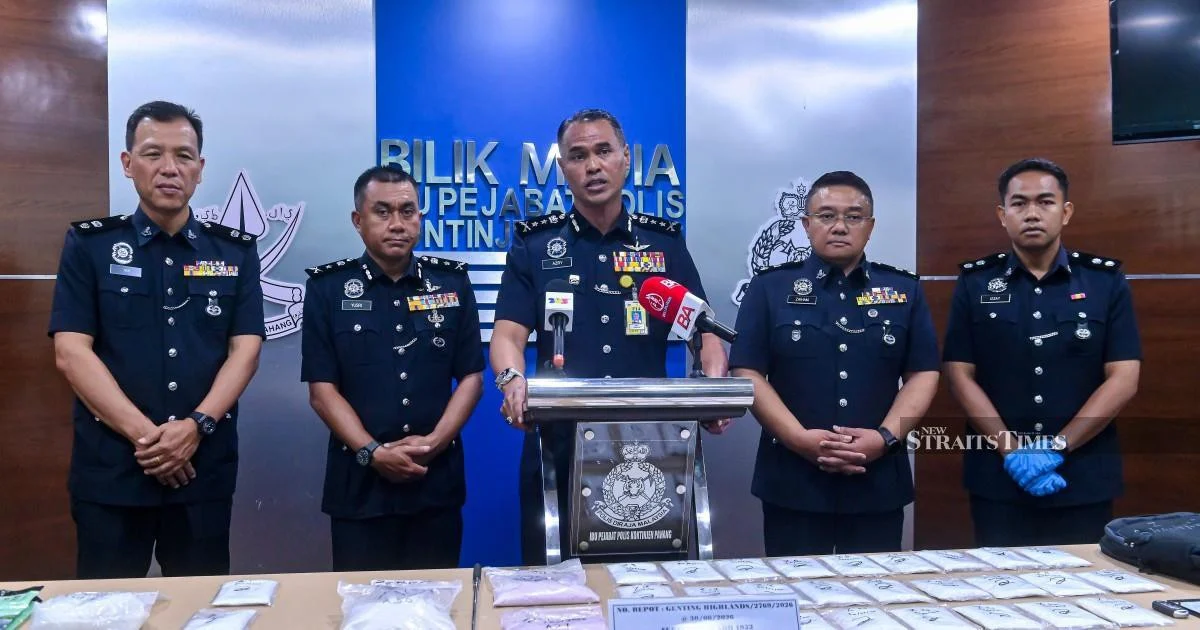
Pahang's police force has concluded a major offensive against drug trafficking, culminating in the arrest of 333 individuals and the recovery of contraband valued at more than RM500,000. The statewide operation, which swept through all 11 districts in the state, targeted key locations known for narcotics activity and represents a significant enforcement effort aimed at disrupting the supply and consumption networks that plague the region.
The three-day campaign demonstrates the continued commitment of state law enforcement to combat substance abuse, a persistent challenge across Malaysia. By concentrating resources across entire districts rather than focusing narrowly on urban centres, authorities sought to dismantle drug operations at multiple levels—from street-level dealing to wholesale distribution points. The comprehensive geographic approach suggests a recognition that drug problems are not confined to city areas but permeate communities throughout Pahang, including smaller towns and outlying settlements that often receive less police attention.
The seizure of drugs, cash and vehicles indicates that officers encountered a range of criminal activity beyond simple possession. The recovery of vehicles is particularly significant, as these are often essential tools in the distribution chain, used to transport narcotics between suppliers and retailers. The cash haul suggests authorities disrupted financial flows associated with trafficking operations, potentially hampering the ability of criminal networks to reinvest profits and expand their reach. Such interdictions have cumulative effects when pursued consistently, gradually eroding the economic viability of drug enterprises.
For Malaysian readers in other states, the Pahang operation underscores the scale at which anti-drug work now operates nationally. Each state experiences its own trafficking challenges shaped by geography, proximity to ports or borders, and local market dynamics. Pahang's position as a large, geographically diverse state with both urban and rural areas makes it representative of enforcement challenges replicated across the country. The resource-intensive nature of the operation—requiring coordination across 11 districts—illustrates why drug enforcement remains expensive and demands sustained political will.
The decision to publicise arrest numbers and seizure valuations serves multiple purposes in the law-and-order narrative. Public announcements of enforcement success can deter casual users, boost public confidence in police capabilities, and justify budget allocations to narcotics units. However, enforcement data alone cannot measure whether such operations meaningfully reduce drug availability or use rates in targeted communities. Sustained reductions typically require complementary efforts in drug treatment, rehabilitation and prevention, areas where resource allocation remains contested across Malaysian jurisdictions.
The three-day timeframe of Operation Hawk suggests an intensive but time-limited deployment, possibly timed to coincide with intelligence about particularly active trafficking periods or capitalising on temporary availability of additional police resources. Such blitz-style operations differ from continuous street-level enforcement and may offer tactical advantages—suspects have less time to disperse or destroy evidence. Conversely, brief campaigns can displace activity rather than eliminate it, as traffickers relocate operations to less heavily policed areas or adjust their methods to avoid detection during subsequent normal policing periods.
Across Pahang's 11 districts, drug problems vary considerably. Coastal areas face unique challenges related to maritime trafficking routes, whilst districts containing major towns experience different criminal dynamics than more rural regions. A statewide operation necessarily applies blanket enforcement strategies, though the intelligence that guided the campaign presumably prioritised resources toward the most significant hotspots. Understanding which districts accounted for the majority of arrests would provide insight into where drug problems are most entrenched and where prevention and treatment resources might be most effectively directed.
The involvement of multiple enforcement agencies is likely, though the announcement emphasises the state police role. Inter-agency coordination between police, customs, immigration and other bodies is essential for comprehensive drug enforcement, particularly in Pahang where state borders, international boundaries and numerous ports of entry create complex operational environments. The success of joint operations depends on mechanisms for sharing intelligence, coordinating surveillance and maintaining clear command structures—areas where bureaucratic friction has historically complicated Malaysian enforcement efforts.
For communities in Pahang where the operations were concentrated, the increased police activity may be visible and reassuring in the short term. Residents in targeted areas would have observed elevated patrols and checkpoints for the three-day period. Whether this translates into sustained improvements in neighbourhood safety and reduced drug availability depends on what follows the operation. Sustainable change typically requires ongoing presence and community engagement, supported by local efforts to address root causes of drug use such as unemployment, educational gaps and social alienation that drive many into substance abuse.
The RM500,000 valuation encompasses drugs seized at street value—a measure that typically reflects retail pricing rather than wholesale costs, thereby inflating the apparent significance of seizures. The actual economic impact on trafficking organisations depends on what proportion of their operational capital was disrupted. A loss of this magnitude may represent a meaningful setback for smaller networks but prove marginal to larger enterprises that operate with substantial financial buffers and diversified supply sources.
Looking forward, the sustainability of anti-drug efforts in Pahang will depend on whether this operation represents part of a coordinated, long-term strategy or functions as a periodic enforcement surge. International evidence suggests that sustained, intelligence-led approaches combining law enforcement, treatment and prevention yield better outcomes than intermittent crackdowns. For Pahang and other Malaysian states, maintaining momentum beyond headline-generating operations remains the central challenge in addressing drug problems that continue to expand despite decades of enforcement effort.

