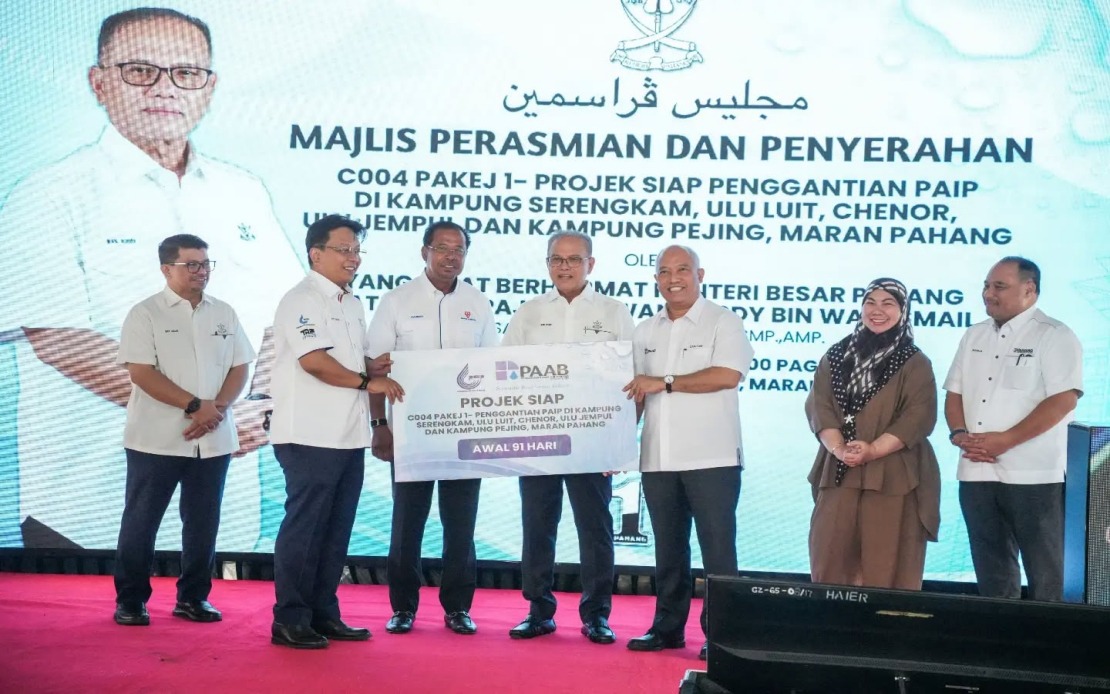
Pengurusan Aset Air Berhad (PAAB) has officially handed over a RM11.19 million water infrastructure project in Maran that marks a turning point for residents who have endured chronic water supply disruptions for nearly two decades. The completion ceremony, overseen by Pahang Menteri Besar Datuk Seri Wan Rosdy Wan Ismail at the Chenor Water Treatment Plant, signals the culmination of extensive remedial work designed to transform water service reliability across the district.
The undertaking involved the wholesale replacement of 29.6 kilometres of aging pipe infrastructure across five localities—Kampung Serengkam, Ulu Luit, Pejing, Ulu Jempul and Chenor—where deteriorating networks had become synonymous with service failures. What distinguishes this project is not merely its scope but its acceleration; PAAB completed the work three months ahead of schedule, demonstrating the logistical competence required to execute complex infrastructure rehabilitation in a geographically challenging landscape. The endeavour, entirely financed by PAAB, directly benefits approximately 10,000 residents who had previously contended with unpredictable supply patterns and persistent pipeline ruptures.
The chronic water supply problems that necessitated this intervention reflect broader challenges confronting Malaysia's aging distribution networks, particularly in Pahang's more remote settlements. The recurring burst pipes that plagued Maran created cascading socioeconomic consequences—disruptions to household routines, constraints on agricultural and small business operations, and elevated water loss through leakage. These challenges intensified seasonally, with dry periods and festive celebrations straining an already compromised system. The infrastructure collapse essentially marooned these communities in a state of perpetual vulnerability, making the rehabilitation project far more consequential than routine maintenance might suggest.
The technical improvements embedded within the project address multiple dimensions of water service delivery simultaneously. By replacing deteriorated pipes with modern infrastructure, PAAB has substantially reduced non-revenue water—the sector's measurement of water lost to leakage and theft before reaching consumers. Simultaneously, the upgraded network now maintains consistent pressure throughout the distribution zones, eliminating the pressure fluctuations that previously rendered morning and evening periods particularly unreliable. These enhancements prove especially critical during the extended dry seasons characteristic of Pahang's climate and during concentrated demand surges around major festivals, when traditionally the system would buckle under increased consumption.
The project represents one component of a substantially larger transformation strategy unfolding across Pahang's water sector. Over the forthcoming three years, PAAB intends to collaborate with Pengurusan Air Pahang Berhad (PAIP) to articulate and execute a comprehensive water infrastructure strategy encompassing multiple districts. This systematic approach signals a departure from reactive crisis management toward proactive network modernisation. The upgrade of electrical systems at the Jengka Utama Water Treatment Plant addresses supply disruptions affecting Felda Jengka residents, another historically problematic service area where systemic vulnerabilities had persisted despite earlier interventions.
Two additional projects underway illustrate the scale of PAAB's investment commitment across the state. A RM35.7 million undertaking will replace 76.2 kilometres of deteriorated pipes in Jerantut and Lipis, reconnecting communities surrounding Pulau Tawar and Kuala Tahan with modernised distribution infrastructure. Concurrently, a RM13 million initiative targets Felda Keratong, where 11 kilometres of replacement pipework will substantially enhance the water supply system's operational efficiency in the Rompin administrative zone. Collectively, these projects demonstrate PAAB's recognition that infrastructure rehabilitation cannot proceed in isolation but must follow strategically coherent planning.
Financial commitment at the state level underscores the seriousness of this transformation agenda. As of July, PAAB had allocated RM1.17 billion toward water supply infrastructure projects throughout Pahang, with RM69.79 million already expended on completed initiatives, RM66.94 million committed to projects currently under construction, and RM981.04 million earmarked for ventures in advanced planning and design phases. These figures illustrate the magnitude of deferred infrastructure investment now receiving sustained attention, suggesting that Pahang's water sector is undergoing systematic renewal rather than responding to individual crises.
The institutional framework supporting these developments merits consideration, particularly for Malaysian readers assessing water governance effectiveness. PAAB, established in 2006 under the Water Services Industry Act, operates as the federal government's implementation agent for the National Water Services Industry Restructuring Plan. Wholly owned by Minister of Finance Incorporated and regulated by the Ministry of Energy Transition and Water Transformation (PETRA), the entity functions as the primary vehicle through which federal water infrastructure policy translates into tangible district-level improvements. PAIP, which signed the Pahang State Water Supply Services Restructuring Agreement in 2020, serves as the operational implementer, creating a division of responsibilities whereby PAAB provides capital and strategic direction whilst PAIP executes maintenance and service delivery.
For Maran's residents, the completion ahead of schedule represents immediate material improvement in daily living standards. Water quality reliability directly correlates with public health outcomes, particularly affecting vulnerable populations including young children and elderly residents. The elimination of frequent disruptions reduces households' need to maintain ad hoc storage solutions and permits residents to conduct activities from hygiene routines to food preparation without the chronic uncertainty that previously characterised their relationship with water access. Socioeconomically, the improvements enable small enterprises—from home-based food production to animal husbandry—to operate with the dependability they require for viability.
Regionally, the Maran project exemplifies how Malaysian federal water authorities are addressing infrastructure deficits accumulated over decades of underinvestment in Peninsular Malaysia's eastern regions. For Southeast Asian governments confronting similar water infrastructure challenges, the project illustrates the feasibility of systematic rehabilitation when adequate capital allocation couples with coordinated institutional responsibility. The three-year forward strategy announced by PAAB and PAIP suggests that this initiative marks the beginning rather than conclusion of Pahang's infrastructure transformation, positioning the state as a potential model for how water-stressed regions might systematically modernise service delivery through integrated planning and committed financial resources.

