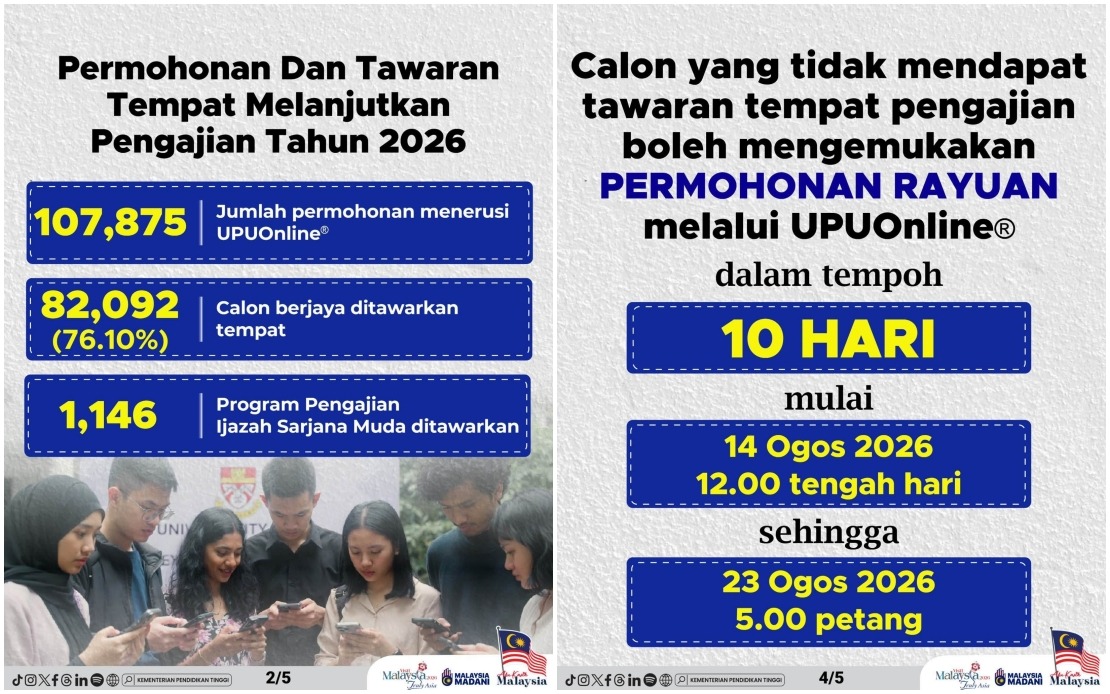
Malaysia's Ministry of Higher Education has announced the allocation of 82,092 undergraduate places across the nation's 20 public universities for this academic year, marking a significant milestone in the country's higher education intake cycle. The figure, representing approximately 76 percent of the 107,875 applications deemed eligible to proceed through the UPUOnline portal, demonstrates the substantial demand for public university education among Malaysian secondary school leavers and other qualifying candidates.
The selection process underpinning these allocations reflects the ministry's commitment to maintaining meritocratic principles in university admissions. All eligible candidates have been ranked according to their individual merit scores, with offers extended in descending order from highest-performing applicants downward. This transparent methodology aims to ensure that places are distributed fairly based on academic achievement rather than other considerations, establishing a standardised foundation for undergraduate cohort composition across the public higher education system.
The breadth of opportunity reflects significant investment in Malaysia's public university sector. Across the 20 participating institutions, a total of 1,146 bachelor's degree programmes span diverse fields of study, from engineering and medicine to business, humanities, sciences, and technical disciplines. This expansive programme portfolio enables successful candidates to pursue qualifications aligned with their academic strengths, career aspirations, and Malaysia's evolving workforce needs across multiple economic sectors.
For many Malaysian families, securing a place at a public university represents a transformative opportunity. Public universities remain more financially accessible than private alternatives for many households, with tuition fees significantly lower and various scholarship schemes available to deserving students. The successful candidates joining these institutions this year will contribute to the nation's human capital development and form part of the emerging professional workforce driving Malaysia's economic competitiveness in increasingly knowledge-intensive sectors.
However, the statistic also illuminates the competitive pressures characterising Malaysia's higher education landscape. With approximately 24 percent of eligible applicants remaining without initial offers, nearly 26,000 students face disappointing outcomes from their university placement attempts. This substantial cohort represents considerable personal and familial investment in secondary education that has not yet yielded their desired undergraduate outcome, underscoring the scarcity of public university places relative to demand among Malaysian youth.
Recognising this challenge, the Ministry of Higher Education has implemented mechanisms designed to provide additional pathways for unsuccessful candidates. The appeal process through UPUOnline, opening from noon on August 14 through 5 pm on August 23, offers applicants an opportunity to contest their outcomes or request reconsideration based on personal circumstances. This 10-day window represents a critical juncture where candidates may present additional information, seek administrative review, or advocate for programme alternatives matching their profile more effectively.
The appeals mechanism reflects broader policy recognition that initial placement algorithms, while systematically fair, may not capture all relevant considerations affecting individual student outcomes. Personal hardship, changes in family circumstances, medical conditions, or administrative errors occasionally warrant human review and potential adjustment to algorithmic decisions. The availability of this recourse channel helps mitigate the rigidity inherent in large-scale, merit-based selection systems processing tens of thousands of applications simultaneously.
For candidates unsuccessfully navigating both initial placement and appeal processes, alternative pathways remain available within Malaysia's broader higher education ecosystem. The nation's expanding private university sector, matriculation programmes offered through various institutions, and diploma qualifications at polytechnics and community colleges provide legitimate routes toward degree attainment and professional qualification. Additionally, some candidates may opt for international study, increasingly accessible as Malaysian students gain recognition in global universities and as scholarship opportunities expand internationally.
The 2026 undergraduate intake cycle also reflects demographic and policy considerations shaping higher education strategy across Southeast Asia. Malaysia, alongside regional peers, has grappled with questions regarding optimal expansion of public university capacity, balance between quality and access, and alignment between graduate output and labour market requirements. The allocation of 82,092 places represents government calibration of these competing priorities, reflecting judgments about sustainable public investment in tertiary education within Malaysia's fiscal environment.
Institutional planning across Malaysia's 20 public universities will now shift toward accommodating this cohort of incoming students. Dormitory arrangements, teaching resource allocation, laboratory and library provisions, and student support services must all expand proportionally to manage the intake effectively. Universities face ongoing challenges in maintaining educational quality whilst absorbing large student populations, particularly within capacity-constrained facilities at established institutions based in major urban centres.
The ministry's statement conveying congratulations to successful candidates carries particular significance for students undertaking higher education at a transformative historical moment. Digital disruption, climate change, geopolitical uncertainty, and evolving workplace demands collectively create an environment where university education provides essential intellectual preparation. The cohort of 82,092 students entering public universities this year will graduate into a professional landscape fundamentally different from the one their older siblings encountered, necessitating adaptable, critical thinking capacities that quality higher education institutions cultivate.
Looking forward, the higher education sector remains positioned as a critical component of Malaysia's national development strategy. Universities serve simultaneously as engines of research innovation, repositories of intellectual expertise, and mechanisms for social mobility and meritocratic advancement. The successful placement of over 82,000 candidates represents tangible progress toward ensuring that Malaysia's talent pool receives appropriate development opportunities, though ongoing challenges regarding access, quality, and responsiveness to labour market needs will continue demanding policy attention and institutional evolution.

