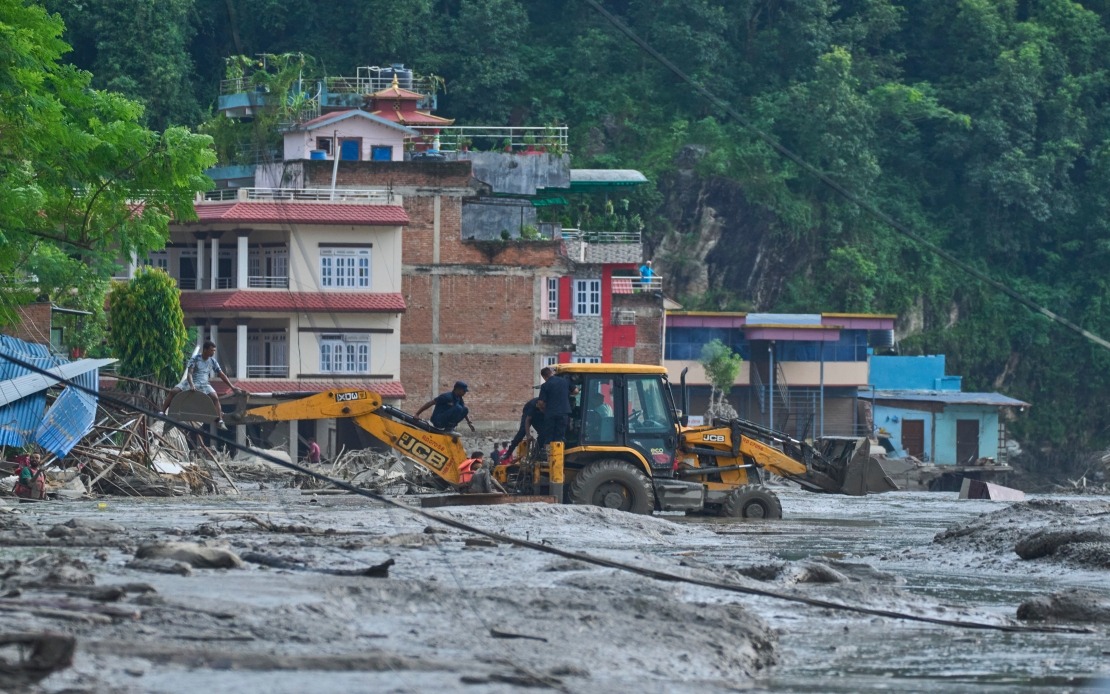
A catastrophic natural disaster has struck the Nepal-China border region, leaving a trail of destruction that continues to claim lives and generate uncertainty about the fate of hundreds of missing persons. As of Wednesday, the confirmed death toll has reached 160, with recovery operations revealing the scale of the tragedy. Nepalese authorities have retrieved 157 bodies from the wreckage of floods and landslides, though only 54 individuals have been successfully rescued from affected areas so far. The figures underscore the severity of conditions hampering search efforts in difficult terrain along one of Asia's most geographically challenging borders.
The missing persons account illustrates the transnational nature of this disaster. Among those unaccounted for are government and security personnel from Nepal, as well as tourists and travellers from multiple nations. Nepal's Prime Minister's Office has documented that 44 army personnel, 28 police officers, 13 armed police personnel, and 60 civilian employees engaged in hydropower project work have disappeared. The civilian casualty list is equally sobering, with initial reports indicating 484 missing tourists and travellers—391 of whom are foreign nationals and 93 Nepalese citizens. Nationalities confirmed among the missing include citizens from Malaysia, Australia, the United Kingdom, South Africa, India, and the Netherlands, highlighting how this regional crisis has captured international attention and mobilised diplomatic responses.
On the Chinese side, official state media reported three confirmed deaths alongside 265 individuals reported missing in the southern Tibet region. The mudslide struck with particular force near Gyirong Port, a crucial border crossing between the two nations situated in Xizang Autonomous Region. The disaster has severed critical infrastructure connecting the two countries, cutting road access to the port and disrupting communications and power supplies. Chinese President Xi Jinping responded swiftly, issuing directives for comprehensive search and rescue operations and emphasising the need to evacuate at-risk residents while providing immediate medical care to the injured. Authorities mobilised rescue forces across Xizang, with all relevant emergency operations proceeding on an urgent footing.
The physical infrastructure damage extends far beyond immediate casualty counts, with implications that will reshape regional connectivity and economic activity. Nepalese government assessments catalogue 19 bridges completely swept away by floodwaters, 40 kilometres of roadway rendered impassable, and 13 hydropower projects suffering severe damage. In parliamentary briefings, Nepal's Foreign Minister Sishir Khanal described the floods as having fundamentally altered the landscape of affected districts, erasing hydropower facilities, government infrastructure, and transportation networks that had taken years to develop. The hardest-hit districts—Rasuwa, Dhading, and Chitwan—serve as vital economic and tourism corridors, meaning recovery will demand sustained investment and international coordination.
The Rasuwagadhi border area has historically served as a gateway for adventurers and pilgrims traversing the Langtang trekking region, one of Nepal's premier mountain destinations. Beyond this, the crossing functions as a crucial transit point for religious tourists bound for Mount Kailash and Lake Mansarovar in Tibet, making the disaster's impact felt across multiple industries and communities. The flooding effectively paralysed these routes, disrupting the movement of thousands of expected visitors and creating a bottleneck for commercial and humanitarian traffic that typically flows through this strategic corridor.
Massive multinational rescue operations have mobilised on both sides of the border, employing advanced technology and coordinated personnel deployment. Nepal has activated search and rescue teams drawn from the Nepal Police, Armed Police Force, and Nepal Army, equipping them with helicopters, drone surveillance systems, and rafting equipment to navigate flood-affected terrain. The integration of these assets reflects the urgent nature of ongoing operations, with rescuers working across severely compromised landscapes where aftershocks, secondary flooding, and unstable ground present constant hazards.
The regional implications of this disaster have prompted swift diplomatic engagement and humanitarian cooperation. Indian Prime Minister Narendra Modi conveyed his condolences to Nepalese counterpart Balendra Shah and confirmed India's readiness to render comprehensive humanitarian assistance. New Delhi dispatched 10 tonnes of relief supplies, including disaster management materials and essential medicines, signalling the broader South Asian commitment to Nepal's recovery. Additionally, Samrat Choudhary, chief minister of Bihar state in eastern India, ordered intensive monitoring of embankments and night patrols in flood-sensitive districts, reflecting concerns that elevated water levels in Nepal could generate spillover effects across the international border into Indian territory.
The international dimension of the missing persons crisis adds complexity to rescue coordination. South Korea's Foreign Ministry reported eight nationals unaccounted for while ten others remained stranded following the initial disaster, prompting Seoul to engage with Kathmandu on repatriation protocols. The diversity of nationalities among the missing—encompassing Southeast Asian, European, Oceanic, and South Asian citizens—means that multiple governments are liaising with Nepalese authorities to locate and support their nationals. This multinational dimension underscores how natural disasters in geographically strategic regions rapidly transcend national boundaries to become matters of international concern.
Government response mechanisms in Nepal have been mobilised to handle the medical and humanitarian surge. Kathmandu's government-run hospitals alongside medical facilities operated by security agencies have been cleared of non-emergency patients to create capacity for treating flood victims and injured survivors. This organisational shift represents the scale of anticipated casualties flowing into healthcare systems, many of whom may require intensive care for injuries sustained in the violent floodwaters or as secondary effects of landslide impacts. The medical infrastructure challenge compounds the already severe logistical problems of accessing remote areas where many of the missing remain unaccounted for.
Looking forward, the disaster poses profound questions about infrastructure resilience and climate adaptation in one of Asia's most tectonically and hydrologically active regions. The simultaneous failure of multiple hydropower projects, combined with the destruction of transportation networks, suggests that existing engineering standards may inadequately account for extreme weather events that appear to be intensifying. For Malaysia and other Southeast Asian nations, this catastrophe serves as a sobering reminder of the transnational vulnerabilities embedded in regional tourism networks and supply chains. As rescue operations continue and investigators begin documenting the sequence of events, the fundamental challenge of building disaster-resistant infrastructure across the Nepal-China border will occupy planners and policymakers for years to come.

