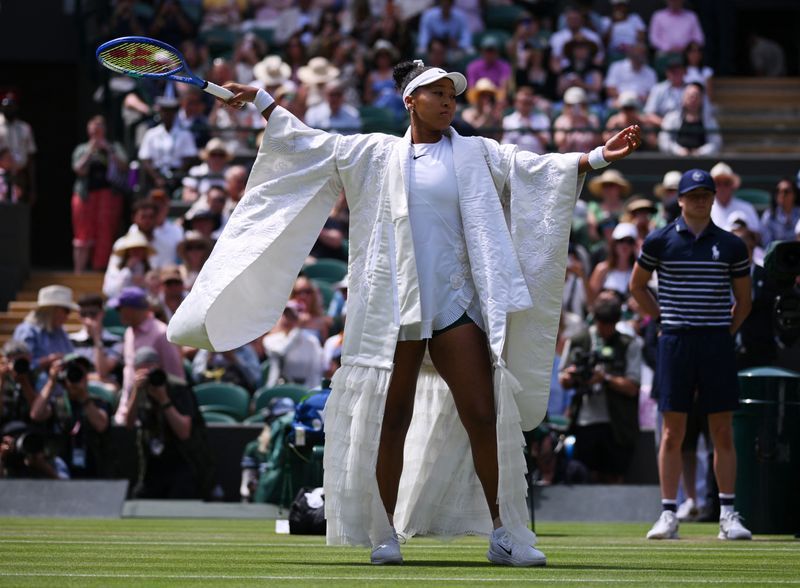
Naomi Osaka has emerged as a formidable presence at Wimbledon this fortnight, blending her established reputation as one of tennis's most stylistically adventurous competitors with performances that are proving her grass court credentials. The Japanese star dismantled unseeded opponent Daria Kasatkina on Friday with a commanding 6-1 6-3 display to breach the fourth round at the All England Club for the first time in her career, signalling that her impact extends well beyond the fashion spotlight that has closely followed her journey through the opening week.
Osaka, seeded 14th in this year's championship, has drawn considerable media attention for her striking attire selections, most notably a sequence of flower-patterned robes inspired by the Kill Bill film series that she has worn during her court entrances. Yet beneath the carefully curated visual presentation lies a competitor whose technical prowess and competitive hunger are increasingly demanding respect from opponents and observers alike. The four-times Grand Slam champion from Tokyo has methodically dismantled the notion that her appeal rests solely on off-court presentation, allowing her tennis skills and mental fortitude to command greater emphasis as the tournament progresses.
On a sun-drenched Court One, Osaka established her dominance early against the Russian-born Kasatkina by executing a precise backhand winner to break serve in the second game. She consolidated this advantage immediately with a deep, punishing forehand stroke that secured a double break and effectively settled the complexion of the opening set, which she claimed in just 33 minutes. The efficiency of her serving and the penetration of her groundstrokes gave Kasatkina limited opportunity to build momentum or establish the rhythm necessary to mount a competitive challenge.
While the second set initially appeared to be following a similar trajectory after Osaka established an early lead, the match demonstrated the championship-calibre resilience that has defined her previous Grand Slam successes. After squandering her initial advantage, Osaka fought back with considerable intensity, ultimately constructing and converting two match points before closing out the contest in commanding fashion. This capacity to regain control after moments of wavering focus distinguishes elite competitors from merely talented players, and Osaka's response underscored her serious championship ambitions during this grass court fortnight.
The significance of this victory extends beyond the immediate advancement to the round of 16. Osaka has been building competitive experience on grass surfaces over the preceding fortnight, having contested matches at Bad Homburg prior to arriving at Wimbledon, where she reached a grass court final before being forced to withdraw due to injury. The accumulated exposure to the specific challenges and rhythms of grass court play appears to have strengthened her confidence and technical execution in navigating the surface's unique demands compared to the hard courts where she has traditionally dominated.
Addressing the crowd from the court following her victory, Osaka expressed gratitude for the supportive atmosphere, emphasizing that she had never previously won a match on Court One and was therefore particularly pleased to have created this positive memory at the venue. Her comments reflected both genuine appreciation for the partisan encouragement and perhaps a recognition that conquering the psychological barriers associated with unfamiliar settings represents an important milestone in her evolution as a complete competitor. The spontaneity and apparent emotional sincerity of her remarks suggested someone genuinely engaged with the experience of competing at one of sport's most prestigious venues.
Osaka's victory positions her to face either world number one Aryna Sabalenka or former French Open champion Jelena Ostapenko in the round of 16, with the winner advancing toward quarter-final contention. Either scenario presents formidable challenges that will definitively test whether her recent form and grass court development represent a genuinely sustained elevation or merely a promising interlude. Both potential opponents possess the technical capability and competitive pedigree to expose any fragility in Osaka's current form, making this forthcoming encounter a critical juncture in assessing her championship prospects.
For Malaysian and broader Southeast Asian tennis audiences, Osaka's progress holds particular interest given her status as one of Asia's most recognizable sporting figures and her consistent engagement with regional markets through sponsorship partnerships and media appearances. Her potential deep run at Wimbledon carries symbolic significance for tennis development across the region, particularly regarding the viability of Asian competitors at the highest competitive levels on diverse surfaces beyond the hard courts that traditionally favour players from the region.
Osaka acknowledged the necessity of maintaining her focus and intensity by emphasizing her preference for considering each match and point independently rather than projecting forward toward ultimate tournament outcomes. This philosophical approach reflects lessons presumably learned from previous high-profile competitions and the psychological strain that can accompany elevated expectations. Her measured commentary suggested someone consciously managing the mental dimensions of competing at a major championship while attempting to sustain the performance levels that have characterized her progress to this stage.

