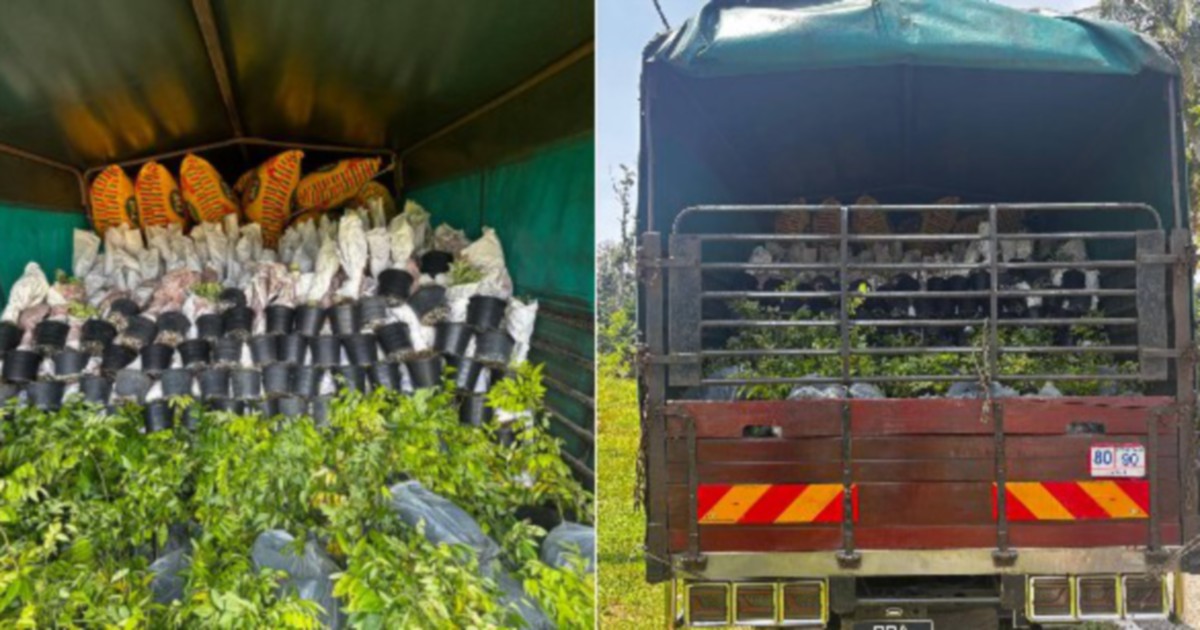
Security officials operating at the Malaysia-Thailand border near Rantau Panjang in Kelantan have successfully intercepted what appears to be a significant horticultural smuggling network. The operation resulted in the seizure of approximately 6,000 ornamental plant saplings that authorities believe were illicitly transported across international boundaries from Thailand into Malaysian territory. A commercial lorry driver has been placed under arrest following the discovery at Kampung Padang Licin, with preliminary valuations suggesting the confiscated botanical cargo was worth RM200,000 at prevailing market rates.
The incident underscores a growing concern among enforcement agencies across Southeast Asia regarding the illicit trade in decorative and ornamental plants. What might initially appear to be a relatively benign smuggling venture—moving landscaping specimens across borders—represents a complex enforcement challenge that intersects with environmental protection, agricultural regulation, and revenue collection. The sheer volume of this particular haul, numbering in the thousands of individual saplings, indicates this was likely a commercial-scale operation rather than a personal acquisition venture, suggesting organised networks may be coordinating cross-border plant movements for profit.
The choice of location—the Rantau Panjang border crossing in Kelantan—is significant given Malaysia's porous northern frontier and the region's established reputation as a transit point for various smuggled commodities. Thailand's horticultural sector, which includes substantial cultivation zones particularly in northern regions, has long been identified as a source point for plants destined for regional black markets. The saplings' alleged Thai origin is consistent with documented trafficking patterns, where plant material is moved southward to supply domestic Malaysian markets and potentially onward destinations.
Ornamental plants occupy a distinctive niche within Malaysia's regulatory framework. Unlike controlled substances or counterfeit goods, botanical smuggling often receives comparatively less enforcement attention despite its economic significance and potential environmental implications. The RM200,000 valuation reveals the considerable profit margins available to smugglers operating in this sector. These financial incentives, combined with enforcement resource constraints, have enabled regular smuggling activities to persist along multiple border corridors throughout Malaysia.
The horticultural market in Malaysia has experienced substantial growth, driven by increased urbanisation, rising middle-class purchasing power, and the booming indoor plant trend that has swept across Southeast Asia in recent years. This demand has created economic opportunity not merely for legitimate growers and retailers but also for criminal enterprises exploiting regulatory gaps and understaffed border checkpoints. Saplings sourced from Thailand, offered at substantially discounted rates due to circumventing import duties and taxes, represent an attractive proposition for unscrupulous dealers seeking to undercut legitimate market participants.
Beyond the commercial dimension, cross-border plant movement raises important phytosanitary and environmental considerations that Malaysian authorities must balance against enforcement priorities. The transportation of plant material across international boundaries without proper quarantine protocols and documentation creates potential pathways for the introduction of pests, diseases, and invasive species into Malaysian ecosystems. The sheer quantity of saplings in this case—numbering six thousand—magnifies these risks substantially. If even a fraction of this shipment contained plants harbouring agricultural pathogens or invasive characteristics, the ecological consequences could prove significant for local farming communities.
The arrest of the lorry driver represents the visible enforcement action, yet typically constitutes merely the surface-level response to what are fundamentally supply-chain operations. Investigations following this seizure will likely focus on identifying upstream suppliers in Thailand, middlemen involved in coordination and logistics, and downstream distribution networks within Malaysia. Successfully dismantling such operations requires coordinated action extending beyond a single apprehension at a border checkpoint, demanding sustained intelligence work and potentially international cooperation with Thai authorities.
Kelantan's position as a key interception point reflects both the border region's practical vulnerability and the effectiveness of operational deployments already in place. However, the continuing discovery of substantial smuggling attempts indicates that current enforcement capacity remains insufficient to deter or prevent all illicit movement. Resource allocation decisions within Malaysian enforcement agencies increasingly reflect a challenging calculus: allocating personnel and technology toward plant smuggling when other perceived criminal priorities—narcotics, human trafficking, counterfeiting—command attention and budget allocation.
The economic implications extend to legitimate Malaysian horticultural businesses that compete on an uneven playing field. Retail nurseries and plant distributors operating within regulatory frameworks and paying statutory duties face undercutting from smuggled sources that carry no such overhead costs. This dynamic not only erodes margins for compliant operators but can gradually displace legitimate businesses unable to compete against artificially depressed smuggled prices, thereby hollowing out the formal supply chain.
Looking forward, this incident will likely prompt renewed attention to border enforcement in Kelantan and potentially trigger broader discussions about horticultural regulation. Authorities may consider strengthening documentation requirements, enhancing quarantine protocols, or implementing targeted intelligence operations focusing on known smuggling nodes. Thai-Malaysian border security discussions might incorporate plant trafficking alongside traditional priorities, potentially enabling coordinated efforts to disrupt supply sources rather than merely intercepting shipments at port-of-entry.

