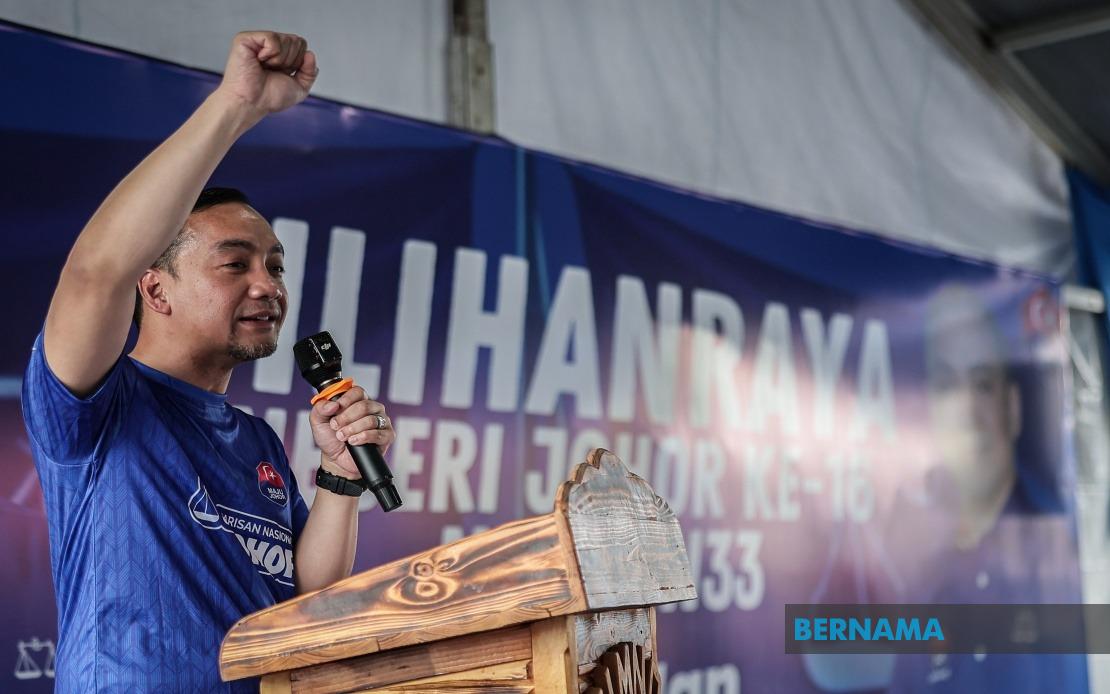
The Barisan Nasional appears to be building momentum in Johor ahead of the state election scheduled for July 11, with party leadership expressing confidence in its chances across multiple constituencies. At a campaign event in Mersing on June 29, BN chairman Datuk Onn Hafiz Ghazi, who also serves as Johor Menteri Besar, highlighted what he described as exceptionally encouraging responses from voters towards the coalition's candidate for the Endau seat, Alwiyah Talib. The positive engagement from the local community throughout the campaign period, he suggested, could translate into a decisive advantage for BN when voters head to the polls in two weeks.
Alwiyah's candidacy carries particular symbolic weight within the broader context of Malaysia's fractious political landscape. Once a prominent figure with the opposition Perikatan Nasional coalition, her decision to rejoin BN represents a significant shift that party strategists view as validation of their political direction. In the previous 2022 Johor state election, she successfully defended the Endau seat while running under the PN banner, securing a majority of 3,041 votes in a five-candidate contest. However, her earlier political journey showed greater alignment with BN—she originally won the constituency during the 14th General Election as a BN representative before transitioning to Bersatu, the Mahathir-associated party that later formed the core of PN's electoral coalition.
Onn Hafiz framed Alwiyah's return within UMNO president Datuk Seri Dr Ahmad Zahid Hamidi's broader Rumah Bangsa initiative, a concept intended to emphasise cohesion and open-minded politics within the historically fractious BN alliance. The terminology and approach suggest an attempt by BN's national leadership to position the coalition as a welcoming home for political figures willing to work within its framework, regardless of their previous affiliations. This strategy carries significance for understanding how BN hopes to rebuild its electoral dominance after years of being fractured by UMNO's internal divisions and its temporary ouster from federal government between 2018 and 2022.
The Menteri Besar's comments during the event at Santai ONN, a campaign gathering in Endau, reflected optimism tempered with the acknowledgement that victory is far from assured. While he noted that party machinery in both Endau and Tenggaroh—represented by BN candidate Mohd Youzaimi Yusof—appeared fully mobilised and committed, electoral outcomes in Malaysia's state elections often hinge on local dynamics that can shift rapidly. The statement that the Johor campaign has proceeded smoothly without significant incidents also served as an implicit contrast to the occasional disruptions that characterise more contentious electoral contests elsewhere in the country.
For Malaysian and Southeast Asian observers watching BN's regeneration, the Johor state election functions as an important bellwether. The state has traditionally been a BN stronghold, yet it experienced significant challenges during the opposition's rise between 2018 and 2022. The composition of candidates fielded and the reception they receive offer insights into whether the coalition's strategy of offering political figures alternative career paths within its structure remains electorally viable. Alwiyah's trajectory and the claimed voter enthusiasm surrounding her candidacy will be closely monitored for signals about BN's capacity to attract and integrate experienced political operatives from other coalitions.
The calendar also matters strategically. With polling day on July 11 and early voting scheduled for July 7, the campaign window for BN to consolidate its advantage is relatively compressed. Onn Hafiz's invocation of religious sentiment—"Insya-Allah, we pray that this momentum continues"—reflects the conventional political language employed in Malaysian electoral contests, where appeals to divine favour remain an embedded rhetorical device. Whether such sentiments translate into actual voter behaviour remains an open question, particularly in constituencies where economic concerns, development grievances, or local personalities might overshadow broader coalition narratives.
Alwiyah's political biography illuminates some of the tactical calculations that underpin Malaysian politics at the state level. Her ability to win the Endau seat in 2022 while representing an opposition coalition, despite BN's traditional dominance in Johor, suggests that local factors and personal political capital can override broader partisan trends. Her reversion to BN, then, might be read either as a shrewd repositioning to align herself with the likely winning coalition, or as a genuine philosophical realignment—the public record does not definitively resolve this ambiguity. What remains clear is that she represents the type of political figure for whom coalition boundaries remain permeable, particularly when party machinery offers the prospect of continued electoral viability.
The broader campaign environment in Johor reflects the consolidation that has occurred across Malaysian politics since the tumultuous 2018-2022 period. The fragmentation that characterised that era, when multiple coalitions competed for dominance, has given way to a more stable two-coalition structure, with BN and the opposition Pakatan Harapan as the primary contenders in most constituencies. Johor's state election will test the durability of this reconfigured political environment and whether BN's strategy of welcoming figures like Alwiyah genuinely strengthens its electoral prospects or merely shifts votes within a largely fixed political base.
From a regional perspective, Malaysia's electoral outcomes continue to influence political calculations across Southeast Asia. The region watches closely how BN manages its internal dynamics, particularly whether it can maintain cohesion within a three-component structure of UMNO, MCA, and MIC, each representing different community constituencies with sometimes divergent interests. The Johor state election provides a limited but meaningful test case of whether this coalition model remains viable in the contemporary political environment, where urbanisation, generational change, and shifting economic conditions have altered the foundations upon which Malaysia's traditional power-sharing arrangements were constructed. The reception accorded to candidates and the actual voting outcomes will offer instructive data points for political analysts assessing the trajectory of Malaysian electoral politics over the coming years.

