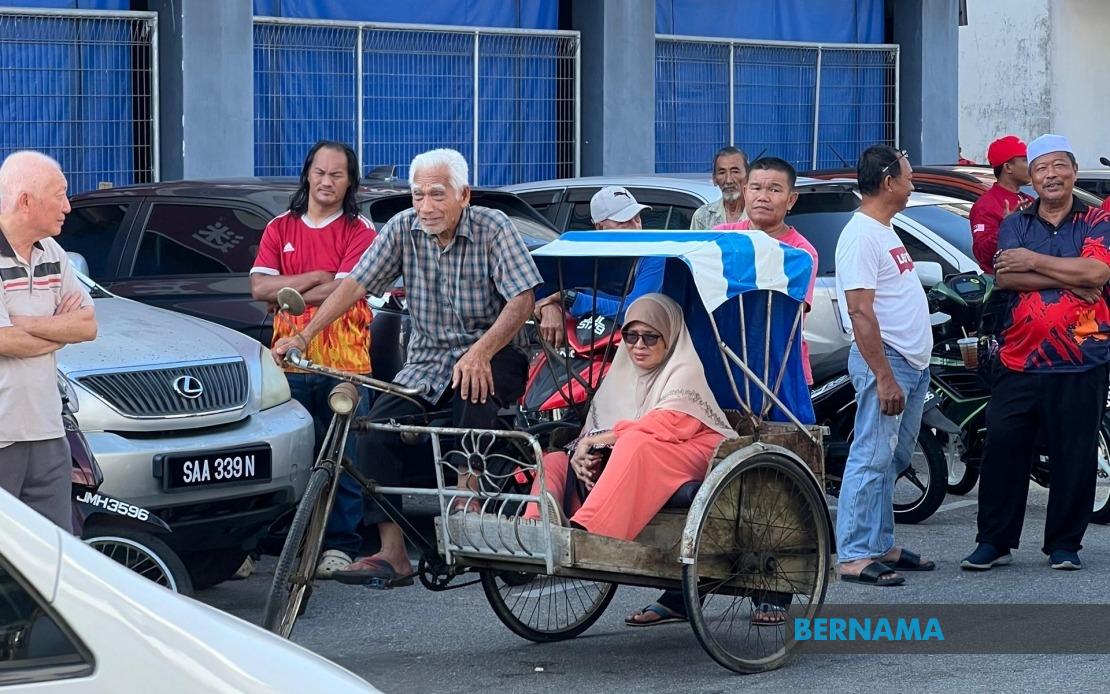
Abdul Razak Pelangga's determination to transport his wife Jamilah Samsudin to a coffee shop in Senggarang on a sweltering July afternoon reveals the depth of personal connection that Malaysian voters maintain with their political leaders. The 86-year-old—himself 87 according to one mention in the account—pedalled nearly a kilometre from their home in Kampung Parit Bugis despite temperatures that would discourage most people from such exertion, driven purely by his wife's desire to catch a glimpse of Prime Minister Datuk Seri Anwar Ibrahim in person during an official meet-and-greet programme.
The choice to use a trishaw rather than motorised transport, though unconventional for a journey undertaken in such heat, reflected practical wisdom. Abdul Razak, who serves as imam of Masjid Raudhatul Jannah Parit Bugis, explained that he simply wanted to avoid the complications of locating a parking space in the crowded town. This detail underscores how everyday logistical considerations shape the decisions of ordinary citizens, even when engaging in civic activities linked to political events. His pragmatic approach ultimately became an exercise in personal commitment, turning a straightforward transport problem into a powerful demonstration of resolve.
Abdul Razak's connection to Anwar runs deeper than a mere voter's casual interest. Years before the current Prime Minister reached the highest office in the land, he had visited the imam's mosque to perform prayers. That encounter left a lasting impression: the two men shook hands, exchanged greetings, and Abdul Razak found Anwar's demeanor approachable and warm. The imam carried that memory forward and shared it with his wife, creating a shared narrative within their household about a political figure who had once been present in their immediate community. When word reached them that Anwar would be visiting Senggarang, Abdul Razak saw an opportunity to bridge the distance between that personal memory and present circumstances.
The Prime Minister's breakfast stop at Kedai Kopi Hailam Sri Medan formed part of the PMX Meet-and-Greet Programme, an engagement strategy aimed at connecting the leadership with constituents in the Senggarang state constituency. Anwar spent approximately 50 minutes at the venue, mingling with local residents and presenting himself as accessible to ordinary Malaysians. Such programmes reflect contemporary political communication strategies in Malaysia, where direct face-to-face interaction remains valued despite the prevalence of digital media. The breakfast format itself—casual, informal, centred on an everyday social ritual—signals an attempt to position political leadership within the rhythm of daily community life rather than as remote or inaccessible.
Although the large crowd prevented Abdul Razak and his wife from achieving a direct face-to-face encounter with Anwar, viewing him from a close distance satisfied their purpose. The distinction matters: for the couple, witnessing their Prime Minister in physical presence, however briefly and from a modest remove, carried significance that television coverage could never provide. This reflects a persistent human dimension to political engagement—the power of tangible proximity, of being in the same space as a leader, regardless of whether actual conversation occurs. Their satisfaction with merely being present and observing from nearby demonstrates that political participation encompasses more than transactional exchanges or substantive policy dialogue.
Abdul Razak's anticipation of the polling day on July 11 carried additional resonance because the date coincided with his 87th birthday. He spoke of this convergence with evident excitement, noting that while he had voted many times throughout his life, casting his ballot on his birthday would imbue the act with special meaning. The alignment of his civic duty with a personal milestone transformed a routine democratic exercise into a memorable event. His birthday vote represented not merely the mechanical fulfilment of citizenship requirements but rather a conscious moment of reflection on his role within the political system and his place in the broader national community.
The timing of Anwar's visit to Johor corresponded with a broader electoral moment. The Johor state election campaign was in full swing, with polling scheduled for July 11 and early voting opportunities available on July 7. Such campaigns generate increased political activity and visibility throughout constituencies, offering voters heightened exposure to candidates and manifestos. The PMX Meet-and-Greet Programme served multiple functions simultaneously: it allowed Anwar to campaign in support of Pakatan Harapan candidates, it generated positive media coverage of the Prime Minister as an engaged leader accessible to ordinary citizens, and it created symbolic moments like Abdul Razak's trishaw journey that demonstrate the emotional investment citizens maintain in their political system.
The presence of Datuk Fahmi Fadzil, who holds the dual role of Pakatan Harapan Communications Director and Communications Minister, underscores the coordinated nature of such political engagement. His attendance at the breakfast event reflected the structured approach to managing the Prime Minister's public image and messaging during campaign season. Media coordination around such events shapes how political narratives reach broader audiences, influencing public perception of leadership accessibility and commitment to constituent interaction.
Abdul Razak's story exemplifies patterns of political engagement in Malaysian society that extend beyond typical electoral analysis. His actions reveal how personal memory, community connection, and civic identity intersect with formal democratic processes. The physical effort invested in the trishaw journey—undertaken at advanced age in uncomfortable weather—demonstrates that for some citizens, political participation encompasses emotional and personal dimensions rather than purely instrumental calculations. The journey itself became an expression of civic commitment, a tangible statement about the value he places on bearing witness to his nation's leadership.
The contrast between Abdul Razak's modest trishaw and the official motorcade that would have accompanied the Prime Minister serves as a subtle metaphor for the relationship between citizen and state. Yet the imam's determination to traverse that gap, through his own effort and determination, illustrates the persistent democratic aspiration that leadership remains accessible and that citizens retain meaningful agency in their political engagement. His willingness to celebrate his birthday through the act of voting reflects a view of democracy not as a burden or obligation but as a privilege worth marking and remembering across the span of a life lived in community.

