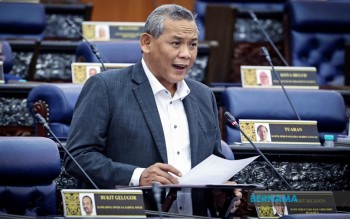
During parliamentary discussions on the Royal Commission of Inquiry report into Tabung Haji, Port Dickson Member of Parliament Datuk Seri Aminuddin Harun has pushed back against blanket assertions that all investment losses stem from impropriety, arguing instead for a more nuanced examination of the pilgrimage fund's financial difficulties. The former Negeri Sembilan menteri besar emphasised that distinguishing between losses caused by ordinary market volatility and those resulting from negligent decisions, conflicts of interest, or inadequate governance structures is essential to any fair assessment of the institution's performance.
This measured approach reflects a broader tension within governance circles regarding how accountability should be balanced against market realities. All investment portfolios carry inherent risks that can produce losses regardless of management quality, a fact that Aminuddin argues must be acknowledged in evaluating Tabung Haji's track record. However, his distinction does not excuse the need for rigorous investigation into specific decisions and processes that contributed to the fund's decline in value over the 2014-2020 period covered by the inquiry.
The RCI report, which was publicly released on July 29 after being presented to the Yang di-Pertuan Agong on August 30, 2022, has generated significant discussion in Parliament regarding the institution's management structures and investment decision-making processes. The 211-page document contained 25 recommendations for improvement, with Tabung Haji reporting that approximately 75 per cent of these had been implemented by July 30. Among the more controversial findings were inadequacies in board governance and the need for forensic audits of 14 investments that had experienced significant decline.
Aminuddin's call for more stringent appointment criteria addresses a long-standing concern about how leaders are selected for positions within Malaysia's sovereign wealth institutions. Rather than relying on connections or treating board positions as political rewards, he argues that Tabung Haji should recruit individuals with demonstrated expertise in investment management, Islamic finance principles, risk assessment, and corporate governance. This professionalization of the appointment process would represent a significant cultural shift within Malaysian institutional practice.
The former menteri besar also highlighted a key RCI recommendation: prohibiting active politicians from serving as chairman or board members of Tabung Haji and its subsidiary companies. This proposal, if implemented, would address concerns about political interference in investment decisions and create greater distance between electoral interests and fiduciary responsibilities. Aminuddin went further, proposing that all board candidates undergo comprehensive screening based not only on investment and Islamic finance experience but also on integrity, risk management competency, accounting and auditing knowledge, legal understanding, corporate governance familiarity, and hajj management expertise.
The question of conflict of interest declaration emerged as particularly important in Aminuddin's remarks. Given that Tabung Haji manages funds belonging to hundreds of thousands of Malaysian Muslims preparing for or having completed the hajj pilgrimage, ensuring that board members' personal or business interests do not compromise investment decisions carries profound significance. Mandatory disclosure of potential conflicts would provide greater transparency and allow for mitigation strategies when board members have competing interests.
While Aminuddin focused on forward-looking institutional reforms, Datuk Mohd Isam Mohd Isa, representing Tampin, raised concerns about the RCI's temporal scope. He pointed out that the inquiry covered only 2014-2020, potentially missing important developments that occurred after 2020 and into the subsequent five years. This observation highlights a challenge inherent in conducting inquiries into ongoing organisations: by the time a report is completed and released, significant events may have already unfolded beyond its investigative reach.
Mohd Isam's proposal that a new RCI be established to cover the 2021-2025 period reflects concerns about continuity in oversight and accountability. He argued that major developments in Tabung Haji's management occurred after the original RCI's timeframe ended, suggesting that extending the first inquiry through 2025 might have provided a more comprehensive picture. The compression of such a complex institutional review into six years means that patterns or problems emerging after 2020 remain outside the formal inquiry's scope.
Parallel to the RCI process, Mohd Isam also called for issues related to Tabung Haji's management and governance to be referred to the Public Accounts Committee for deeper scrutiny, particularly covering 2022-2026. This dual-track approach—combining the RCI findings with PAC examination—would potentially create layered oversight mechanisms and allow parliamentary committees to probe areas the inquiry may not have fully developed. The PAC's continuing mandate makes it suited to monitoring the implementation of RCI recommendations and assessing whether governance problems have genuinely been resolved.
The establishment of the RCI itself was announced in 2021, with members appointed on January 20, 2022, suggesting that concerns about Tabung Haji's financial performance and institutional management had accumulated sufficient political weight to warrant formal state-level investigation. The public release of findings nearly a year after submission to the Yang di-Pertuan Agong reflects the bureaucratic processes surrounding sensitive institutional reviews.
For Malaysian investors and pilgrims who have entrusted their savings to Tabung Haji, these parliamentary discussions carry immediate practical significance. The quality and integrity of board decisions directly affect whether their contributions generate adequate returns and whether their hajj financing remains secure. The push for professionalized appointments and stronger governance mechanisms addresses legitimate concerns that unqualified or conflicted decision-makers could further erode the institution's financial health and public trust.
Among Southeast Asian sovereign wealth institutions, the Tabung Haji experience provides instructive lessons about governance standards and the risks of politicising investment decision-making. As other regional nations manage similar institutions serving large Muslim populations, the Malaysian example—both its problems and proposed solutions—carries relevant implications for institutional design and accountability frameworks across the region.
Moving forward, the degree to which parliamentary recommendations translate into genuine structural change will determine whether Tabung Haji can restore public confidence and recover its financial standing. Aminuddin's emphasis on distinguishing legitimate market losses from governance failures suggests that transparency about both successes and setbacks, combined with reformed appointment processes, may be essential to rebuilding the institution's credibility among the millions of Malaysians who depend upon it.

