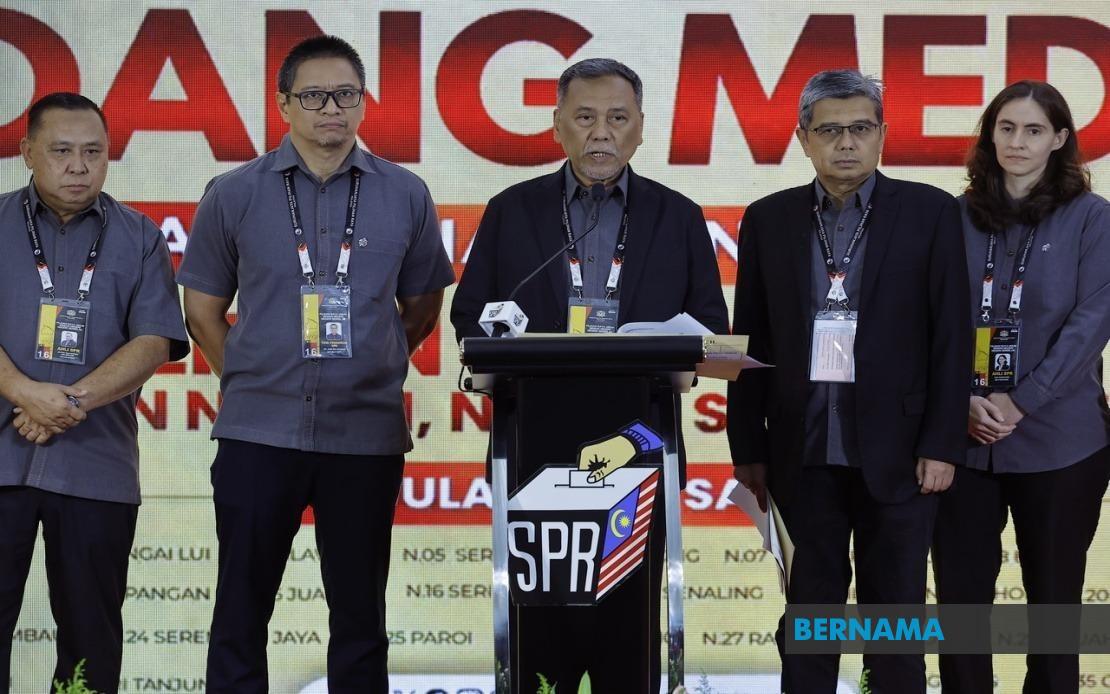
The 16th Negeri Sembilan state election is shaping up as a closely contested race with 103 candidates officially cleared to contest across the state's 36 assembly seats, the Election Commission announced on July 18 after the close of nominations. The complex electoral landscape reflects intensifying competition among major coalitions, with a significant proportion of constituencies presenting voters with multi-way choices rather than the traditional two-candidate format.
Election Commission chairman Datuk Seri Ramlan Harun confirmed that all nominations had been thoroughly verified following the submission deadline at 10 am at eight nomination centres across the state. The presence of nearly one hundred competing candidates underscores the elevated political stakes in what observers view as a critical test of voter sentiment in one of Malaysia's traditionally significant peninsular states. The dissolution of the state assembly on June 5 triggered the electoral process, which culminates in polling day on August 1, with early voting scheduled for July 28.
Pakatan Harapan has positioned itself as the frontrunner, fielding 36 candidates across all available seats, representing the coalition's confident approach to reclaiming or consolidating state control. Barisan Nasional, the traditional governing coalition, has fielded 25 candidates, suggesting a more selective strategy in contesting certain stronghold and swing constituencies. This disparity in candidate deployment may reflect different organizational capacities or tactical assessments of winnable seats within each coalition's structure.
The political landscape has become further fragmented by the entry of other significant players. Bersatu, the party that triggered the coalition realignment in Malaysian politics following the 2022 general election, has fielded 24 candidates, nearly matching Barisan Nasional's numbers and indicating serious ambitions for state-level influence. Perikatan Nasional, which Bersatu leads at the federal level, has added 11 candidates to the mix, creating potential candidate overlaps and strategic complications across the contested seats.
Beyond the major players, smaller parties and independent candidates have also staked their claims. The Barisan Jemaah Islamiah Se-Malaysia (Berjasa), the Malaysian Orang Asli Party (ASLI), and the Socialist Party of Malaysia (PSM) have each fielded single candidates, while four independent contenders are running outside formal party structures. Although individually insignificant, these candidacies highlight the democratic principle of candidacy access and may influence outcomes in tightly margined constituencies.
The most striking feature of the election is the prevalence of three-cornered contests, which will occur in 21 of the 36 seats, approximately 58 per cent of the legislature. This proportion suggests that voters across the majority of constituencies will encounter scenarios where none of the three top contenders can claim a clear ideological or coalitional dominance. Eleven seats are configured for straight fights between two candidates, while four seats, notably Nilai and Sri Tanjung, will feature five-cornered contests. Jeram Padang and Rahang will experience four-cornered clashes, adding further complexity to vote-splitting dynamics and outcome prediction.
The candidate demographics reveal important details about political recruitment patterns. Of the 103 candidates, 94 are male and nine are female, reflecting persistent gender imbalance in Malaysian electoral politics despite gradual increases in female representation. Age range spans from a 23-year-old Bersatu contestant in Sri Tanjung to a 70-year-old Pakatan Harapan candidate contesting Gemencheh, demonstrating the diversity of generational involvement across competing organizations.
The electoral roll comprises 889,490 eligible voters, a figure that provides context for understanding the state's political weight within the broader Malaysian system. This electorate consists of 867,151 ordinary voters, supplemented by 16,884 military personnel and their spouses and 5,455 police officers, groups whose voting patterns have historically influenced outcomes in state and federal elections. The inclusion of armed forces personnel eligibility reflects long-standing constitutional provisions regarding their electoral participation rights.
The competitive intensity evident in the scale and distribution of candidates positions the Negeri Sembilan election as a significant barometer for coalition performance and voter preferences in a critical period. The high incidence of three-way contests means that victory margins may be compressed, potentially enabling minority candidates to determine seat outcomes through strategic vote concentration. This dynamic creates unpredictable elements that could produce results substantially different from national-level polling trends, making the August 1 election particularly consequential for understanding Malaysian electoral behaviour at the state level.
For Malaysian political observers, the Negeri Sembilan contest represents an important test of how effectively each coalition can mobilize its support base and convert candidate numbers into legislative seats. The prevalence of triangular contests introduces elements of tactical voting and coalition preference fluidity that may not be fully captured by conventional pre-election analysis. Results from this election will likely inform strategic calculations for all major political actors as Malaysia moves toward subsequent electoral cycles at state and potentially federal levels.

